Full Text (PDF)
Indian Journal of Forensic Medicine and Pathology 17(1):p 25-30, January-March 2024. | DOI: https://doi.org/10.21088/ijfmp.0974.3383.17124.4
Original Article
Importance of Leukocyte count, Neutrophil to Lymphocyte Ratio and Platelet to Lymphocyte Ratio in Prognosis of Pesticide Poisoning
Shubham Chourishi, Vijayalaxmi S. Patil
Author Information
Licence:
Attribution-Non-commercial 4.0 International (CC BY-NC 4.0)This license enables reusers to distribute, remix, adapt, and build upon the material in any medium or format for noncommercial purposes only, and only so long as attribution is given to the creator.
Indian Journal of Forensic Medicine and Pathology 17(1):p 25-30, January-March 2024. | DOI: https://doi.org/10.21088/ijfmp.0974.3383.17124.4
How Cite This Article:
Chourishi S, Patil VS. Importance of Leukocyte count, Neutrophil to Lymphocyte Ratio and Platelet to Lymphocyte Ratio in Prognosis of Pesticide Poisoning. Indian J Forensic Med Pathol. 2024;17(1):25-30.Timeline
Received : January 25, 2024
Accepted : March 29, 2024
Published : March 30, 2024
Abstract
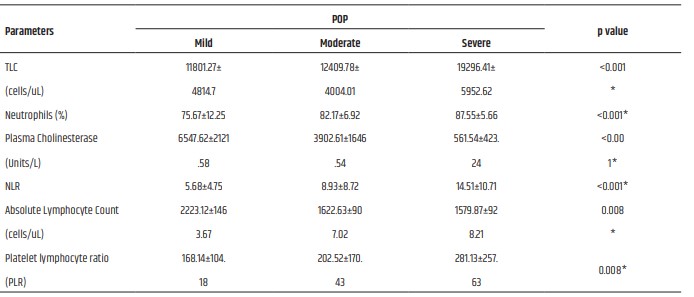
Context: Pesticides are chemical compounds used for crop protection and poisoning with them is a very common occurrence in farmers. In an emergency setting, the identification of quick and powerful prognostic markers can be of high significance in the management of these patients. Aims: To assess the severity of Pesticide Poisoning by assessing the leukocyte count, neutrophil count, neutrophil-lymphocyte ratio (NLR) and platelet lymphocyte ratio (PLR) and its comparison with levels of Plasma Cholinesterase (PChE) as an aid to clinical diagnosis, for early treatment of the patients. Settings and Design: Hospital based Cross-sectional study. Study period 1st November 2018 - 30th May 2020 Methods and Material: Study was done on 148 confirmed cases of pesticide poisoning over a period of 1.5 years. Blood samples were collected in EDTA and plain vacutainers within 24 hours of admission and the values of total leukocyte Count (TLC), neutrophil count, NLR, PLR and PChE were measured and compared. The severity of poisoning was assessed according to Peradeniya Organophosphorus (POP) scale. Statistical Analysis used: Mean ± SD, Chi square test for association, Comparison of mean using ANOVA test for comparison between and among groups, Sensitivity and specificity analysis. Results: 89.86% and 10.14% of cases were due to poisoning by Organophosphorus compounds and carbamate respectively. The severely poisoned patients according to POP scale had more leukocyte count, neutrophil count, NLR and PLR; and less plasma cholinesterase level as compared to the patients with mild and moderate poisoning. Conclusions: Total Leukocyte count, neutrophil count, NLR and PLR are simple and easy to use parameters for estimating the severity of pesticide poisoning and assessing its prognosis. In resource limited setups, along with the clinical history, these basic CBC parameters can be useful and patient’s immediate treatment can be started as early as possible.
References
- 1. Dundar ZD, Ergin M, Koylu R, Ozer R, Cander B and Gunaydin YK. Neutrophil-lymphocyte ratio in patients with pesticide poisoning. The Journal of Emergency Medicine.2014;47:286–93.
- 2. G Ravi, C Rajendiran, P Thirumalaikolundu subramanian, N Babu. Poison control, training and research center, Institute of Internal Medicine, Government General Hospital, Madras Medical College, Chennai, India. Presented at 6th Annual congress of Asia Pacific Association of Medical Toxicology, Bangkok, Thailand 2-14 December2007.
- 3. Behere PB, Behere AP. Farmers’ suicide in Vidarbha region of Maharashtra state: A myth or reality? Indian J Psychiatry.2008;50:124-7.
- 4. Szinicz L. History of chemical and biological warfare agents. Toxicology 2005; 214:167-81.
- 5. Cannard K. The acute treatment of nerve agent exposure. J Neurol Sci 2006; 249: 86-94.
- 6. Karalliadde L, Senanayake N. Organophosphorus insecticide poisoning. Br J Anaest.1998; 63 : 736-50.
- 7. Namba T, Nolte CT, Jackrel J, Grob D. Poisoning due to organophosphate insecticides. Am J Med. 1971; 50: 475 –92.
- 8. Eddleston M, Buckley NA, Checketts H et al. Speed of initial atropinisation in significant organophosphorous pesticide poisoning—a systematic comparison of recommended regimens. J Toxicol Clin Toxicol. 2004; 42:865–75.
- 9. Eddleston M, Clark R. Insecticides: Organic Phosphorus Compounds and Carbamates. In: Goldfrank LR, Flomenbaum NE, Lewin NA, Howland MA, Hoffman RS, Nelson L. Goldfrank’s Toxicological Emergencies. 7th ed. New York: McGraw-Hill; 2002:1450-62.
- 10. Dubey TN, Yadav S, Kawre KK. Correlation of Severity of Organophoshorus Poisoning as Assessed by Peradeniya Organophosphorus Poisoning Scale with Serum Amylase and CPK Level. IJCMR.2016;3(9):2534-7.
- 11. Hernandez AF, Lacasana M, Gil F, Barranco MR, Pla A, Guarnido OL. Evaluation of pesticide-induced oxidative stress from a gene-environment interaction perspective. Toxicology.2012;307:95–102.
- 12. Kumar S, Agrawal S, Raisinghani N, Khan S. Leukocyte Count: A Reliable Marker for the Severity of Organophosphate Intoxication? Journal of Laboratory Physicians.2018;10:185-8.
- 13. Tang Y, Hu L, Hong G, Zhong D, Song J, Zhao G et al. Diagnostic value of complete blood count in paraquat and organophosphorus poisoning patients. Toxicology and Industrial Health.2018;34:439-47.
- 14. Elhosary N, Abdelbar E. Red cell distribution width, neutrophil lymphocyte and platelet lymphocyte ratios as prognostic markers in acutely pesticides- poisoned patients. The Egyptian Journal of Forensic Sciences and Applied Toxicology.2018;18(4):29-46.
- 15. Kang C, Kim S, Lee S, Jeong J, Kim D, Kim D. Absolute Lymphocyte Count as a Predictor of Mortality in Emergency Department Patients with Paraquat Poisoning. PLoS One.2013;8 :e78160.
- 16. Westerdijk K, Simons K, Zegers M, Wever P, Pickkers P, de Jager C. The valueoftheneutrophil-lymphocyteco untratiointhediagnosisofsepsisin patients admitted to the Intensive Care Unit: A retrospective cohort study. PLOS ONE. 2019;14:e0212861.
Data Sharing Statement
There are no additional data available.
Funding
This research received no funding.
Author Contributions
All authors contributed significantly to the work and approve its publication.
Ethics Declaration
This article does not involve any human or animal subjects, and therefore does not require ethics approval.
Acknowledgements
Information not provide.
Conflicts of Interest
The authors report no conflicts of interest in this work.
About this article

Cite this article
Chourishi S, Patil VS. Importance of Leukocyte count, Neutrophil to Lymphocyte Ratio and Platelet to Lymphocyte Ratio in Prognosis of Pesticide Poisoning. Indian J Forensic Med Pathol. 2024;17(1):25-30.
Licence:
Attribution-Non-commercial 4.0 International (CC BY-NC 4.0)This license enables reusers to distribute, remix, adapt, and build upon the material in any medium or format for noncommercial purposes only, and only so long as attribution is given to the creator.
| Received | Accepted | Published |
|---|---|---|
| January 25, 2024 | March 29, 2024 | March 30, 2024 |
DOI: https://doi.org/10.21088/ijfmp.0974.3383.17124.4
Keywords
Pesticide PoisoningOrganophosphorus poisoningNeutrophil to lymphocyte ratioPlatelet to lymphocyte ratioPlasma cholinesteraseSearch for Similar Articles
Similar Articles
- Diatom Analysis in Thermophilic water bodies: A Study on Hot Water Springs of Ma...
- Morphometric Study of Supra-meatal Triangle and Mastoid process in the Adult dry...
- Histopathological Spectrum of Autopsy Cases: A One Year Retrospective Observatio...
- Forensic Differentiation of Manner of Death in Railway Fatalities: A FourCase Se...
- Understanding assault Patterns: A Cross-sectional study of Cases at Chri, Kelamb...
Article Level Metrics
Last UpdatedMonday 19 October 2026, 13:02:18 (IST)
16333
Accesses
17
3216
00
Citations
NA
NA
NA
Download citation
Article Keywords
Keyword Highlighting
Highlight selected keywords in the article text.
Timeline
| Received | January 25, 2024 |
| Accepted | March 29, 2024 |
| Published | March 30, 2024 |
licence
Attribution-Non-commercial 4.0 International (CC BY-NC 4.0)
This license enables reusers to distribute, remix, adapt, and build upon the material in any medium or format for noncommercial purposes only, and only so long as attribution is given to the creator.