Full Text (PDF)
Indian Journal of Forensic Medicine and Pathology 16(2):p 123-131, April–June 2023. | DOI: https://doi.org/10.21088/ijfmp.0974.3383.16223.5
Original Article
Impact of Winter Season and Other Contributory Variables on Estimation of Time Since Death using Livor and Rigor Mortis in Varanasi Region
Surendra Kumar Pandey, Jyotsana Singh, Ambrish Kumar, Ramkrishna Mishra
Author Information
Licence:
Attribution-Non-commercial 4.0 International (CC BY-NC 4.0)This license enables reusers to distribute, remix, adapt, and build upon the material in any medium or format for noncommercial purposes only, and only so long as attribution is given to the creator
Indian Journal of Forensic Medicine and Pathology 16(2):p 123-131, April–June 2023. | DOI: https://doi.org/10.21088/ijfmp.0974.3383.16223.5
How Cite This Article:
Singh J, Kumar A, Mishra R, et al. Impact of winter season and other contributory variables on estimation of time since death using livor and rigor mortis in Varanasi region. Indian J Forensic Med Pathol. 2023;16(2):123-131.Timeline
Received : January 09, 2023
Accepted : March 17, 2023
Published : June 30, 2023
Abstract
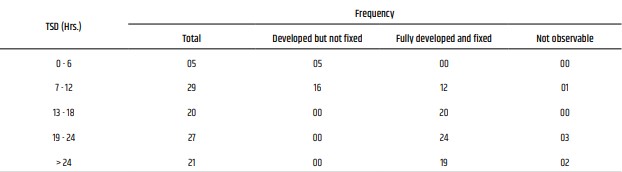
A signifi cant question in forensic casework is the estimation of time since death (TSD) in the early post-mortem phase. Muscles undergo a condition of rigor mortis following death, accompanied by post-mortem consumption of adenosine triphosphate. Lividity is a dark purple coloration of the skin induced by blood accumulating in the aff ected area. Environmental factors play a crucial part in the determination of TSD using diff erent parameters through various methods. The purpose of this study is assessment of TSD and eff ect of contributory variables on existence of rigor mortis and fi xation of lividity in cadavers kept at room temperature during winter season in Varanasi region. This is a prospective and observational study. 102 cadavers escorted for medicolegal autopsy at the mortuary of the Department of Forensic Medicine, Banaras Hindu University, Varanasi for the duration of consecutive two years in winter season from December 2019 - February 2020 and November 2020 - February 2021. All the cases were studied for rigor mortis and found an average post-mortem interval of 18.67 ± 9.43 hrs. Post-mortem lividity was found to be not fi xed in 21 (20.59%) cases before 10 hrs, while 76 (74.51%) cases of lividity had already been fi xed after 10 hrs and 5 (4.9%) cases of lividity were found to be not observable. Livor and rigor mortis have minimal predictive potential due to the eff ect of diff erent contributory variables on the development of rigor and fi xation of lividity
References
- 1. Crostack C, Sehner S, Raupach T, Anders S. Re-establishment of rigor mortis: evidence for a considerably longer post-mortem time span. Int J Legal Med 2017;131:1039– 42.https://doi.org/10.1007/s00414-017- 1558-x.
- 2. Sugatha M, Ramana V. Assessment of Time Since Death using Forensic Autopsies based on the Presence of Rigor Mortis– A Cross-Sectional Study. Int J Contemp Med Res [IJCMR] 2019;6:11–4. https://doi.org/10.21276/ ijcmr.2019.6.4.52.
- 3. Kori S. Time since Death from Rigor Mortis: Forensic Prospective. J Forensic Sci Crim Investig 2018;9. https://doi.org/10.19080/ jfsci.2018.09.555771.
- 4. Matsuishi M, Tsuji M, Yamaguchi M, Kitamura N, Tanaka S, Nakamura Y, et al. Inosine-5’-monophosphate is a candidate agent to resolve rigor mortis of skeletal muscle. Anim Sci J 2016;87:1407–12. https://doi.org/10.1111/asj.12562.
- 5. Shedge, Rutwik; Kewal, Krishna; Warrier, Varsha; Kanchan T. Postmortem Changes. StatPearls Publishing; 2021.
- 6. Tsokos M, Byard RW. Putrefactive “rigor mortis.” Forensic Sci Med Pathol 2012;8:200–1. https://doi. org/10.1007/s12024-011-9232-y.
- 7. Mathur A, Agrawal YK. An overview of methods used for estimation of Time since death. Aust J Forensic Sci 2011;43:275–85. https://doi.or g/10.1080/00450618.2011.568970.
- 8. Reddy, K.S.N; Murty O. The Essentials of Forensic Medicine and Toxicology. 34th ed. Jaypee Brothers Medical Publishers; 2017.
- 9. Madea B. Methods for determining time of death. Forensic Sci Med Pathol 2016;12:451–85. https://doi.org/10. 1007/s12024-016- 9776-y.
- 10. Stenholm S, Head J, Aalto V, Kivimäki M, Kawachi I, Zins M, et al. Body mass index as a predictor of healthy and disease-free life expectancy between ages 50 and 75: A multicohort study. Int J Obes 2017;41:769–75. https://doi. org/10.1038/ijo.2017.29.
- 11. Kivimäki M, Strandberg T, Pentti J, Nyberg ST, Frank P, Jokela M, et al. Body-mass index and risk of obesityrelated complex multimorbidity: an observational multicohort study. Lancet Diabetes Endocrinol 2022; 10:253– 63. https://doi.org/10.1016/S2213- 8587(22)00033-X.
- 12. Anders S, Kunz M, Gehl A, Sehner S, Raupach T, Beck-Bornholdt HP. Estimation of the Time since death-reconsidering the re-establishment of rigor mortis. Int J Legal Med 2013;127:127–30. https://doi. org/10.1007/s00414-011-0632-z.
- 13. Frerichs D, Vidler A, Gatzidis C. Biologically inspired simulation of livor mortis. Vis Comput 2017;33: 1453–66. https://doi.org/10.1007/s00371-016- 1291-3.
- 14. Brooks JW. Postmortem Changes in Animal Carcasses and Estimation of the Postmortem Interval. Vet Pathol 2016;53:929–40. https://doi. org/10.1177/0300985816629720.
- 15. Arikeri SM, Abhinandana R, Patil BS. Post-mortem lividity and its determinants-A cross sectional study. J Indian Acad Forensic Med 2019;41:86. h t t p s : / / d o i . o r g / 1 0 . 5 9 5 8 / 0 9 7 4 - 0848.2019.00024.1.
- 16. Ranjan SK, Kumari P, Kumar A, Kumar S, Kumari B. Observational Study to Estimate Time since Death on the Basis of Post-Mortem Staining, Rigor Mortis, Ocular and Putrefaction Changes in Dead Body. Int J Health Sci (Qassim) 2019;9:100–4.
- 17. Rayamane AP, Kumar MP, Nanandkar SD, Chavan GS, Bhise SS, Dayananda R. Medicolegal significance of postmortem lividity in determination of Time since death. J Forensic Med Toxicol 2014;31:12– 7.
- 18. D'Souza D, Rajesh M, Harish S, Kiran J. Rigor mortis in an unusual position: Forensic considerations. Int J Appl Basic Med Res 2011;1:120. https://doi. org/10.4103/2229-516x.91160.
- 19. Joshi R, Kumar A, Singh G, Varghese A, Singh R, Chhabra HS. Estimation of Time Since Death from Rigor Mortis - An Autopsy Study in Tertiary Care Hospital of Malwa Region of Punjab state of India. Int J Ethics, Trauma Vict 2021;7:10–5. https://doi.org/10.18099/ ijetv.v7i02.3.
- 20. Varetto L, Curto O. Long persistence of rigor mortis at constant low temperature. Forensic Sci Int 2005;147:31–4. https://doi.org/10.1016/j. forsciint.2004.03.033.
Data Sharing Statement
There are no additional data available. All raw data and code are available upon request.
Funding
This research received no funding.
Author Contributions
All authors contributed significantly to the work and approve its publication.
Ethics Declaration
This article does not involve any human or animal subjects, and therefore does not require ethics approval.
Acknowledgements
We would like to express our gratitude to the patients, their families, and all those who have contributed to this study.
Conflicts of Interest
No conflicts of interest in this work.
About this article

Cite this article
Singh J, Kumar A, Mishra R, et al. Impact of winter season and other contributory variables on estimation of time since death using livor and rigor mortis in Varanasi region. Indian J Forensic Med Pathol. 2023;16(2):123-131.
Licence:
Attribution-Non-commercial 4.0 International (CC BY-NC 4.0)This license enables reusers to distribute, remix, adapt, and build upon the material in any medium or format for noncommercial purposes only, and only so long as attribution is given to the creator
| Received | Accepted | Published |
|---|---|---|
| January 09, 2023 | March 17, 2023 | June 30, 2023 |
DOI: https://doi.org/10.21088/ijfmp.0974.3383.16223.5
Keywords
Time since deathPost-mortem ChangesPost-motem intervalLivor mortisRigor mortisSearch for Similar Articles
Similar Articles
- Diatom Analysis in Thermophilic water bodies: A Study on Hot Water Springs of Ma...
- Morphometric Study of Supra-meatal Triangle and Mastoid process in the Adult dry...
- Histopathological Spectrum of Autopsy Cases: A One Year Retrospective Observatio...
- Forensic Differentiation of Manner of Death in Railway Fatalities: A FourCase Se...
- Understanding assault Patterns: A Cross-sectional study of Cases at Chri, Kelamb...
Article Level Metrics
Last UpdatedWednesday 21 October 2026, 13:42:40 (IST)
16511
Accesses
71
3226
00
Citations
NA
NA
NA
Download citation
Article Keywords
Keyword Highlighting
Highlight selected keywords in the article text.
Timeline
| Received | January 09, 2023 |
| Accepted | March 17, 2023 |
| Published | June 30, 2023 |
licence
Attribution-Non-commercial 4.0 International (CC BY-NC 4.0)
This license enables reusers to distribute, remix, adapt, and build upon the material in any medium or format for noncommercial purposes only, and only so long as attribution is given to the creator