Full Text (PDF)
Indian Journal of Pathology: Research and Practice 13(1):p 19-23, January - March 2024. | DOI: https://doi.org/10.21088/ijprp.2278.148X.13124.3
Review Article
Histopathological Study of Liver in Medicolegal Cases: A Tertiary Care Centre Study
Shrinivas Bharat Borkar, Mohammed A. Sameer, Vijaya G. Muddamwar, Deepak S. Sadhu
Author Information
Licence:
Attribution-Non-commercial 4.0 International (CC BY-NC 4.0)This license enables reusers to distribute, remix, adapt, and build upon the material in any medium or format for noncommercial purposes only, and only so long as attribution is given to the creator.
Indian Journal of Pathology: Research and Practice 13(1):p 19-23, January - March 2024. | DOI: https://doi.org/10.21088/ijprp.2278.148X.13124.3
How Cite This Article:
Shrinivas Bharat Borkar, Mohammed A.Sameer, Vijaya G.Muddamwar. Histopathological Study of Liver in Medicolegal Cases: A Tertiary Care Centre Study. Ind Jr of Path: Res and Practice 2024;13(1) 19–23.Timeline
Received : January 23, 2023
Accepted : February 26, 2023
Published : March 30, 2023
Abstract
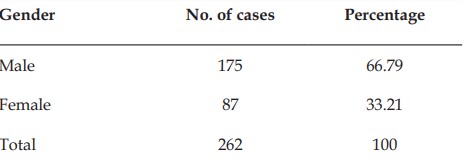
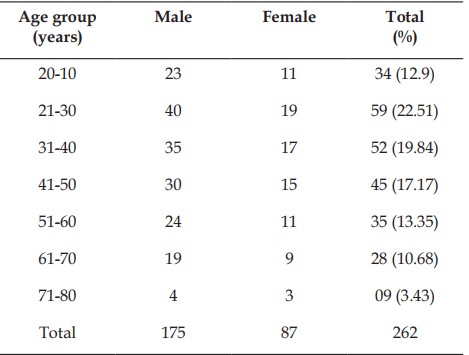
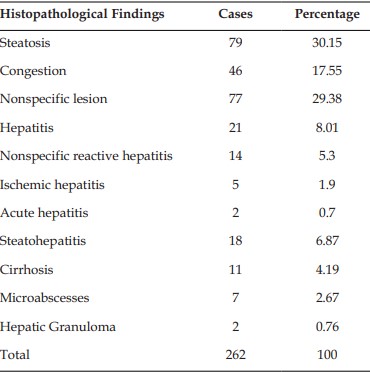
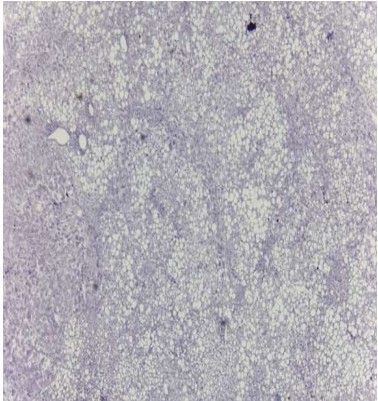
Background: The pathological examinations of medicolegal cases is not confined to determining the cause of death but also useful in teaching pathogenesis and demography of the disease. Liver is the principal site of many metabolic activities and is vulnerable to many metabolic, toxic, microbial and circulatory insults. Due to enormous functional reserve, many liver lesions are silent till late in the course of disease. Aims: This study aimed to analyse histopathological findings of liver diseases in medicolegal cases and correlate with clinical findings wherever available. Methods and Material: The present study is a retrospective observational study with 262 medicolegal autopsy cases over a one-year period conducted in the Department of Pathology of a tertiary care centre. Representative tissue from the liver was collected in 10% neutral buffered formalin and sent for histopathological examination. Results: Total 262 medicolegal cases studied showed predominance of male (68.65%). Maximum cases were in the age group of 21 to 30 years (20.14%) followed by 31 to 40 years (18.28%). The most common lesion was steatosis, accounting for 78 (30%) out of 262 liver specimens. There were 43 (16.5%) cases of congestion, 20 (7.8%) cases of hepatitis and 17 (6.5%) cases of steatohepatitis. Ten (4%) cases of cirrhosis were noted. Conclusions: The present study showed that Histological analysis of liver is important learning objective for pathologists and a significant role in ascertaining the cause and manner of death.
References
- 1. Bhagat R, Singh S, Kumar V. Histopathological Spectrum of Liver Diseases in Autopsy Cases. Tuberculosis. 2019;7(7):467–71. doi:10.18535/jmscr/v7i7.85.
- 2. Singal P, Kaur M, Deepika. Incidental Findings in Autopsy Examination of Liver: A Study of 70 Cases. Ann Int Med Den Res. 2017;3(3):30–2.
- 3. Patel PR, Patel R, Tailor H et al. Incidental Findings in Autopsy examination of liver: a study at tertiary care hospital. International journal of community Medicine and Public Health 2016;3(30):697–99.
- 4. Porwal V, Jain D, Khandelwal S, Gupta S, Rathi A. Spectrum of Liver Pathology in Autopsy Cases: A Study at Ajmer. Ann Pathol Lab Med. 2018;5.
- 5. Selvi RT, Selvam V, Subramaniam PM. Common Silent Liver Disease In and Around of Salem Population: An Autopsy Study. Journal of Clinical and Diagnostic Research 2012;6(2):207–10.
- 6. Alagarsamy J, Muthureddy Y, Yadav N. Incidentally Discovered Liver Diseases— An Autopsy Study of Fifty Cases. International Journal of Science and Research (IJSR) 2014;3(5):1330–32.
- 7. The value of histological examination in the audit of hospital autopsies: a quantitative approach. Zaitoun AM, Fernandez C. Pathology. 1998;30:100–104. [PubMed] [Google Scholar]
- 8. A comprehensive review of pathological examination in forensic medicine: past, present, and future. Singh D, Tiwari RC, Kumar A, et al. Cureus. 2022;14:0. [PMC free article] [PubMed] [Google Scholar]
- 9. Majethia NK, Patil MV, Kalgutkar AD. A HistoPathological Study of Liver in 118 Cases of Cirrhosis. J Liver. 216;5(1). doi:10.4172/2167- 0889.1000193.
- 10. Pathological findings in liver autopsy. Bal MS, Singh SP, Bodal VK, Oberoi SS, Surinder K. J Indian Acad Forensic Med. 2004;26:55–57. [Google Scholar]
- 11. Silent liver diseases in autopsies from forensic medicine of Tehran. Sotoudehmanesh R, Sotoudeh M, Ali-Asgari A, et al. https://pubmed.ncbi.nlm.nih.gov/17061603/ Arch Iran Med. 2006;9:324–328. [PubMed] [Google Scholar]
- 12. Prevalence of lung lesions at autopsy: a histopathological study. Khare P, Gupta R, Ahuja M, Khare N, Agarwal S, Bansal D. J Clin Diagn Res. 2017;11:0–6. [PMC free article] [PubMed] [Google Scholar]
- 13. Bal MS, Singh SP, Bodal VK. et al., Pathological Findings in Liver Autopsy. Journal of Indian Academy of Forensic Medicine 2004;26(20):55–57.
- 14. Kakar S, Gill RM. Nonneoplastic liver disease. In: Mill SE, Greenson JK, Homick JL, Longacre TA, Reuter VE(Eds). Sternberg’s Diagnostic Surgical Pathology. Philadelphia;Wolters Kluwer Health 2015:1694.
Data Sharing Statement
There are no additional data available. All raw data and code are available upon request.
Funding
This research received no funding.
Author Contributions
All authors contributed significantly to the work and approve its publication.
Ethics Declaration
This article does not involve any human or animal subjects, and therefore does not require ethics approval.
Acknowledgements
We would like to express our gratitude to the patients, their families, and all those who have contributed to this study.
Conflicts of Interest
No conflicts of interest in this work.
About this article

Cite this article
Shrinivas Bharat Borkar, Mohammed A.Sameer, Vijaya G.Muddamwar. Histopathological Study of Liver in Medicolegal Cases: A Tertiary Care Centre Study. Ind Jr of Path: Res and Practice 2024;13(1) 19–23.
Licence:
Attribution-Non-commercial 4.0 International (CC BY-NC 4.0)This license enables reusers to distribute, remix, adapt, and build upon the material in any medium or format for noncommercial purposes only, and only so long as attribution is given to the creator.
| Received | Accepted | Published |
|---|---|---|
| January 23, 2023 | February 26, 2023 | March 30, 2023 |
DOI: https://doi.org/10.21088/ijprp.2278.148X.13124.3
Keywords
Medicolegal casesTertiary care centreLiverSteatosisCirrhosisSearch for Similar Articles
Similar Articles
- Clinico-Pathological and Immunohistochemical Study of Primary CNS Tumors in a Te...
- The Role of SGLT2 Inhibitors in Cardiovascular Protection Beyond Diabetes: A Co...
- Epidermal Inclusion Cyst Presenting as 4th Ventricle Space Occupying Lesion: A R...
- Silent Retroperitoneal Seminoma Arising from an Occult Undescended Testis: Diagn...
- Scapular Metastasis of Oral Squamous Cell Carcinoma: A Case Report of an Unusual...
Article Level Metrics
Last UpdatedSunday 20 September 2026, 22:00:44 (IST)
3662
Accesses
9
541
00
Citations
NA
NA
NA
Download citation
Article Keywords
Keyword Highlighting
Highlight selected keywords in the article text.
Timeline
| Received | January 23, 2023 |
| Accepted | February 26, 2023 |
| Published | March 30, 2023 |
licence
Attribution-Non-commercial 4.0 International (CC BY-NC 4.0)
This license enables reusers to distribute, remix, adapt, and build upon the material in any medium or format for noncommercial purposes only, and only so long as attribution is given to the creator.