Full Text (PDF)
Indian Journal of Forensic Medicine and Pathology 15(1):p 25-31, January-March 2022. | DOI: https://doi.org/10.21088/ifjmp.0974.3383.15122.3
Original Article
Histopathological Evaluation of Cardiac Lesions in Autopsy Specimens
Clement Wilfred, Chinki Anupam
Author Information
Licence:
Attribution-Non-commercial 4.0 International (CC BY-NC 4.0)This license enables reusers to distribute, remix, adapt, and build upon the material in any medium or format for noncommercial purposes only, and only so long as attribution is given to the creator
Indian Journal of Forensic Medicine and Pathology 15(1):p 25-31, January-March 2022. | DOI: https://doi.org/10.21088/ifjmp.0974.3383.15122.3
How Cite This Article:
Wilfred DC, Anupam C. Histopathological evaluation of cardiac lesions in autopsy specimens. Indian J Forensic Med Pathol. 2022;15(1):25-31.Timeline
Received : January 25, 2022
Accepted : March 03, 2022
Published : March 30, 2022
Abstract
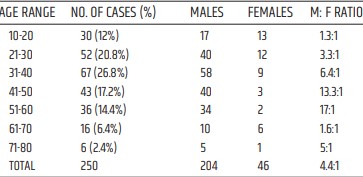
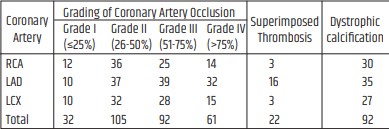
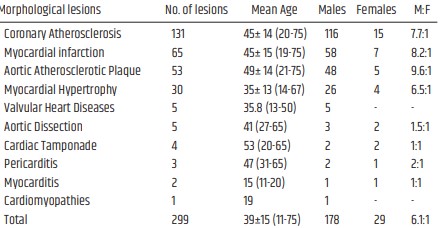
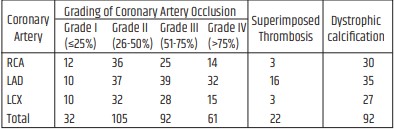
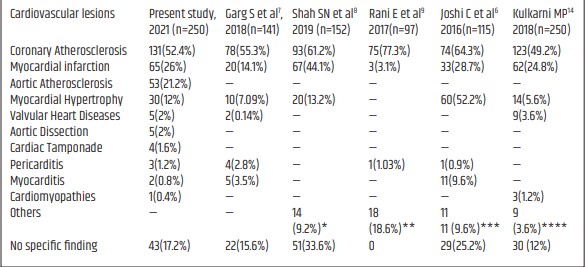
Context: Evaluation of cardiac autopsy specimens is crucial for identifying concealed cardiovascular pathology and providing insights into the pathogenesis and progression of disease. Hence, this study was undertaken to evaluate the histopathological features of cardiac lesions in autopsy specimens. method: The was a prospective cross-sectional study conducted on cardiac specimens from routine autopsies over a period of three and half years, between January 2018 and June 2021, at M.S. Ramaiah Medical College and Hospitals, Bengaluru. The hearts were evaluated grossly and microscopically to identify the various histopathological changes. results: A total of 250 cases, with mean age of 39±15 years and male-female ratio of 4.4:1, were evaluated. In 207 (82.8%) cases 299 morphological lesions were identified, comprised of coronary atherosclerosis (52.4%), myocardial infarction (26%), aortic atherosclerosis (21.2%), cardiac hypertrophy (12%), valvular disease (2%), aortic dissection (2%), cardiac tamponade (1.6%), pericarditis (1.2%), myocarditis (0.8%) and cardiomyopathy (0.4%). conclusion: Cardiac lesions were detected in 82.8% in autopsies. The most frequent finding is coronary atherosclerosis with triple vessel involvement being the commonest. Severe luminal occlusion, calcification and thrombosis are most frequent in Left anterior descending coronary artery. The next most common lesion is Myocardial Infarction, the most significant pathogenetic mechanism of which is coronary atherosclerosis. There is a strong association between coronary and ascending aorta atherosclerosis. Thus, many preventable and concealed lesions are discovered at cardiac autopsies and this data is important for assessing disease trends and introducing new interventions and therapeutic management regimes.
References
- 1. Buja LM, Barth RF, Krueger GR, Brodsky SV, Hunter RL. The Importance of the Autopsy in Medicine: Perspectives of Pathology Colleagues. Acad. Pathol.2019;6:1-9.
- 2. Sreeniwas Kumar A, Sinha N. Cardiovascular disease in India: A 360 degree overview. Med J Armed Forces India. 2020;76(1):1-3.
- 3. India State-Level Disease Burden Initiative CVD Collaborators. The changing patterns of cardiovascular diseases and their risk factors in the states of India: the Global Burden of Disease Study 1990-2016. Lancet Glob Health. 2018;6(12):e1339-e1351.
- 4. Dhankar V, Khare P, Rawat A, Gupta R. A Histopathological Array of Cardiac Lesions on Autopsy. Indian J. Appl. Res.2019;9:67-9.
- 5. Venkatesh K, Deepak DC, Venkatesha VT. Postmortem Study of Hearts – Pathology of Coronary Artery Atherosclerosis. J Forensic Sci & Criminal Inves. 2019; 12(4): 001-005.
- 6. Joshi C. Postmortem study of histopathological lesions of heart in cases of sudden death - An incidental findings. J Evid Based Med Healthc.2016; 3(6), 184-8.
- 7. Garg S, Hasija S, Sharma P, Kalhan S, Saini N, Khan A. A histopathological analysis of prevalence of various heart diseases: an autopsy study. Int J Res Med Sci 2018;6:1414-8.
- 8. Shah SN, Patel KA, Patel HB, Bhalodia JN. Histomorphological study of changes in heart – An autopsy study. Arch Cytol Histopathol Res. 2019;4(2):159- 63.
- 9. Rani E, Kumar S, Mehrolia V. Morphological Patterns in Heart DiseasesAn Autopsy Study. Int. J of Current Advanced Research.2017;06(08): 5391-3.
- 10. Karanfil R, Gulmen MK, Hilal A. Evaluation of cardiac conduction system in sudden death cases. J For Med. 2013;27(1):17-28.
- 11. Marwah N, Sethi B, Gupta S, Duhan A, Singh S, Sen R, et al. Histomorphological Spectrum of Various Cardiac Changes in Sudden Death: An Autopsy Study. Iran J Pathol. 2011;6:179- 86.
- 12. Sudha ML, Sundaram S, Purushothaman KR, Kumar PS, Prathiba D. Coronary atherosclerosis in sudden cardiac death: an autopsy study. Indian J Pathol Microbiol. 2009;52(4):486-9.
- 13. Thiripurasundari R, Sreekumari K, Aravindan K P. Autopsy-based morphometric study of coronary atherosclerosis in young adults. Indian J Med Res. 2019;150:592-7.
- 14. Kulkarni MP, Sulhyan KR, Ramteerthakar NA. Histopathological Study of Cardiac Lesions in Medicolegal Autopsies. Indian J. Forensic Med. Pathol.2018;11(2):89-94.
- 15. Mitchell RN, Connolly AJ. The Heart. In: Kumar V, Abbas AK, Aster JC, editors. Robbins & Cotran Pathologic Basis of Disease 10th ed. Philadelphia: Elsevier.2021; 527-82.
- 16. Agmon Y, Khandheria BK, Meissner I, Schwartz GL, Petterson TM, O’Fallon WM, et al. Relation of coronary artery disease and cerebrovascular disease with atherosclerosis of the thoracic aorta in the general population. Am J Cardiol. 2002 Feb 1;89(3):262-7.
- 17. van der Wall EE, van der Laarse A. Aortic and coronary atherosclerosis: a natural association?. Int J Cardiovasc Imaging.2009; 25, 219–22.
- 18. Mitchell RN, Halushka MK. Blood Vessels. In: Kumar V, Abbas AK, Aster JC, editors. Robbins & Cotran Pathologic Basis of Disease 10th ed. Philadelphia: Elsevier.2021; 485-525.
- 19. Huynh N, Thordsen S, Thomas T, Mackey-Bojack SM, Duncanson ER, Nwuado D, et al. Clinical and pathologic findings of aortic dissection at autopsy: Review of 336 cases over nearly 6 decades. Am Heart J. 2019;209:108-15.
Data Sharing Statement
There are no additional data available. All raw data and code are available upon request.
Funding
This research received no funding.
Author Contributions
All authors contributed significantly to the work and approve its publication.
Ethics Declaration
This article does not involve any human or animal subjects, and therefore does not require ethics approval.
Acknowledgements
We would like to express our gratitude to the patients, their families, and all those who have contributed to this study.
Conflicts of Interest
No conflicts of interest in this work.
About this article

Cite this article
Wilfred DC, Anupam C. Histopathological evaluation of cardiac lesions in autopsy specimens. Indian J Forensic Med Pathol. 2022;15(1):25-31.
Licence:
Attribution-Non-commercial 4.0 International (CC BY-NC 4.0)This license enables reusers to distribute, remix, adapt, and build upon the material in any medium or format for noncommercial purposes only, and only so long as attribution is given to the creator
| Received | Accepted | Published |
|---|---|---|
| January 25, 2022 | March 03, 2022 | March 30, 2022 |
DOI: https://doi.org/10.21088/ifjmp.0974.3383.15122.3
Keywords
atherosclerosisautopsycardiac specimencoronarymyocardial infarctionSearch for Similar Articles
Similar Articles
- Diatom Analysis in Thermophilic water bodies: A Study on Hot Water Springs of Ma...
- Morphometric Study of Supra-meatal Triangle and Mastoid process in the Adult dry...
- Histopathological Spectrum of Autopsy Cases: A One Year Retrospective Observatio...
- Forensic Differentiation of Manner of Death in Railway Fatalities: A FourCase Se...
- Understanding assault Patterns: A Cross-sectional study of Cases at Chri, Kelamb...
Article Level Metrics
Last UpdatedSunday 18 October 2026, 14:45:14 (IST)
16275
Accesses
15
3209
00
Citations
NA
NA
NA
Download citation
Article Keywords
Keyword Highlighting
Highlight selected keywords in the article text.
Timeline
| Received | January 25, 2022 |
| Accepted | March 03, 2022 |
| Published | March 30, 2022 |
licence
Attribution-Non-commercial 4.0 International (CC BY-NC 4.0)
This license enables reusers to distribute, remix, adapt, and build upon the material in any medium or format for noncommercial purposes only, and only so long as attribution is given to the creator