Full Text (PDF)
New Indian Journal of Surgery 14(2):p 53-55, April-June 2023. | DOI: https://dx.doi.org/10.21088/nijs.0976.4747.14223.2
Original Article
Hemorrhoidectomy: Open versus Closed: A Randomised Trial
Nikhil Naithottu G, T Kempraj null
Author Information
Licence:
Attribution-Non-commercial 4.0 International (CC BY-NC 4.0)This license enables reusers to distribute, remix, adapt, and build upon the material in any medium or format for noncommercial purposes only, and only so long as attribution is given to the creator.
New Indian Journal of Surgery 14(2):p 53-55, April-June 2023. | DOI: https://dx.doi.org/10.21088/nijs.0976.4747.14223.2
How Cite This Article:
Naithottu GN, Kempraj T. Hemorrhoidectomy: open versus closed: a randomised trial. New Indian J Surg. 2023;14(2):53-55.Timeline
Received : February 07, 2023
Accepted : March 03, 2023
Published : June 29, 2023
Abstract
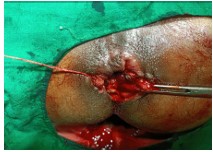
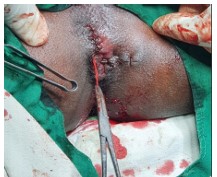
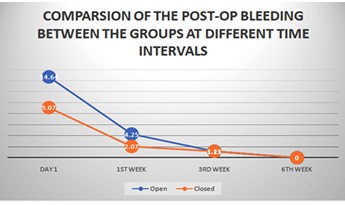
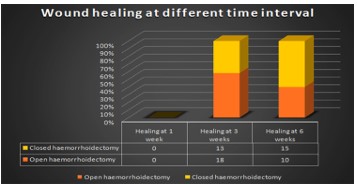
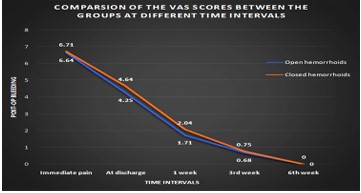
Aims and objectives: 1. To evaluate the outcomes of open and closed hemorrhoidectomy. 2. To compare the advantages and disadvantages in open and closed hemorrhoidectomy. Methodology: A randomised control trail was conducted on 56 patients presenting with grade 3 or grade 4 haemorrhoids at tertiary care centre. Patients were divided into groups of Group A – undergoing Open haemorrhoidectomy and Group B – undergoing Closed haemorrhoidectomy. Each group consisted of 28 patients. Patients in both groups were followed up and various parameters were assessed. Results: Mean duration of procedure for open haemorrhoidectomy was 22.32 minutes and for closed haemorrhoidectomy was 30 minutes. Mean intraoperative blood loss in both the procedures was 23.39 ml. 64.28% of patients showed wound healing at 3 weeks in group A and 46.42% in group B. Mean VAS score at discharge was 3.71 for group A and 4.64 for group B (p <0.001). Mean hospital stay for group A – 3.7 and for group B – 5 (p < 0.001). Conclusion: As per the observations made and data obtained in our study it showed that open haemorrhoidectomy to be superior to closed haemorrhoidectomy.
References
- 1. Jasim H, Al-Alwan M. Haemorrhoidectomy: a Comparative Study of Open & Closed Methods. MMJ 2009; 8:23-26.
- 2. Borse H, Dhake S. A Comparative Study of Open (Milligan-Morgan) Versus Closed (Ferguson) Hemorrhoidectomy. Mvpjms 2016; 3(1): 7-10.
- 3. Burkitt d p. varicose veins, dvt and hemorrhoids. Epidemiology and suggestive aetiology. British medical journal – 2 1972. 556-561.
- 4. Kumar A, Gupta A, Gupta N, Krishnegowda U, Durga C. A Prospective Comparative Study Between Stapled And Conventional Haemorrhoidectomy. Hellenic Journal of Surgery 2015; 87(6): 468-72.
- 5. Nugent K. The anus and anal canal. In: Williams N, O’Connell P, McCaskie A, editors. Bailey & Love’s Short Practice of Surgery. 27th ed. Vol 2; 2018. p. 1339-73.
- 6. Farquharson E. Surgery of the anus and perineum. In: Farquharson M, Hollingshead J, Moran B, editors. Farquharson’s Textbook of Operative General Surgery. 10th ed. Vol 1; 2015. p. 435-58.
- 7. Ellesmore, Windsor (2002). Surgical History of Hemorrhoids. In Charles MV (ed.). Surgical Treatment of Hemorrhoids. London: Springer.
- 8. Cataldo, Peter (2005). Hemorrhoids. Arlington Heights, IL: American Society of Colon and Rectal Surgeons.
- 9. Kumar M, Sinha K. Open Haemorrhoidectomy versus Closed Haemorrhoidectomy: A Comparative Study. JMSCR 2017; 5(5): 21698-701.
- 10. Ali M, Nasir S, Nazir S, Shehbaz L, Saad M, Anwar M, et al. Postoperative complications of haemorrhoidectomy, a comparative analysis of open versus closed operating technique. Pak J Surg 2016; 32(1): 26-28.
- 11. Mohapatra R, Murmu D, Mohanty A. A comparative study of open and closed hemorrhoidectomy. Int Surg J 2018; 5(6): 2335-38.
Data Sharing Statement
There are no additional data available.
Funding
This research received no funding
Author Contributions
All authors contributed significantly to the work and approve its publication.
Ethics Declaration
This article does not involve any human or animal subjects, and therefore does not require ethics approval
Acknowledgements
Information Not Provided
Conflicts of Interest
No conflicts of interest in this work.
About this article

Cite this article
Naithottu GN, Kempraj T. Hemorrhoidectomy: open versus closed: a randomised trial. New Indian J Surg. 2023;14(2):53-55.
Licence:
Attribution-Non-commercial 4.0 International (CC BY-NC 4.0)This license enables reusers to distribute, remix, adapt, and build upon the material in any medium or format for noncommercial purposes only, and only so long as attribution is given to the creator.
| Received | Accepted | Published |
|---|---|---|
| February 07, 2023 | March 03, 2023 | June 29, 2023 |
DOI: https://dx.doi.org/10.21088/nijs.0976.4747.14223.2
Keywords
HaemorrhoidsMilligan Morgan Open hemorrhoidectomyFerguson Closed haemorrhoidectomyPost-operative painWound healingSearch for Similar Articles
Similar Articles
- Laparoscopy-Guided Bilateral Oblique Subcostal Transversus Abdominis Plane Bloc...
- Recognizing the Columnar Cell Subtype of Papillary Thyroid Carcinoma: A Case Rep...
- Randomized Controlled Study To Compare Intraperitoneal Plus Port-Site Instillat...
- Single Preoperative Dose Versus Conventional Multidose Antibiotic Prophylaxis In...
- To Compare the Dissection of Gallbladder by Ultrasonic Harmonic Scalpel Versus...
Article Level Metrics
Last UpdatedTuesday 29 September 2026, 10:34:09 (IST)
5222
Accesses
9
437
00
Citations
NA
NA
NA
Download citation
Article Keywords
Keyword Highlighting
Highlight selected keywords in the article text.
Timeline
| Received | February 07, 2023 |
| Accepted | March 03, 2023 |
| Published | June 29, 2023 |
licence
Attribution-Non-commercial 4.0 International (CC BY-NC 4.0)
This license enables reusers to distribute, remix, adapt, and build upon the material in any medium or format for noncommercial purposes only, and only so long as attribution is given to the creator.