Full Text (PDF)
Indian Journal of Pathology: Research and Practice 13(3):p 93-98, July- September 2024. | DOI: https://doi.org/10.21088/ijprp.2278.148X.13324.1
Original Article
Genotypic Pattern of Sickle Cell Anaemia among Tribal Community of Dahod: A Tertiary Hospital Based Study
Author Information
Licence:
Attribution-Non-commercial 4.0 International (CC BY-NC 4.0)This license
enables reusers to distribute, remix, adapt, and build upon the material in any
medium or format for noncommercial purposes only, and only so long as
attribution is given to the creator.
Indian Journal of Pathology: Research and Practice 13(3):p 93-98, July- September 2024. | DOI: https://doi.org/10.21088/ijprp.2278.148X.13324.1
How Cite This Article:
Dhiraj J Trivedi, Genotypic Pattern of Sickle Cell Anaemia among Tribal Community of Dahod: A Tertiary Hospital Based Study. Ind Jr of Path: Res and Practice 2024;13(3)93-98.Timeline
Received : July 23, 2024
Accepted : August 27, 2024
Published : September 30, 2024
Abstract
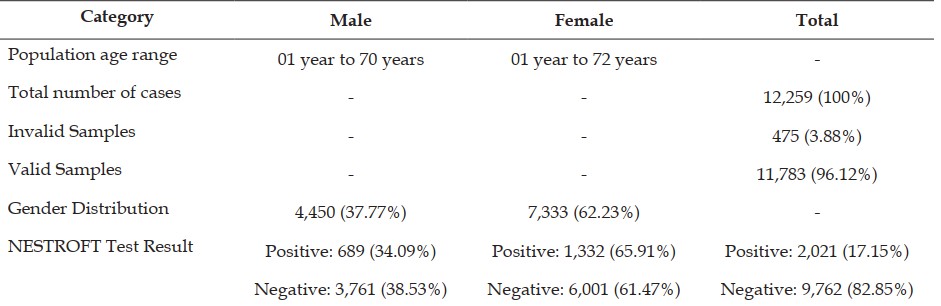
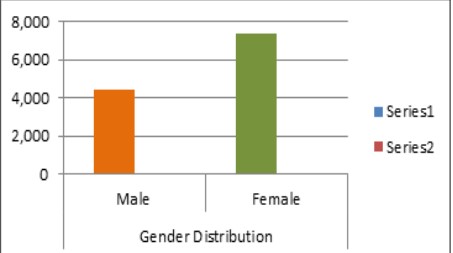
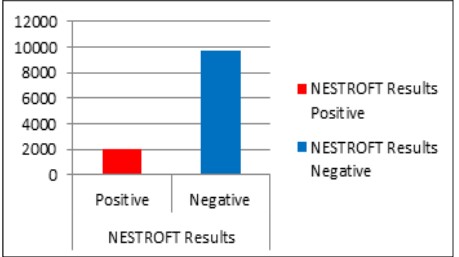
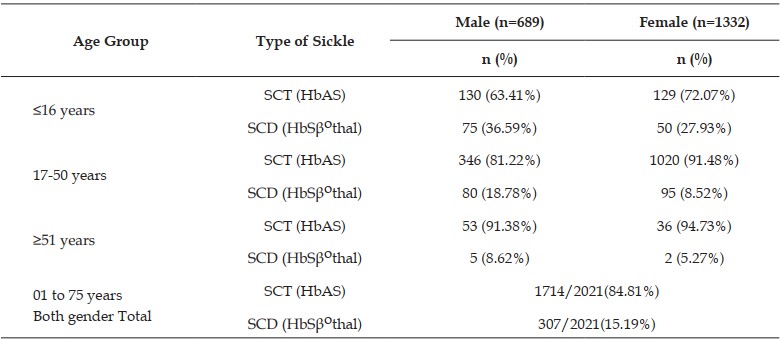
Sickle cell anaemia (SCA) is a prevalent haemoglobinopathy worldwide, with Gujarat exhibiting a notably high prevalence. This study focuses on the frequency and genotype distribution of SCA within the tribal community of Dahod, aiming to enhance public health outcomes and contribute to a sickle cell-free India. Study conducted at a tertiary care hospital, it analyses data from 12,259 individuals during June 2024 to August 2024. The findings reveal a 17.15% prevalence of SCA among the tribal community. Among HbS positive individuals, SCT-AS genotype was observed in 14.55% of cases, while the SCD HbSb0thal genotype was noted in 2.61% of cases. The frequency of SCT Hb-AS is approximately 5.6 times higher than that of SCD HbSb0thal among the HbS-positive tribal population. Additionally, a gender disparity was observed, with a higher frequency in females.
References
- 1. WHO Report, Community control of hereditary anaemias. Memorandum from a WHO meeting. Bull World Health Organ.1983; 61: 63-80.
- 2. Kanjaksha Ghosh, Roshan B. Colah, and Malay B. Mukherjee. Haemoglobinopathies in tribal populations of India: Indian J Med Res.2015; 141(5): 505-508.
- 3. BhatiaHM, RaoVR. Genetic atlas of Indian Tribes, Bombay: Institute of Immunohematology (ICMR); 1987.
- 4. RaoVR. Genetics and epidemiology of sickle cell anemia in India. Indian J Med Sci.1988; 42: 218-22.
- 5. Patel AP, Naik MR, Shah NM, Sharma N, Parmar P. Prevalence of common hemoglobinopathies in Gujarat: An analysis of a large population screening programme. Natl. J Community Med: 2012; 3: 112-6.
- 6. Patel AG, Shah AP, Sorathiya SM, Gupte SC. Hemoglobinopathies in South Gujarat population and incidence of anaemia in them. Indian J Hum Genet: 2012; 18: 294-8.
- 7. Diggs, L. W, Walker, R: A Solubility Test for Sickle Cell Hemoglobin I. Aggregation and Separation of Soluble and Insoluble Components With-out Centrifugation. Lab. Med: 1973; 4:27-31.
- 8. Huntsman RG, Barclay GP, Canning DM, Yawson GI. A rapid whole blood solubility test to differentiate the sickle-cell trait from sickle-cell anaemia. Journal of Clinical Pathology: 1970;23(9):781-3.
- 9. Muhammad Noman Hasan et al. Paper-based microchip electrophoresis for point-of-care hemoglobin testing. Analyst: 2020; 145(7): 2525–2542.
- 10. Balgir RS. The burden of hemoglobinopathies in India and the challenges ahead. Current Sci. Association. 2000;79(11):1536-47.
- 11. Balgir RS. The genetic burden of haemoglobinopathies with special references to community health in India and the challenges ahead. Indian J Hemat. Blood Transfuse: 2002;20:2-7
Data Sharing Statement
There are no additional data available. All raw data and code are available upon request.
Funding
This research received no funding.
Author Contributions
All authors contributed significantly to the work and approve its publication.
Ethics Declaration
This article does not involve any human or animal subjects, and therefore does not require ethics approval.
Acknowledgements
We would like to express our gratitude to the patients, their families, and all those who have contributed to this study.
Conflicts of Interest
No conflicts of interest in this work.
About this article

Cite this article
Dhiraj J Trivedi, Genotypic Pattern of Sickle Cell Anaemia among Tribal Community of Dahod: A Tertiary Hospital Based Study. Ind Jr of Path: Res and Practice 2024;13(3)93-98.
Licence:
Attribution-Non-commercial 4.0 International (CC BY-NC 4.0)This license
enables reusers to distribute, remix, adapt, and build upon the material in any
medium or format for noncommercial purposes only, and only so long as
attribution is given to the creator.
| Received | Accepted | Published |
|---|---|---|
| July 23, 2024 | August 27, 2024 | September 30, 2024 |
DOI: https://doi.org/10.21088/ijprp.2278.148X.13324.1
Keywords
HemoglobinopathiesHemoglobinSickle Cell AnaemiaSickle Cell Traitickle Cell DiseaseHemoglobin SThalassemiaTribalSearch for Similar Articles
Similar Articles
- Clinico-Pathological and Immunohistochemical Study of Primary CNS Tumors in a Te...
- The Role of SGLT2 Inhibitors in Cardiovascular Protection Beyond Diabetes: A Co...
- Epidermal Inclusion Cyst Presenting as 4th Ventricle Space Occupying Lesion: A R...
- Silent Retroperitoneal Seminoma Arising from an Occult Undescended Testis: Diagn...
- Scapular Metastasis of Oral Squamous Cell Carcinoma: A Case Report of an Unusual...
Article Level Metrics
Last UpdatedTuesday 22 September 2026, 05:39:14 (IST)
3671
Accesses
11
541
00
Citations
NA
NA
NA
Download citation
Article Keywords
Keyword Highlighting
Highlight selected keywords in the article text.
Timeline
| Received | July 23, 2024 |
| Accepted | August 27, 2024 |
| Published | September 30, 2024 |
licence
Attribution-Non-commercial 4.0 International (CC BY-NC 4.0)
This license
enables reusers to distribute, remix, adapt, and build upon the material in any
medium or format for noncommercial purposes only, and only so long as
attribution is given to the creator.