Full Text (PDF)
Journal of Forensic Chemistry and Toxicology 11(1):p 16-19, Jan-June 2025. | DOI: 10.21088/jfct.2454.9363.11125.2
Review Article
Forensic Analysis: Focus on Collection and Preservation of Viscera and Biological Sample in Poisoning Cases
Author Information
Licence:
Attribution-Non-commercial 4.0 International (CC BY-NC 4.0)This license enables reusers to distribute, remix, adapt, and build upon the material in any medium or format for noncommercial purposes only, and only so long as attribution is given to the creator.
Journal of Forensic Chemistry and Toxicology 11(1):p 16-19, Jan-June 2025. | DOI: 10.21088/jfct.2454.9363.11125.2
How Cite This Article:
Kori S. Forensic Analysis: Focus on Collection and Preservation of Viscera and Biological Sample in Poisoning Cases. J Forensic Chem Toxicol. 2025;11(1):16–9.Timeline
Received : April 11, 2025
Accepted : May 13, 2025
Published : June 12, 2025
Abstract
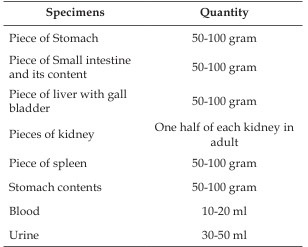
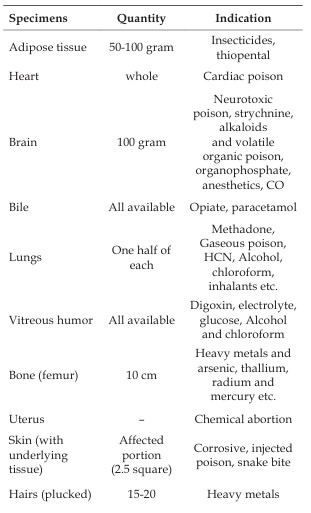
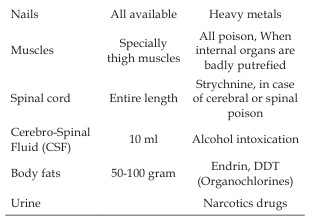
In offences involving the human body, Laboratory analysis of material obtained from the victim or the accused can prove vital to proper investigation of the case. In case of poisoning, Viscera and Biological Sample are the main physical evidences whichplayveryimportantroletosolvethecrime.Unfortunately,MedicalOf cers are often not aware as to the exact nature or quantity of samples to be taken, nor the correct manner of preservation or packing that should be followed. Collection and preservation of viscera for chemical analysis, it is a duty of doctor to collect and preserve the viscera and other exhibits property. The aim of this literature is to behelpfultomedical of cers&policepersonalsinCollectionandPreservationof Viscera and Biological Sample in Poisoning cases to solve crime.
References
- 1. Joseph M., & H. Kaur, A Handbook of Forensic Medicine and Toxicology. B. Jain Publishers Pvt. Limited, 2009.
- 2. Pillay V.V., Murty O.P., Dikshit P.C., Mehrotra V.K., Fimate L., Dutta V.K., Verma S.K., and Shantha Kumar B. Guidelines for viscera Preservation in poisoning cases, JFMT 1999; Vol. 16, No 1.
- 3. Pillay V.V., Modern Medical Toxicology. Jaypee Brothers Medical Publishers New Delhi, 1995.
- 4. Pounder O.J., Smit D.R.W., Postmortem diffusion of alcohol from the stomach. Am J Forensic Med Pathol 1995; 16: 89 - 96.
- 5. Deshpande V.L., Post Mortem Examination and Viscera Preservation.
- 6. Bardale R., Principles of Forensic Medicine & Toxicology, Jaypee Brothers Medical Publishers (p) Ltd, First Edition, 2011.
- 7. Pillayi V.V., Textbook of Forensic Medicine & Toxicology, Publisher: Paras Medical Publisher, 20th edition, 2023.
Data Sharing Statement
There are no additional data available. All raw data and code are available upon request.
Funding
This research received no funding."
Author Contributions
All authors contributed significantly to the work and approve its publication.
Ethics Declaration
This article does not involve any human or animal subjects, and therefore does not require ethics approval.
Acknowledgements
No Information provided
Conflicts of Interest
No conflicts of interest in this work.
About this article

Cite this article
Kori S. Forensic Analysis: Focus on Collection and Preservation of Viscera and Biological Sample in Poisoning Cases. J Forensic Chem Toxicol. 2025;11(1):16–9.
Licence:
Attribution-Non-commercial 4.0 International (CC BY-NC 4.0)This license enables reusers to distribute, remix, adapt, and build upon the material in any medium or format for noncommercial purposes only, and only so long as attribution is given to the creator.
| Received | Accepted | Published |
|---|---|---|
| April 11, 2025 | May 13, 2025 | June 12, 2025 |
DOI: 10.21088/jfct.2454.9363.11125.2
Keywords
VisceraCollectionPreservationPoisoningSearch for Similar Articles
Similar Articles
- Simultaneous Determination and Method Validation For Opioids, Cannabinol and Nic...
- Algorithm for Investigating Suspected Mothball Poisoning
- Analytical Advances in Date Rape Drug Detection: A Comparative Study of Metaboli...
- An Empirical Assessment of Dermatoglyphics & Psychological Profiling of Juvenile...
- Detection of Mustard Oil Adulteration in Kanpur City
Article Level Metrics
Last UpdatedTuesday 08 September 2026, 19:59:23 (IST)
1386
Accesses
7
143
00
Citations
NA
NA
NA
Download citation
Article Keywords
Keyword Highlighting
Highlight selected keywords in the article text.
Timeline
| Received | April 11, 2025 |
| Accepted | May 13, 2025 |
| Published | June 12, 2025 |
licence
Attribution-Non-commercial 4.0 International (CC BY-NC 4.0)
This license enables reusers to distribute, remix, adapt, and build upon the material in any medium or format for noncommercial purposes only, and only so long as attribution is given to the creator.