Full Text (PDF)
Indian Journal of Pathology: Research and Practice 15(1):p 65-71, Jan-Apr 2026. | DOI: 10.21088/ijprp.2278.148X.15126.6
Review Article
Footfall Analysis of Sickle Cell Patients in a Tribal Healthcare: A Single Centre Analysis
Dhiraj Trivedi, Nandkishor Chauhan, Nirali Koladiya, Manthansinh Parmar, Kailash Gadekar
Author Information
Licence:
Attribution-Non-commercial 4.0 International (CC BY-NC 4.0)This license enables reusers to distribute, remix, adapt, and build upon the material in any medium or format for noncommercial purposes only, and only so long as attribution is given to the creator.
Indian Journal of Pathology: Research and Practice 15(1):p 65-71, Jan-Apr 2026. | DOI: 10.21088/ijprp.2278.148X.15126.6
How Cite This Article:
Chauhan N, Koladiya N, Parmar M, et al. Footfall Analysis of Sickle Cell Patients in a Tribal Healthcare: A Single-Centre Analysis. Ind Jr of Path: Res and Practice. 2026;15(1):65-71.Timeline
Received : December 12, 2025
Accepted : January 13, 2026
Published : April 30, 2026
Abstract
Haemoglobin disorders occur worldwide, with particularly high prevalence in regions such as sub-Saharan Africa, the Mediterranean, the Middle East, and South Asia. One of the most common hemoglobinopathies is sickle cell disorder (HbS). In India, the prevalence of sickle cell haemoglobin ranges from 1% to 40%, with significantly higher rates observed among rural tribal communities. This singlecentre, retrospective study analysed healthcare footfall of sickle cell patients from the tribal area of Dahod.
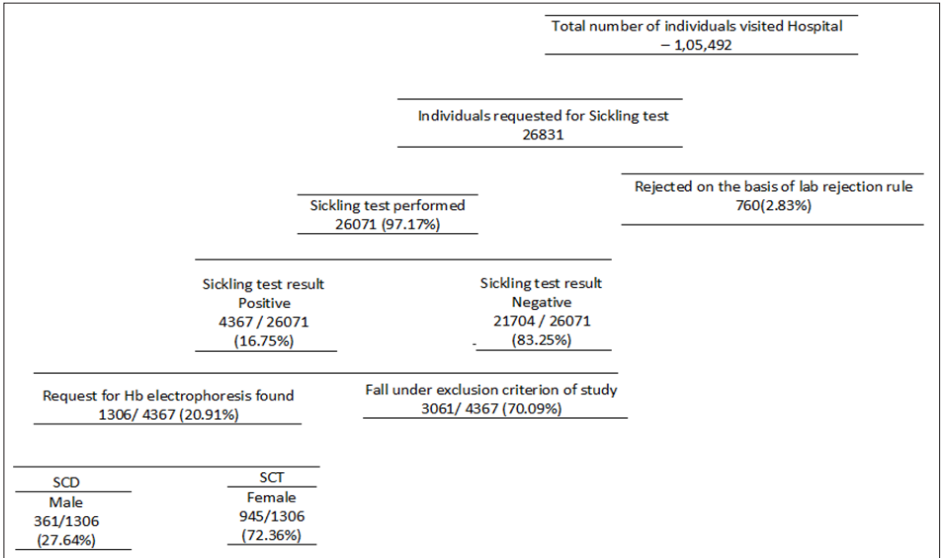
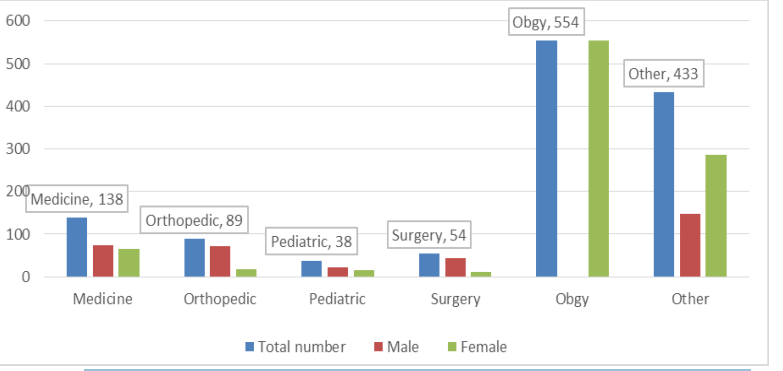
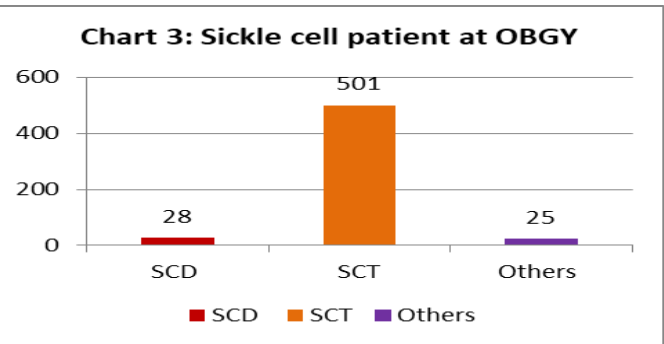
A total of 105,492 patient records from the District Hospital were reviewed between January and June 2025. At District Hospital-Dahod, the prevalence of sickle cell-positive cases is 16.75%. Among these, 6.66% were diagnosed with sickle cell disease, and 93.34% were identified as a sickle cell trait, silent carriers of the disease. Among the records assessed, 42.42% of individuals sought health care from the obstetrics and gynaecology (OBGY) department. Of these, 98% were females of reproductive age. Within this group, 5.05% were diagnosed with sickle cell disease (SCD), while 90.43% carried the sickle cell trait.
The high predominance of sickle cell trait among antenatal females highlights a critical public health concern that may be contributing to the high maternal and infant mortality rates reported in the Dahod district.
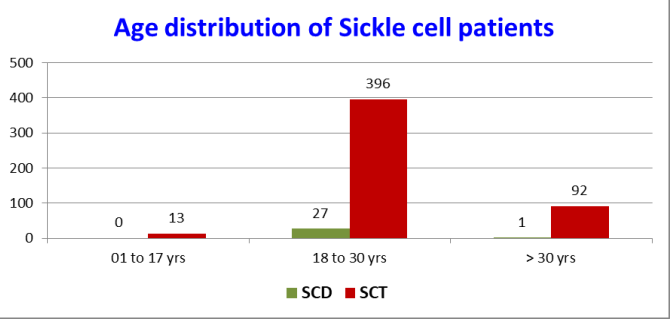
These findings further underscore the need for routine screening protocols, genetic counselling, and the requirement for targeted awareness programs, particularly among adolescent females and young males in tribal regions. The development of more effective healthcare interventions warrants policy attention to mitigate the burden of sickle cell disorder and improve maternal and infant mortality rates in this vulnerable population.
References
- 1. Modell B, Darlison M. Global epidemiology of haemoglobin disorders and derived service indicators. Bull World Health Organ. 2008;86(6):480-487.
- 2. Gupta K, Krishnamurti L, Jain D. Sickle cell disease in India: the journey and hope for the future. Hematology Am Soc Hematol Educ Program. 2024;2024(1):1-9.
- 3. Colah RB, Mukherjee MB, Martin S, Ghosh K. Sickle cell disease in tribal populations in India. Indian J Med Res. 2015;141(5):509-515.
- 4. Trivedi DJ. Sickle cell anaemia among Dahod’s tribes: a genetic perspective. World J Pharm Sci Res. 2024;3(5):291-297.
- 5. National Health Mission, Gujarat. Sickle Cell Anaemia Control Program [Internet]. Gandhinagar: NHM; [cited 2026 Mar 12].
- 6. New Indian Express. Over 2,447 newborns, 156 maternal deaths in Gujarat hospitals last three months [Internet]. 2024 [cited 2026 Mar 12].
- 7. Hasan MN, Fraiwan A, An R, Alapan Y, Ung R, Akkus A, et al. Paper-based microchip electrophoresis for point-of-care hemoglobin testing. Analyst. 2020;145(7):2525-2542.
- 8. Diggs LW, Walker R. A Solubility Test for Sickle Cell Hemoglobin I. Aggregation and Separation of Soluble and Insoluble Components Without Centrifugation. Lab Med. 1973;4(1):27-31.
- 9. Huntsman RG, Barclay GP, Canning DM, Yawson GI. A rapid whole blood solubility test to differentiate the sickle-cell trait from sickle-cell anaemia. J Clin Pathol. 1970;23(9):781-783.
- 10. Indian Society of Haematology & Blood Transfusion, ICMR. National guidelines on management and control of sickle cell disease [Internet]. 2023 [cited 2026 Mar 12].
- 11. Nischal PM. India launches Sickle Cell Anaemia guidelines and third phase of Thalassaemia Bal Sewa Yojana. Natl Med J India. 2023;36(4):254-255.
- 12. Agarwal RK, Dhanya R, Parmar L, et al. Prenatal hemoglobinopathy screening and prevention in India: A cross-sectional study. Indian J Med Res. 2025;161(5):441-448.
- 13. ICMR-ISHBT. Sickle Cell Disease Guidelines [Internet]. 2023 [cited 2026 Mar 12].
- 14. Colah RB, Mukherjee MB, Martin S, Ghosh K. Sickle cell disease in tribal populations in India. Indian J Med Res. 2015;141(5):509-515.
- 15. Yadav R, Lazarus M, Ghanghoria P, Singh MP, et al. Sickle cell disease in Madhya Pradesh, Central India: A comparison of clinical profile of sickle cell homozygote vs. sickle-beta thalassaemia individuals. Hematology. 2016;21(9):558-563.
- 16. Gorakshakar AC. Epidemiology of Sickle Hemoglobin in India [Internet]. ICMR-NIRTH; [cited 2026 Mar 12].
Data Sharing Statement
There are no additional data available. All raw data and code are available upon request.
Funding
This research received no funding.
Author Contributions
Whether all authors contributed significantly to the work and approve its publication.
Ethics Declaration
This article does not involve any human or animal subjects, and therefore does not require ethics approval.
Acknowledgements
We would like to express our gratitude to the patients, their families, and all those who have contributed to this study.
Conflicts of Interest
The authors report no conflicts of interest in this work.
About this article

Cite this article
Chauhan N, Koladiya N, Parmar M, et al. Footfall Analysis of Sickle Cell Patients in a Tribal Healthcare: A Single-Centre Analysis. Ind Jr of Path: Res and Practice. 2026;15(1):65-71.
Licence:
Attribution-Non-commercial 4.0 International (CC BY-NC 4.0)This license enables reusers to distribute, remix, adapt, and build upon the material in any medium or format for noncommercial purposes only, and only so long as attribution is given to the creator.
| Received | Accepted | Published |
|---|---|---|
| December 12, 2025 | January 13, 2026 | April 30, 2026 |
DOI: 10.21088/ijprp.2278.148X.15126.6
Keywords
Sickle haemoglobinSCD • SCTTribalANC mothersMaternal mortalitySearch for Similar Articles
Similar Articles
- Clinico-Pathological and Immunohistochemical Study of Primary CNS Tumors in a Te...
- The Role of SGLT2 Inhibitors in Cardiovascular Protection Beyond Diabetes: A Co...
- Epidermal Inclusion Cyst Presenting as 4th Ventricle Space Occupying Lesion: A R...
- Silent Retroperitoneal Seminoma Arising from an Occult Undescended Testis: Diagn...
- Scapular Metastasis of Oral Squamous Cell Carcinoma: A Case Report of an Unusual...
Article Level Metrics
Last UpdatedSunday 20 September 2026, 22:02:09 (IST)
3662
Accesses
24
541
00
Citations
NA
NA
NA
Download citation
Article Keywords
Keyword Highlighting
Highlight selected keywords in the article text.
Timeline
| Received | December 12, 2025 |
| Accepted | January 13, 2026 |
| Published | April 30, 2026 |
licence
Attribution-Non-commercial 4.0 International (CC BY-NC 4.0)
This license enables reusers to distribute, remix, adapt, and build upon the material in any medium or format for noncommercial purposes only, and only so long as attribution is given to the creator.