Full Text (PDF)
New Indian Journal of Surgery 17(2):p 43-47, April-June 2026. | DOI: https://doi.org/10.21088/nijs.0976.4747.17226.1
Original Article
Evaluation of Hyperbilirubinemia as a Diagnostic Marker for Complicated Appendicitis and Other Causes of Right Iliac Fossa Pain
Prateek Mangal, Mohammad Salim, Lokesh K. Meena, Sandeep Khadda, Mohd R. Rao
Author Information
Licence:
Attribution-Non-commercial 4.0 International (CC BY-NC 4.0)This license
enables reusers to distribute, remix, adapt, and build upon the material in any
medium or format for noncommercial purposes only, and only so long as
attribution is given to the creator.
New Indian Journal of Surgery 17(2):p 43-47, April-June 2026. | DOI: https://doi.org/10.21088/nijs.0976.4747.17226.1
How Cite This Article:
Prateek Mangal, Mohammad Salim, Lokesh K. Meena, et al. Evaluation of Hyperbilirubinemia as a Diagnostic Marker for Complicated Appendicitis and Other Causes of Right Iliac Fossa Pain. New Indian J Surg. 2025; 17(2): 43-47.Timeline
Received : April 25, 2026
Accepted : May 28, 2026
Published : June 30, 2026
Abstract
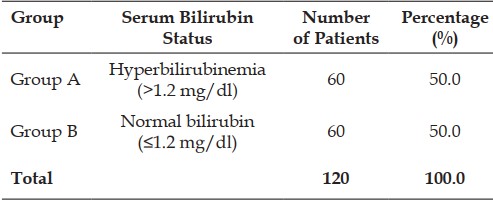
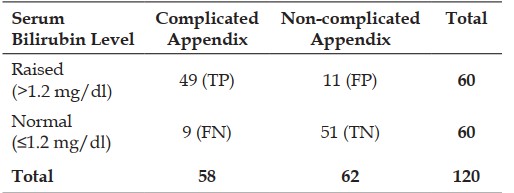
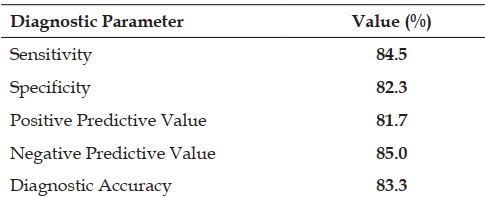
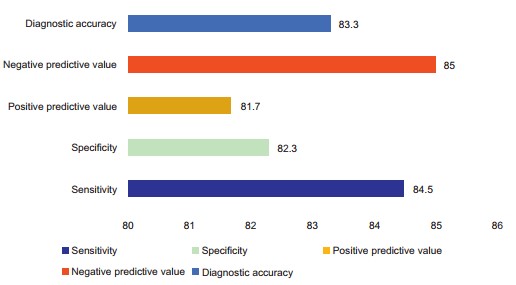
Context: The risk of perforation and necrosis is elevated by delayed diagnosis of acute appendicitis, which is the most prevalent surgical emergency. The clinical relevance of identifying a simple biochemical marker for the early detection of complicated appendicitis remains intact. Aims: To study the relationship between hyperbilirubinemia and acute appendicitis and to evaluate its usefulness as a diagnostic marker for complicated appendicitis, and to differentiate appendicitis from other causes of right iliac fossa pain. Settings and Design: A prospective observational study was conducted at a tertiary care teaching hospital in India. Methods and Material: One hundred twenty patients with right iliac fossa pain were enrolled. Patients were categorized into two groups according to serum bilirubin levels: hyperbilirubinemia (>1 mg/dl) and normal bilirubin (≤1 mg/dl). Operative findings and histology were regarded as the gold standard. Statistical Analysis Used: Chi-square test and diagnostic accuracy measures. Results: Hyperbilirubinemia demonstrated a statistically significant correlation with complex appendicitis (p < 0.001). Serum bilirubin exhibited significant sensitivity and negative predictive value in predicting complicated appendicitis. Conclusions: Hyperbilirubinemia is a valuable adjunctive diagnostic marker for complicated appendicitis; nevertheless, its limited specificity diminishes its capacity to reliably differentiate appendicitis from non-appendicular pathology. Key Messages 1. Hyperbilirubinemia has a significant association with complicated appendicitis. 2. Normal bilirubin levels can help distinguishing severe appendicitis due to high negative predictive value. 3. Serum bilirubin is a simple, cost-effective adjunct in pre-operative assessment.
References
- 1. Chaudhary, P., Kumar, A., Saxena, N., & Biswal, U. C. (2013). Hyperbilirubinemia as a predictor of gangrenous/perforated appendicitis: A prospective study. Annals of Gastroenterology, 26(4), 325–331.
- 2. Sand, M., Bechara, F. G., Holland-Letz, T., Sand, D., Mehnert, G., & Mann, B. (2009). Diagnostic value of hyperbilirubinemia as a predictive factor for appendiceal perforation in acute appendicitis. American Journal of Surgery, 198(2), 193–198. https://doi.org/10.1016/j.amjsurg.2008.08.026.
- 3. Bakshi, S., & Mandal, N. (2021). Evaluation of role of hyperbilirubinemia as a new diagnostic marker of complicated appendicitis. BMC Gastroenterology, 21(1), 42. https://doi.org/10.1186/s12876-021-01614-x.
- 4. Khan, S. (2006). Evaluation of hyperbilirubinemia in acute inflammation of appendix: A prospective study of 45 cases. Kathmandu University Medical Journal, 4(3), 281–289.
- 5. Paidipelly, K. K., & S., S. (2018). Risk factors of acute and perforated appendicitis in a semi-rural population: A retrospective study. International Surgery Journal, 5(7), 2432–2436. https://doi. org/10.18203/2349-2902.isj20182488
- 6. Chandel, U. K., Sharma, D., Surinder, S., & Malhotra, P. (2016). Evaluation of hyperbilirubinaemia as a new diagnostic marker for acute appendicitis and its role in prediction of appendicular perforation. Surgical Review: International Journal of Surgery, Trauma and Orthopedics, 2(4), 71–78. https://doi.org/10.17511/ijoso.2016.i04.04.
- 7. Mir, F. A., Aara, S., Jan, M., & Wani, N. A. (2017). Diagnostic value of serum hyperbilirubinemia in acute appendicitis and its complications. International Surgery Journal, 4(5), 1710– 1714. https://doi.org/10.18203/2349-2902.isj20171626.
- 8. Cardall, T., Glasser, J., & Guss, D. A. (2004). Clinical value of the total white blood cell count and temperature in the evaluation of patients with suspected appendicitis. Academic Emergency Medicine, 11(10), 1021–1027. https://doi.org/10.1197/j.aem.2004.04.011.
- 9. West, W. M., Brady-West, D. C., McDonald, A. H., Hanchard, B., & Fearon-Boothe, D. (2006). Ultrasound and white blood cell counts in suspected acute appendicitis. West Indian Medical Journal, 55(2), 100–102. https://doi.org/10.1590/s0043-31442006000200007.
- 10. Khan, S. (2009). The diagnostic value of hyperbilirubinemia and total leucocyte count in the evaluation of acute appendicitis. Journal of Clinical and Diagnostic Research, 3, 1647– 1652.
- 11. Atahan, K., Üreyen, O., Aslan, E., Deniz, M., Çökmez, A., Gür, S., Avci, A., & Tarcan, E. (2011). Preoperative diagnostic role of hyperbilirubinaemia as a marker of appendix perforation. Journal of International Medical Research, 39(2), 609–618. https://doi.org/10.1 177/147323001103900230.
- 12. Emmanuel, A., Murchan, P., Wilson, I., & Balfe, P. (2011). The value of hyperbilirubinaemia in the diagnosis of acute appendicitis. Annals of the Royal College of Surgeons of England, 93(3), 213–217. https://doi.org/10.1308/147870811X566402.
Data Sharing Statement
There are no additional data available. All raw data and code are available upon request.
Funding
This research received no funding.
Author Contributions
All authors contributed significantly to the work and approve its publication.
Ethics Declaration
This article does not involve any human or animal subjects, and therefore does not require ethics approval.
Acknowledgements
We would like to express our gratitude to the patients, their families, and all those who have contributed to this study.
Conflicts of Interest
No conflicts of interest in this work.
About this article

Cite this article
Prateek Mangal, Mohammad Salim, Lokesh K. Meena, et al. Evaluation of Hyperbilirubinemia as a Diagnostic Marker for Complicated Appendicitis and Other Causes of Right Iliac Fossa Pain. New Indian J Surg. 2025; 17(2): 43-47.
Licence:
Attribution-Non-commercial 4.0 International (CC BY-NC 4.0)This license
enables reusers to distribute, remix, adapt, and build upon the material in any
medium or format for noncommercial purposes only, and only so long as
attribution is given to the creator.
| Received | Accepted | Published |
|---|---|---|
| April 25, 2026 | May 28, 2026 | June 30, 2026 |
DOI: https://doi.org/10.21088/nijs.0976.4747.17226.1
Keywords
HyperbilirubinemiaAcute appendicitisComplicated appendicitisRight iliac fossa painSearch for Similar Articles
Similar Articles
- Laparoscopy-Guided Bilateral Oblique Subcostal Transversus Abdominis Plane Bloc...
- Recognizing the Columnar Cell Subtype of Papillary Thyroid Carcinoma: A Case Rep...
- Randomized Controlled Study To Compare Intraperitoneal Plus Port-Site Instillat...
- Single Preoperative Dose Versus Conventional Multidose Antibiotic Prophylaxis In...
- To Compare the Dissection of Gallbladder by Ultrasonic Harmonic Scalpel Versus...
Article Level Metrics
Last UpdatedTuesday 29 September 2026, 14:03:11 (IST)
5230
Accesses
23
437
00
Citations
NA
NA
NA
Download citation
Article Keywords
Keyword Highlighting
Highlight selected keywords in the article text.
Timeline
| Received | April 25, 2026 |
| Accepted | May 28, 2026 |
| Published | June 30, 2026 |
licence
Attribution-Non-commercial 4.0 International (CC BY-NC 4.0)
This license
enables reusers to distribute, remix, adapt, and build upon the material in any
medium or format for noncommercial purposes only, and only so long as
attribution is given to the creator.