Full Text (PDF)
Indian Journal of Anesthesia and Analgesia 9(3):p 137-139, May-June 2022. | DOI: https://doi.org/10.21088/ijaa.2349.8471.9322.13
Case Report
Erector Spinae Block for thoracic Trauma
Ravi Madhusudhana null, Rahul Kurra 1 null, Ravi Madhusudhana 2 null, Sumanth T3 null
Author Information
Licence:
Attribution-Non-commercial 4.0 International (CC BY-NC 4.0)This license enables reusers to
distribute, remix, adapt, and build upon the material in any medium or format
for noncommercial purposes only, and only so long as attribution is given to
the creator.
Indian Journal of Anesthesia and Analgesia 9(3):p 137-139, May-June 2022. | DOI: https://doi.org/10.21088/ijaa.2349.8471.9322.13
How Cite This Article:
Rahul Kurra, Ravi Madhusudhana, Sumanth T/Erector Spinae Block for thoracic Trauma/Indian J Anesth Analg. 2022;9(3):137-139.
Timeline
Received : April 12, 2022
Accepted : May 03, 2022
Published : June 20, 2022
Abstract
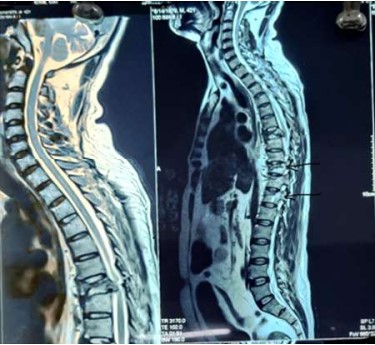
Introduction: Anesthesiologists face a difficult task in managing pain in trauma patients with acute rib and spine fractures, and attaining appropriate analgesia is critical in minimizing pulmonary consequences. Erector spinae plane (ESP) blocks are a type of localized anaesthetic that can be used to treat pain. Case Report: After falling off his bike, a 42-year-old man suffered several rib and spine fractures. His injuries included fractures of the D4, D5, D8, D11, and D12 vertebral bodies, as well as fractures of the pedicle and spinous process of the D7 and D9 vertebrae, as well as comminuted fractures of the D7 and D10 vertebral bodies. The decision to proceed with bilateral ESP block was made. A right-sided ESP block was conducted. On presentation, the patient was in excruciating pain due to multiple rib and spine fractures, and was experiencing pain-related decreased respiratory effort. After receiving an ESP block, the patient's pain gradually subsided, and his respiratory effort improved, and he was managed conservatively in the hospital until he was taken for surgical intervention. Conclusion: A novel myofascial plane block for thoracic analgesia is the ultrasound-guided erector spinae plane block (ESP). It allows patients to cough and breathe deeply while also reducing the length of time they are on mechanical ventilation.
References
- 1. M. Forero, S. D. Adhikary, H. Lopez, C. Tsui, and K. J. Chin,“The erector spinae plane block a novel analgesic techniquein thoracic neuropathic pain,” Reg Anesth Pain Med 2016;41: 621–627.
- 2. D. L. Hamilton and B. Manickam, “Erector spinae plane block for pain relief in ribfractures,” Br. J.
- 3. M. Forero, M. Rajarathinam, S. Adhikary, and K. J. Chin,“Erectorspinae plane (ESP) blockin the management of post thoracotomy pain syndrome: a case series,” Scand. J. Pain2017;17: 325–329.
- 4. K. J. Chin, L. Malhas, and A. Perlas, “The erector spinaeplane block provides visceral abdominal analgesia in bariatric surgery: a report of 3 cases,” RegAnesth Pain Med, 2017; 42:372–376,2017.
- 5. J. P. Melvin, R. J. Schrot, G. M. Chu, and K. J. Chin, “Lowthoracic erector spinae plane block for perioperative analgesiain lumbosacral spine surgery: a case series,” Can J Anaesth, 2018 ; 65:1057–1065.
- 6. S. D. Adhikary, S. Bernard, H. Lopez, and K. J. Chin, “Erector spinae plane block versusretrolaminar
- 7. Adhikary SD, Liu WM, Fuller E, Cruz Eng H, Chin KJ. The effect of erector spinae plane block on respiratory and analgesic outcomes in multiple rib fractures: a retrospective cohort study. Anaesthesia. 2019 ;74:585-93.
Data Sharing Statement
There are no additional data available. All raw data and code are available upon request.
Funding
This research received no funding.
Author Contributions
All authors contributed significantly to the work and approve its publication.
Ethics Declaration
Provide information related to the Ethics Committee approval with approval number OR write, This article does not involve any human or animal subjects, and therefore does not require ethics approval.
Acknowledgements
We would like to express our gratitude to the patients, their families, and all those who have contributed to this study.
Conflicts of Interest
The authors report no conflicts of interest in this work.
About this article

Cite this article
Rahul Kurra, Ravi Madhusudhana, Sumanth T/Erector Spinae Block for thoracic Trauma/Indian J Anesth Analg. 2022;9(3):137-139.
Licence:
Attribution-Non-commercial 4.0 International (CC BY-NC 4.0)This license enables reusers to
distribute, remix, adapt, and build upon the material in any medium or format
for noncommercial purposes only, and only so long as attribution is given to
the creator.
| Received | Accepted | Published |
|---|---|---|
| April 12, 2022 | May 03, 2022 | June 20, 2022 |
DOI: https://doi.org/10.21088/ijaa.2349.8471.9322.13
Keywords
ErectorSpinaeblock;horacictraumaSearch for Similar Articles
Similar Articles
- Awake Fibreoptic Intubation for Airway Management in Massive Thyroid Enlargement...
- A Case of Thoracotomy with One Lung Ventilation for Carcinoma Oesophagus
- A Case of Empyema for Thoracotomy and Decortication-Anaesthesia Management
- Full Mouth Rehabilitation in a 3-Year-Old Female Child with Repaired Tetralogy o...
- Do Gel Manicures Affect SpO2 Readings ? A Clinical Investigation
Article Level Metrics
Last UpdatedFriday 11 September 2026, 04:42:30 (IST)
9033
Accesses
9
803
00
Citations
NA
NA
NA
Download citation
Article Keywords
Keyword Highlighting
Highlight selected keywords in the article text.
Timeline
| Received | April 12, 2022 |
| Accepted | May 03, 2022 |
| Published | June 20, 2022 |
licence
Attribution-Non-commercial 4.0 International (CC BY-NC 4.0)
This license enables reusers to
distribute, remix, adapt, and build upon the material in any medium or format
for noncommercial purposes only, and only so long as attribution is given to
the creator.