Full Text (PDF)
Indian Journal of Forensic Medicine and Pathology 11(1):p 5-9, January - March 2018. | DOI: 10.21088/ijfmp.0974.3383.11118.1
Original Article
Demography of Suicide in Coastal Region of Odisha: An Autopsy Based Study
Jyotish Ch. Choudhury, Amarendra Nayaka
Author Information
Licence:
Attribution-Non-commercial 4.0 International (CC BY-NC 4.0)This license enables reusers to distribute, remix, adapt, and build upon the material in any medium or format for noncommercial purposes only, and only so long as attribution is given to the creator
Indian Journal of Forensic Medicine and Pathology 11(1):p 5-9, January - March 2018. | DOI: 10.21088/ijfmp.0974.3383.11118.1
How Cite This Article:
Timeline
Received : November 06, 2017
Accepted : December 08, 2017
Published : December 30, 2017
Abstract
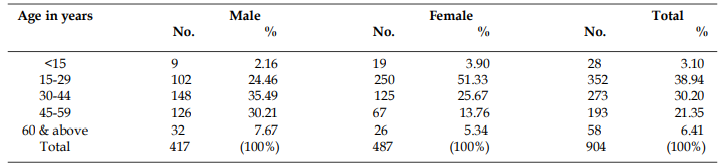
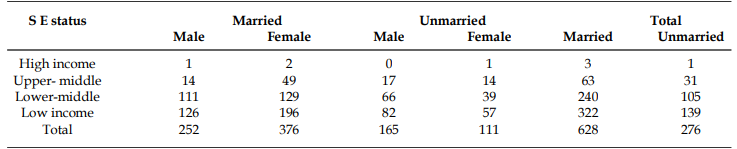
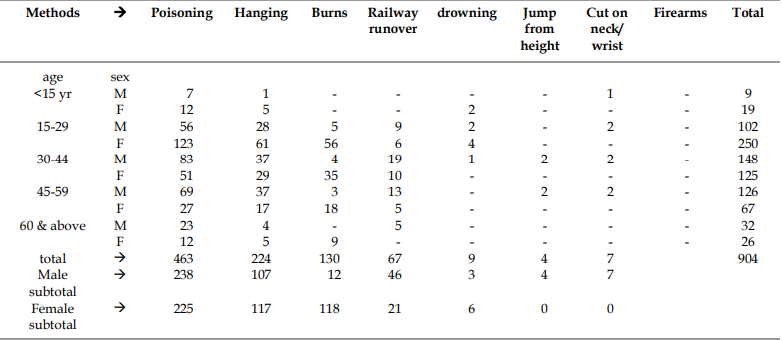
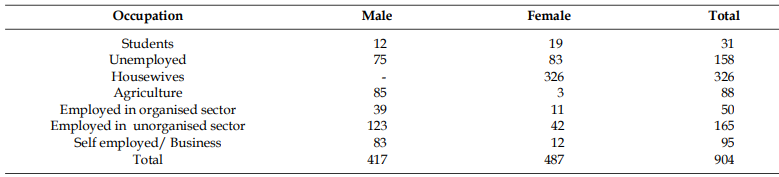
Introduction: Suicide being a major contributor to fatality world over still remains an enigma for the manyscholars who have devoted time and resources to unravel its secrets. As per WHO, there occurs one suicidal death every 40 seconds. Materials and Methods: A prospective autopsy based study was conducted over a 3 year period from 2014-2016 in S.C.B. Medical College and Hospital, Cuttack and a total of 904 cases of suicidal deaths were studied using a specially devised questionnaire. Multiple social, biological and psychological factors were taken into account. Result: It revealed a male to female ratio in completed suicides of 1:1.17 and 69.14% suicides to be in the age group of 15-44 years. The victims predominantly belonged to lower income groups followed by those from lower middle class. Married females clearly outnumbered the married males. Males were seen to be more vulnerable when living in a nuclear setup. Poisoning followed by hanging was found to be the most preferred methods to commit suicide. Housewives contributed heavily to the total case load. It was found that persons with a regular employment were least likely to commit suicid
References
- 1. World Health Organization. World health statistics 2017. Geneva: World Health Organization; 2017.
- 2. National Crime Records Bureau. Accidental deaths & suicides in India 2014. New Delhi: Ministry of Home Affairs, Government of India; 2015.
- 3. Azmak AD. Suicides in Trakya Region, Turkey. Med Sci Law. 2006;46(1):19-30.
- 4. Khajuria B. Profile of suicidal autopsies in a militancy affected state of India. J Clin Diagn Res. 2007;1(6):505-10.
- 5. Lalwani S, Sharma GS, Kabra SK, Girdhar S, Dogra TD. Suicide among children and adolescents in South Delhi (1991-2000). Indian J Pediatr. 2004;71(8):701-3.
- 6. Bhugra D, Desai MI, Baldwin S. Attempted suicide in West London, incidence rates across ethnic communities. Psychol Med. 1999;29(5):1125-30.
- 7. National Crime Records Bureau. Accidental deaths & suicides in India 2012. New Delhi: Ministry of Home Affairs, Government of India; 2013.
- 8. Kanchan T, Menezes RG. Suicidal poisoning in Southern India: gender differences. J Forensic Leg Med. 2008;15(1):7-14.
- 9. Vijayakumar L. Indian research on suicide. Indian J Psychiatry. 2010;52(Suppl 1):S291-6.
- 10. Patel V, Ramasundarahettige C, Vijayakumar L, Thakur JS, Gajalakshmi V, Gururaj G, et al. Suicide mortality in India: a nationally representative survey. Lancet. 2012;379(9834):2343-51.
- 11. Murty OP, Cheh LB, Bakit PA, Hui FJ, Ibrahim ZB, Nazirah B. Suicide and ethnicity in Malaysia. Am J Forensic Med Pathol. 2008;29(1):19-22.
- 12. Meera TH, Singh MBK. Pattern of neck findings in suicidal hanging – a study in Manipur. J Indian Acad Forensic Med. 2011;33(4):352-4.
- 13. Shukla GD, Verma BL, Mishra DN. Suicide in Jhansi city. Indian J Psychiatry. 1990;32(1):44-51.
- 14. Sharma R, Vijayakumar L, Chaturvedi S. Suicidal behaviour amongst adolescent students in South Delhi. Indian J Psychiatry. 2008;50(1):30-3.
- 15. Soreff SM. Suicide attempts. Biol Psychiatry. 2004;55(1):46.
- 16. Gururaj G, Isaac MK, Subbakrishna DK, Ranjani R. Case control study of completed suicides in Bangalore, India. Inj Control Saf Promot. 2004;11(3):193-200.
- 17. Chavan BS, Singh GP, Kaur J, Kochar R. Psychological autopsy of 101 suicide cases from northwest region of India. Indian J Psychiatry. 2008;50(1):34-8.
- 18. Prajapati P, Prajapati S, Pandey A, Joshi V, Prajapati N. Pattern of suicidal deaths in females of South Gujarat region. Natl J Med Res. 2012;2(1):31-4.
- 19. Khan MM, Reza H. The pattern of suicide in Pakistan. Crisis. 2000;21(1):31-5.
- 20. Patel SP, Gaw AC. Suicide among immigrants from the Indian subcontinent. Psychiatr Serv. 1996;47(5):517-21.
- 21. Arun M, Yoganarasimha K, Kar N, Palimar V, Mohanty MK. A comparative analysis of suicide and parasuicide in India. Med Sci Law. 2007;47(4):335-40.
- 22. Chakrabarti NK. Socio-legal problem of suicide and its prevention: analysis of suicides in India. In: Proceedings of the 6th World Conference on Injury Prevention and Control. Montreal; 2002. p. 701-2.
- 23. Williams JMG, Pollock LR. Factors mediating suicidal behaviour: their utility in primary and secondary prevention. J Ment Health. 1993;2(1):23-6.
Data Sharing Statement
There are no additional data available. All raw data and code are available upon request.
Funding
This research received no funding.
Author Contributions
Whether all authors contributed significantly to the work and approve its publication.
Ethics Declaration
This article does not involve any human or animal subjects, and therefore does not require ethics approval.
Acknowledgements
We would like to express our gratitude to the patients, their families, and all those who have contributed to this study.
Conflicts of Interest
The authors report no conflicts of interest in this work.
About this article

Cite this article
Licence:
Attribution-Non-commercial 4.0 International (CC BY-NC 4.0)This license enables reusers to distribute, remix, adapt, and build upon the material in any medium or format for noncommercial purposes only, and only so long as attribution is given to the creator
| Received | Accepted | Published |
|---|---|---|
| November 06, 2017 | December 08, 2017 | December 30, 2017 |
DOI: 10.21088/ijfmp.0974.3383.11118.1
Keywords
SuicideDemographyMarital StatusFamily StructureOccupationSearch for Similar Articles
Similar Articles
- Diatom Analysis in Thermophilic water bodies: A Study on Hot Water Springs of Ma...
- Morphometric Study of Supra-meatal Triangle and Mastoid process in the Adult dry...
- Histopathological Spectrum of Autopsy Cases: A One Year Retrospective Observatio...
- Forensic Differentiation of Manner of Death in Railway Fatalities: A FourCase Se...
- Understanding assault Patterns: A Cross-sectional study of Cases at Chri, Kelamb...
Article Level Metrics
Last UpdatedMonday 19 October 2026, 18:37:37 (IST)
16355
Accesses
11
3216
00
Citations
NA
NA
NA
Download citation
Article Keywords
Keyword Highlighting
Highlight selected keywords in the article text.
Timeline
| Received | November 06, 2017 |
| Accepted | December 08, 2017 |
| Published | December 30, 2017 |
licence
Attribution-Non-commercial 4.0 International (CC BY-NC 4.0)
This license enables reusers to distribute, remix, adapt, and build upon the material in any medium or format for noncommercial purposes only, and only so long as attribution is given to the creator