Full Text (PDF)
Indian Journal of Forensic Medicine and Pathology 15(2):p 95-101, APRIL-JUNE 2022. | DOI: https://doi.org/10.21088/ijfmp.0974.3383.15222.5
Original Article
Correlation between Lip Print and Skeletal Malocclusion
Shoaib Ulla Khan, Kalashri K K, Goutham B, Sunil Muddaiah, Sanju Somaiah5
Author Information
Licence:
Attribution-Non-commercial 4.0 International (CC BY-NC 4.0)This license enables reusers to distribute, remix, adapt, and build upon the material in any medium or format for noncommercial purposes only, and only so long as attribution is given to the creator
Indian Journal of Forensic Medicine and Pathology 15(2):p 95-101, APRIL-JUNE 2022. | DOI: https://doi.org/10.21088/ijfmp.0974.3383.15222.5
How Cite This Article:
Kalashri KK, Khan SU, Goutham B, Muddaiah S, Somaiah S. Correlation between lip print and skeletal malocclusion. Indian J Forensic Med Pathol. 2022;15(2):95-101.Timeline
Received : February 09, 2022
Accepted : May 15, 2022
Published : June 30, 2022
Abstract
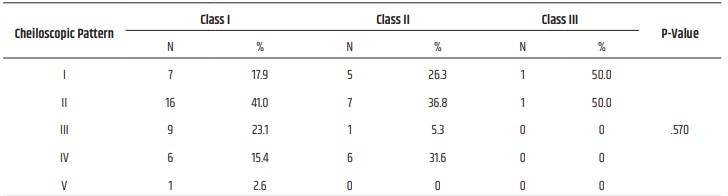
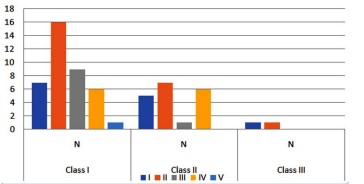
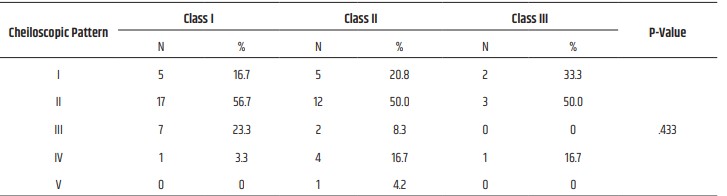
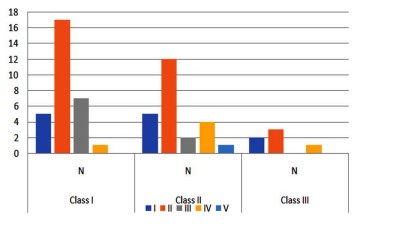
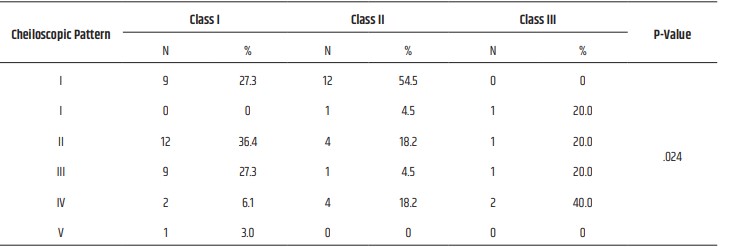
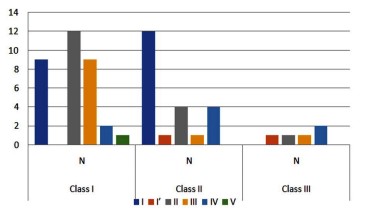
Introduction: Lip prints, like fingerprints, are unique to each person and are simple to record. Cheiloscopic analysis has been demonstrated to be effective in both judging deformity and identifying individuals. Many studies have been conducted on lip prints and its relationship with individual’s skeletal pattern. Aim: The goal of this study was to see if there was a link between lip print and skeletal malocclusion, as well as how reliable it was as a forensic tool for identifying people. Material & Method: Lip prints were collected from 180 people, 60 of whom were from Kerala, 60 from Karnataka, and 60 from Kodagu, regardless of their dental class I, class II, or class III malocclusion. Lip prints were captured using the lipstick cellophane method and categorised using Tsuchihashi’s categorization system: Type I, Type I’, Type II, Type III, Type IV, Type V. Results: We have noticed that the most common lip pattern among Karnataka and Coorg Population was type II and in Kerala population was type I. Conclusion: We conclude our research by stating that lip prints are a useful and important diagnostic tool for identifying individuals of various ethnic backgrounds, and that there is a strong correlation between skeletal growth patterns of various ethnicities and their lip patterns. .keywords | Cheiloscopy; Lip prints; Skeletal malocclusion; Forensic too
References
- 1. Molano MA, Gil JH, Jaramillo JA, Ruiz SM. Estudio queiloscópico en estudiantes de la facultad de odontología de la Universidad de Antíoquia. Rev Fac Odontol Univ Antioquia 2002; 14:29-37.
- 2. Sivapathasundharam B, Prakash PA, Sivakumar G. Lipprints (cheiloscopy). Indian J Dent Res 2001; 149:129-32.
- 3. Kaur I, Cheema JK. Assessment of pattern of lip prints in patients with oral premalignant lesions. J Adv Med Dent Sci Res 2018; 6:8-11.
- 4. Tsuchihashi Y. Studies on personal identification by means of lip prints. Forensic Sci 1974; 3:233-48.
- 5. Mossey, P.A. The heritability of malocclusion: part 2. The influen¬ce of genetics in malocclusion. Br J Orthod 1999; 26:195-203.
- 6. Kulkarni N, Vasudevan SD, Shah R, et al. Cheiloscopy: a new role as a marker of sagittal jaw relation. J Forensic Dent Sci 2012; 4:6–12. DOI: 10.4103/0975- 1475.99152.
- 7. Vahanwala SP, Parekh BK. Study of lip prints as an aid to forensic methodology. J Indian Dent Assoc 2000; 71:16-9.
- 8. Verghese AJ, Somasekar M, Umesh Babu R. A study on lip print types among the people of Kerala. J Indian Acad Forensic Med 2010; 32:6-7.
- 9. Kaushal B, Mittal S, Aggarwal I. association of lip print patterns with sagittal malocclusions in district Solan population. Int J Res Health Allied Sci 2018; 4:75-81.
- 10. Raghav P, Kumar N, Shingh S, Ahuja N, Ghalaut P. Lip prints: The barcode of skeletal malocclusion. J Forensic Dent Sci. 2013;5(2):110.
- 11. Aditi S, Tikku T, Khanna R, Maurya RP Srivastava K. Chelioscopy:Association of lip prints in different skeletal malocclusions. Int J Orthod Rehabil. 2019;10:156–60.
- 12. Verma Y, Einstein A, Gondhalekar R, Verma A, George J, Chandra S, et al. A study of lip prints and its reliability as a forensic tool. Natl J Maxillofac Surg. 2015;6(1):25.
- 13. Ravindran V, Rekha CV, Annamalai S, Sharmin DD, NorouziBaghkomeh P. A comparative evaluation between cheiloscopic patterns and the permanent molar relationships to predict the future malocclusions. J Clin Exp Dent. 2019;11(6):e553–7.
- 14. Anuradha Pandey, Naveen Kumar, Aaysha Tabinda nabi, Kumari Kavitha, Pallawee Choudhary Rachana Raj. Correlation between lip print patterns and skeletal class I and II malocclusions-a tool to diagnose early. J Fam Med Prim care. 2020;9:39– 43.
- 15. Srinivasan I, Lalitya D, Allani S, Setty J V, Jawa A. Determination of Relationship between Lip Prints and Skeletal Malocclusion in Children of Age 9–14 Years. Int J Clin Pediatr Dent. 2019;12(6):494–9.
Funding
This research received no funding.
Author Contributions
All authors contributed significantly to the work and approve its publication.
Ethics Declaration
This article does not involve any human or animal subjects, and therefore does not require ethics approval.
Acknowledgements
We would like to express our gratitude to the patients, their families, and all those who have contributed to this study.
Conflicts of Interest
No conflicts of interest in this work.
About this article

Cite this article
Kalashri KK, Khan SU, Goutham B, Muddaiah S, Somaiah S. Correlation between lip print and skeletal malocclusion. Indian J Forensic Med Pathol. 2022;15(2):95-101.
Licence:
Attribution-Non-commercial 4.0 International (CC BY-NC 4.0)This license enables reusers to distribute, remix, adapt, and build upon the material in any medium or format for noncommercial purposes only, and only so long as attribution is given to the creator
| Received | Accepted | Published |
|---|---|---|
| February 09, 2022 | May 15, 2022 | June 30, 2022 |
DOI: https://doi.org/10.21088/ijfmp.0974.3383.15222.5
Keywords
CheiloscopyLip printsSkeletal malocclusionForensic toolSearch for Similar Articles
Similar Articles
- Diatom Analysis in Thermophilic water bodies: A Study on Hot Water Springs of Ma...
- Morphometric Study of Supra-meatal Triangle and Mastoid process in the Adult dry...
- Histopathological Spectrum of Autopsy Cases: A One Year Retrospective Observatio...
- Forensic Differentiation of Manner of Death in Railway Fatalities: A FourCase Se...
- Understanding assault Patterns: A Cross-sectional study of Cases at Chri, Kelamb...
Article Level Metrics
Last UpdatedSunday 18 October 2026, 12:21:17 (IST)
16262
Accesses
11
3205
00
Citations
NA
NA
NA
Download citation
Article Keywords
Keyword Highlighting
Highlight selected keywords in the article text.
Timeline
| Received | February 09, 2022 |
| Accepted | May 15, 2022 |
| Published | June 30, 2022 |
licence
Attribution-Non-commercial 4.0 International (CC BY-NC 4.0)
This license enables reusers to distribute, remix, adapt, and build upon the material in any medium or format for noncommercial purposes only, and only so long as attribution is given to the creator