Full Text (PDF)
Indian Journal of Forensic Medicine and Pathology 17(3):p 153-159, July- September 2024. | DOI: https://doi.org/10.21088/ijfmp.0974.3383.17324.1
Original Article
Comprehensive Analysis of Drowning Fatalities: A Prospective Autopsy Study at GMC Purnea Bihar
Author Information
Licence:
Attribution-Non-commercial 4.0 International (CC BY-NC 4.0)This license enables reusers to distribute, remix, adapt, and build upon the material in any medium or format for noncommercial purposes only, and only so long as attribution is given to the creator.
Indian Journal of Forensic Medicine and Pathology 17(3):p 153-159, July- September 2024. | DOI: https://doi.org/10.21088/ijfmp.0974.3383.17324.1
How Cite This Article:
Kumar P, Wahab A. Comprehensive Analysis of Drowning Fatalities: A Prospective Autopsy Study at GMC Purnea Bihar. Indian J Forensic Med Pathol. 2024;17(3):153-159.Timeline
Received : April 12, 2024
Accepted : July 22, 2024
Published : September 30, 2024
Abstract
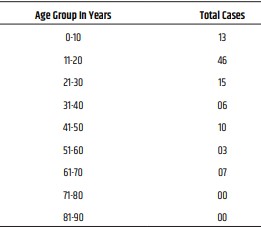
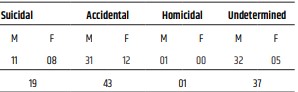
Background: Drowning is a significant cause of mortality worldwide, necessitating comprehensive investigations. This prospective autopsy study aimed to analyze drowning fatalities comprehensively, focusing on demographic, circumstantial, and forensic aspects. Methods: Conducted at GMC Purnea Bihar from Jan to Dec 2023, the study included 100 drowning cases. Approval was obtained from the Institutional Ethics Committee. Data were systematically collected and analyzed using descriptive statistics. Results: Among 100 cases, males predominated (88%), with individuals aged 11-20 years most affected (46%). Accidental drownings were common (43%), followed by suicidal cases (19%) and undetermined incidents (37%). Postmortem findings included froth from the mouth, washer woman’s hands and feet, and internal petechial hemorrhages. Most incidents occurred in lakes and rivers (92%), with heightened risk during the rainy season. Ethanol positivity was noted in 43% of cases, and males exhibited higher lung weights than females. Conclusion: The study provides insights into drowning incidents, highlighting demographic disparities and seasonal variations. Enhanced preventive measures and awareness campaigns are crucial to mitigate drowning-related fatalities. Addressing identified risk factors is essential for community safety.
References
- 1. Brundtl and GH. From WHO Reducing risks to health, promoting healthy life. JAMA 2002; 288(16):1974.
- 2. The George Institute for Global Health. (2020). 2020 Annual Report. https://www. georgeinstitute.org/sites/ default/files/annual-reports/ tgi-india-20ar.pdf.
- 3. Peden MM, Mc Gee K. The epidemiology of drowning worldwide. Inj Control SafPromot 2003; 10(4):195-9.
- 4. Mukherjee AA, Dhawane SG, Dhoble SV. Medico legal study of drowning deaths: a forensic perspective. Journal of Research in Forensic Medicine and Toxicology; Vol 2, Issue 1, Jan-June 2016; Page 1-4.
- 5. New Indian Express. (2023, December 16). Around 38,000 Indians die of drowning every year; 5 to 14 years at higher risk: Centre. Retrieved from https:// w w w. n e w i n d i a n e x p re s s. com/nation/2023/Dec/16/ around-38000-indians-dieof-drowning-every-year-5- to-14-years-at-higher-riskcentre-2642179.html.
- 6. Mason JK. The pathology of trauma 2nd ed. Edward Arnold 1993:204-26.
- 7. Modi JP. Textbook of Medical Jurisprudence and Toxicology, 21st ed. N.M.Tripathi Private Ltd 1996:188- 220.
- 8. Dr. Tanuj Kanchan, Dr. Prateekrastogi, Dr. Manoj Kumar Mohanty, Profile of near drowning victims in coastal region of Karnataka, JIAFM,2007;29(4).
- 9. Roger W. Byard, M.D. Gillian Houldsworth, Ross A. James and John D. Gilbert, Characteristic Featuresof Suicidal Drowning A 20year study, The American Journal of Forensic Medicine and Pathology 2001;22(2):134-138.
- 10. Davoudi-Kiakalayeh A, Mohammadi R, StarkEkman D, YousefzadeChabok S, Behboudi F, Jamson B. Estimating drowning deaths in Northern Iran using capture-recapture method. Health Policy 2011:100(2- 3):290-296.
- 11. Ardeshir S, Mohammad H G, Epidemiology of Drowning in Isfahan Province, cener of Iran. J. Res Med Sci.2009, MarchApril;13(2):79-87.
- 12. Sayed ZAT, Farhat HM, Hamid AP. Medico legal investigation of violent asphyxial deaths– an autopsy based study. Journal of the Dow University of Health Sciences, Karachi 2012;6(3):86-90.
- 13. Vijay C, Prashant B, Ajay S. Violent asphyxial deaths in rural area of Maharashtra. Indian Journal of Forensic Medicine and Pathology 2009;2(4):161-4.
- 14. Singh A, Goria RK. A study of demographic variables of violent asphyxial death. JPAFMAT 2003;3:22-5.
- 15. Salachin S. An analysis of the medico legal autopsies performed in adana, Turkey, in 1983- 1988. American Journal of Forensic Med and Pathology 1991;12(3):191- 93.
- 16. Gross VA, Weiss MG, Ring M, et al. Method of suicide: international suicide patterns derived from WHO mortality database. Available at: www. unece.org/trans/conventn/ distsigns.pdf. 17. Momamchand A. Violent asphyxial deaths in imphal. Journal of Forensic Medicine & Toxicology 1998;15(1):60-4.
- 18. Reddy SP, Kumar R, Rudramurthy. Asphyxial deaths at district hospital, Tumkur a retrospective study. J Indian Acad Forensic Med 2012;34(2):146-147.
- 19. Chidanand C, Satish K.V. Study of incidence of middle ear hemorrhage in drowning. Journal of evidence based Medicine and Health care: 2(6) Feb 09,2015;621-628.
- 20. Prabir et al. Histopathological changes in lungs and spleen in cases of drowning with demographic variability, European Journal of Biomedical and Pharmaceutical Sciences, 2015 2(2):479-485.
- 21. Girela-López E, Beltran-Aroca CM, Dye A, Gill JR. Epidemiology and autopsy findings of 500 drowning deaths. Forensic Sci Int. 2022 Jan;330:111137. doi: 10.1016/j. forsciint.2021.111137.
- 22. B. Kringsholm, A. Filskov, K. Kock, Autopsied cases of drowning in Denmark 1987- 1989, Forensic Sci. Int. 52 (1991) 85–92.
- 23. P. Lunetta, G.S. Smith, A. Penttilä, A. Sajantila, Unintentional drowning in Finland 1970-2000: a population-based study, Int. J. Epidemiol. 33 (2004) 1053–1063.
- 24. Lunetta P, Penttila A, Sajantila A. Circumstances and macropathologic findings in 1590 consecutive cases of bodies found in water. Am J Forensic Med Pathol. 2002 Dec;23(4):371-6. doi: 10.1097/00000433- 200212000-00015.
- 25. Di Maio, D. J., & Di Maio, V. J. (2001). Forensic Pathology (2nd ed.). CRC Press.
- 26. Byard RW. Drowning and near drowning - definitions and terminology. Forensic Sci Med Pathol. 2017 Dec;13(4):529-530. doi: 10.1007/s12024-017-9890-5.
- 27. Ho KC, Roessmann U, Straumfjord JV, Monroe G. Analysis of brain weight. I. Adult brain weight in relation to sex, race, and age. Arch Pathol Lab Med. 1980 Dec;104(12):635-9.
- 28. Thurlbeck WM, Angus GE. Growth and aging of the normal human lung. Chest. 1975 Feb;67(2 Suppl):3S-6S. doi: 10.1378/ chest.67.2_supplement.3s.
- 29. Grandmaison GL, Clairand I, Durigon M. Organ weight in 684 adult autopsies: new tables for a Caucasoid population. Forensic Sci Int. 2001 Jun 15;119(2):149-54. doi: 10.1016/ s0379-0738(00)00401-1.
- 30. Mubbunu L, Bowa K, Petrenko V, Silitongo M. Correlation of Internal Organ Weights with Body Weight and Body Height in Normal Adult Zambians: A Case Study of Ndola Teaching Hospital. Anat Res Int. 2018 Apr 18;2018:4687538. doi: 10.1155/2018/4687538.
Data Sharing Statement
There are no additional data available.
Funding
This research received no funding.
Author Contributions
All authors contributed significantly to the work and approve its publication.
Ethics Declaration
This article does not involve any human or animal subjects, and therefore does not require ethics approval.
Acknowledgements
We extend our gratitude to the staff in the Department of Forensic Medicine & Toxicology, GMC Purnea Bihar, for their support and cooperation during the conduct of this study.
Conflicts of Interest
No conflicts of interest in this work.
About this article

Cite this article
Kumar P, Wahab A. Comprehensive Analysis of Drowning Fatalities: A Prospective Autopsy Study at GMC Purnea Bihar. Indian J Forensic Med Pathol. 2024;17(3):153-159.
Licence:
Attribution-Non-commercial 4.0 International (CC BY-NC 4.0)This license enables reusers to distribute, remix, adapt, and build upon the material in any medium or format for noncommercial purposes only, and only so long as attribution is given to the creator.
| Received | Accepted | Published |
|---|---|---|
| April 12, 2024 | July 22, 2024 | September 30, 2024 |
DOI: https://doi.org/10.21088/ijfmp.0974.3383.17324.1
Keywords
DrowningAutopsyEpidemiologyCyanosisPulmonary edemaSearch for Similar Articles
Similar Articles
- Diatom Analysis in Thermophilic water bodies: A Study on Hot Water Springs of Ma...
- Morphometric Study of Supra-meatal Triangle and Mastoid process in the Adult dry...
- Histopathological Spectrum of Autopsy Cases: A One Year Retrospective Observatio...
- Forensic Differentiation of Manner of Death in Railway Fatalities: A FourCase Se...
- Understanding assault Patterns: A Cross-sectional study of Cases at Chri, Kelamb...
Article Level Metrics
Last UpdatedMonday 19 October 2026, 10:55:35 (IST)
16327
Accesses
98
3215
00
Citations
NA
NA
NA
Download citation
Article Keywords
Keyword Highlighting
Highlight selected keywords in the article text.
Timeline
| Received | April 12, 2024 |
| Accepted | July 22, 2024 |
| Published | September 30, 2024 |
licence
Attribution-Non-commercial 4.0 International (CC BY-NC 4.0)
This license enables reusers to distribute, remix, adapt, and build upon the material in any medium or format for noncommercial purposes only, and only so long as attribution is given to the creator.