Full Text (PDF)
Indian Journal of Forensic Medicine and Pathology 15(3):p 175-179, July-September 2022. | DOI: https://doi.org/10.21088/ijfmp.0974.3383.15322.6
Original Article
Comparative Study of Bilateral Symmetry in Dermatoglyphic Patterns with reference to Geographical Parameters
Author Information
Licence:
Attribution-Non-commercial 4.0 International (CC BY-NC 4.0)This license enables reusers to distribute, remix, adapt, and build upon the material in any medium or format for noncommercial purposes only, and only so long as attribution is given to the creator
Indian Journal of Forensic Medicine and Pathology 15(3):p 175-179, July-September 2022. | DOI: https://doi.org/10.21088/ijfmp.0974.3383.15322.6
How Cite This Article:
Vaishali, Babu GR. Comparative study of bilateral symmetry in dermatoglyphic patterns with reference to geographical parameters. Indian J Forensic Med Pathol. 2022;15(3):175-179.Timeline
Received : May 04, 2022
Accepted : July 08, 2022
Published : September 30, 2022
Abstract
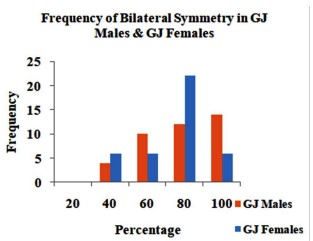
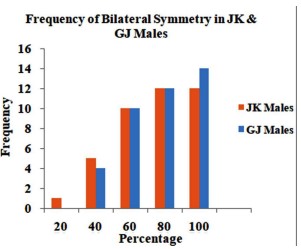
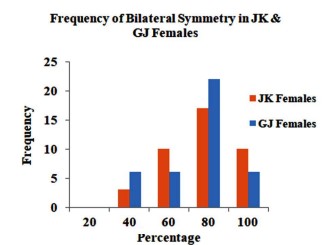
Introduction: The personal identification is reliable tool for both legal and societal motives in forensic discipline. The utmost conventional manner of identification of individuals is based on the fingerprints. The present study has been carried out on 200 subjects, 100 males and 100 females of different age groups belonging to range from 18-55 years of Jammu and Kashmir and Gujarat population to compare the differences in bilateral symmetry in dermatoglyphic patterns along with frequency distribution of patterns with reference to the geographical locations. The research recommends that there are significant differences in bilateral symmetry and fingerprint patterns between males and females within the two populations and significant differences are observed between the two populations. The predominant fingerprint pattern was Ulnar loop, followed by Whorl in both Jammu and Kashmir and Gujarat state. Moreover, it was observed that maximum inhabitants have 80% of Bilateral Symmetry in (40%) of the two populations followed by 100% (26%) of both Jammu and Kashmir and Gujarat populations.
References
- 1. (U.S.)., N. I. (2002). The Fingerprint Sourcebook. Washington, DC 20531: CreateSpace Independent Publishing.
- 2. Astha Pandey, J. M. (2014). A Comparative Case Study of Fingerprint Patterns in Male Convicts of Sabarmati Jail (Ahmedabad) in Gujarati Population. Indian Journal of Forensic Medicine & Toxicology.
- 3. Cummins, H. &. (1963). Finger Prints, Palms and Sole. Annals of Human Genetics, 72-75.
- 4. Eric H. Holder, J. (n.d.). The Fingerprint Sourcebook. National Institute of Justice.
- 5. Harold Cummins, W. J. (1941). The breadths of epidermal ridges on the finger tips and palms: A study of variation. American Journal of Anatomy.
- 6. Muralidhar Reddy Sangam, K. K. (2011). A Study of Finger Prints: Bilateral Asymmetry and Sex Difference in the Region of Andhra Pradesh. Journal of Clinical and Diagnostic Research, 597-600.
- 7. Nadezhda Petrova, E. A. (2022). Fingerprint Patterns and their Bilateral differences in Patients with Mental Disorders and Healthy Controls. J of IMAB, 3213.
- 8. Nithin MD, M. B. (2011). Gender differentiation by finger ridge count among South Indian population. J Forensic Leg Med, 18(2):79–81. doi:http://dx.doi. org/10.1016/j.jflm.2011.01.006
- 9. Parveen Ojha, G. G. (2014). Dermatoglyphic Study: A Comparison in Hands of Type II Diabetes Mellitus Patients and Normal Persons of Udaipur Region. Journal of Evolution of Medical and Dental Sciences, 11358-11368.
- 10. Sudha, S. I. (2012). Biometrics and Fingerprint Analysis. New Delhi: Selective and Selective Books.
- 11. Vaishali, G. R. (2021). Molecular Fingerprinting a new technique for Personal Identification: An Update. Indian Journal of Forensic Medicine and Pathology, 59-66.
- 12. Varun Parmar, R. B. (2012). A comparative study on the correlation of sex and age of individual with the ridge density and ridge width among Gujarati Population. J. Kar. Med.Leg. Soc, Vol 21 (02).
Data Sharing Statement
There are no additional data available. All raw data and code are available upon request.
Funding
This research received no funding.
Author Contributions
All authors contributed significantly to the work and approve its publication.
Ethics Declaration
This article does not involve any human or animal subjects, and therefore does not require ethics approval.
Acknowledgements
We would like to express our gratitude to the patients, their families, and all those who have contributed to this study.
Conflicts of Interest
No conflicts of interest in this work.
About this article

Cite this article
Vaishali, Babu GR. Comparative study of bilateral symmetry in dermatoglyphic patterns with reference to geographical parameters. Indian J Forensic Med Pathol. 2022;15(3):175-179.
Licence:
Attribution-Non-commercial 4.0 International (CC BY-NC 4.0)This license enables reusers to distribute, remix, adapt, and build upon the material in any medium or format for noncommercial purposes only, and only so long as attribution is given to the creator
| Received | Accepted | Published |
|---|---|---|
| May 04, 2022 | July 08, 2022 | September 30, 2022 |
DOI: https://doi.org/10.21088/ijfmp.0974.3383.15322.6
Keywords
FingerprintsPatternsBilateral SymmetryPatternsBilateral SymmetrySearch for Similar Articles
Similar Articles
- Diatom Analysis in Thermophilic water bodies: A Study on Hot Water Springs of Ma...
- Morphometric Study of Supra-meatal Triangle and Mastoid process in the Adult dry...
- Histopathological Spectrum of Autopsy Cases: A One Year Retrospective Observatio...
- Forensic Differentiation of Manner of Death in Railway Fatalities: A FourCase Se...
- Understanding assault Patterns: A Cross-sectional study of Cases at Chri, Kelamb...
Article Level Metrics
Last UpdatedSunday 18 October 2026, 08:53:52 (IST)
16253
Accesses
27
3204
00
Citations
NA
NA
NA
Download citation
Article Keywords
Keyword Highlighting
Highlight selected keywords in the article text.
Timeline
| Received | May 04, 2022 |
| Accepted | July 08, 2022 |
| Published | September 30, 2022 |
licence
Attribution-Non-commercial 4.0 International (CC BY-NC 4.0)
This license enables reusers to distribute, remix, adapt, and build upon the material in any medium or format for noncommercial purposes only, and only so long as attribution is given to the creator