Full Text (PDF)
New Indian Journal of Surgery 14(2):p 75-79, April-June 2023. | DOI: https://dx.doi.org/10.21088/nijs.0976.4747.14223.5
Original Article
Clinico-Epidemiological Profile of Blunt Trauma Abdomen Patients in a Tertiary Care Hospital: An Observational Study
Manohar Dawan, Samriddh Kumar, Irene Halam, Sandeep Khadda, Abhishek Chhabra, Sunder v
Author Information
Licence:
Attribution-Non-commercial 4.0 International (CC BY-NC 4.0)This license enables reusers to distribute, remix, adapt, and build upon the material in any medium or format for noncommercial purposes only, and only so long as attribution is given to the creator.
New Indian Journal of Surgery 14(2):p 75-79, April-June 2023. | DOI: https://dx.doi.org/10.21088/nijs.0976.4747.14223.5
How Cite This Article:
Kumar S, Halam I, Khadda S, et al. Clinico-epidemiological profile of blunt trauma abdomen patients in a tertiary care hospital: an observational study. New Indian J Surg. 2023;14(2):75-79.Timeline
Received : February 24, 2023
Accepted : May 06, 2023
Published : June 29, 2023
Abstract
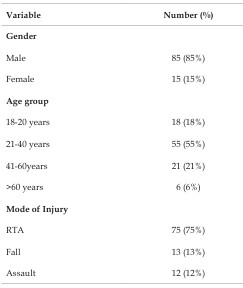
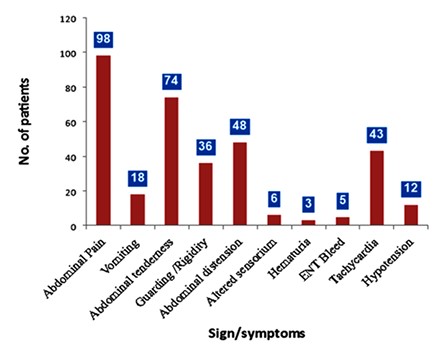
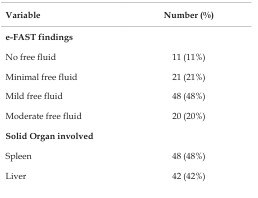
Background: Trauma is the leading cause of death in the population under the age of 45 year sold.1 Among trauma cases, Abdominal trauma accounts for the third most commonly injured part of the body. With the rising trend of road traffic accidents, the clinical patterns and profile of blunt abdominal trauma patients is also changing. Aim: To access the incidence, mode of injury and clinical presentation of blunt abdominal trauma patients in order to access the problem size in the study area. Material and Method: A prospective descriptive type of study was conducted in a tertiary care hospital including 100 study participants. All the patients with the diagnosis of the blunt abdominal trauma were assessed clinically at the time of presentation. After obtaining written informed consent, the detailed information regarding the mode of injury, clinical presentation was collected and recorded. Data Analysis: The data collected were then entered in MS Excel sheet and was analysed using SPSS v 20.0. the data was presented in the form of numbers and proportions. Results and conclusion: 85% of participants were male, majority (55%) belong to 21-40 years age group. The most common mode of injury was Road traffic accidents (75%) and most common clinical presentation was pain abdomen (98%). Spleen was the most common solid organ involved.
References
- 1. Soto JA, Anderson SW. Multi detector CT of blunt abdominal trauma. Radiology .2012Dec;265(3):678 93.
- 2. Aubakirova A, Kossumov A, Igissinov N. Road traffic accidents in Kazakhstan. Iranian journal of public health.2013;42(3):231.
- 3. Ramachandr ML, Krishna SR. Solid organ injury in blunt trauma abdomen: an etiological evaluation and success rate of non - operative management .International Surgery Journal.2018 Mar23;5(4):1350-3.
- 4. Agrawal C, Jindal R, Mukherjee S. A Clinical Study of Blunt Trauma Abdomen with Respect to Management and Outcomein a Tertiary Care Hospital.
- 5. Baldiwala AS, Lad VC. Management of solid organ injury in patient of blunt abdominal trauma. International Surgery Journal.2021Jul28;8(8):2361-5.
- 6. . V Nandhana Prashanth, B Kanchana, Vivekananda S Nathan. Analysisof visceral injuries in blunt abdomen trauma. Med Pulse – International Medical Journal. February2016;3(2): 222-225.
- 7. Panchal HA,Ra manuj AM. Thestudy of abdominal trauma: patterns of injury, clinical presentation, organ in volvementand associated injury. International Surgery Journal.2016Dec9;3(3):1392-8.
- 8. Verma S, Noori MT, Garg P, Yadav A, Sirohi V, Garg N. Study of pattern and management strategies of solid visceral injuries in blunt trauma abdomen in tertiary care centre. International Surgery Journal.2020May26;7(6):1808-12.
- 9. DavisJJ, CohnJrIS, Nance FC. Diagnos is and management of blunt abdominal trauma. Annals of surgery.1976Jun;183(6):672.
- 10. Mehta N, Babu S, Venugopal K. An experience with blunt abdominal trauma: evaluation, management and outcome. Clinics and practice.2014Jun18;4(2):599.
Data Sharing Statement
There are no additional data available.
Funding
This research received no funding
Author Contributions
All authors contributed significantly to the work and approve its publication.
Ethics Declaration
This article does not involve any human or animal subjects, and therefore does not require ethics approval
Acknowledgements
Information Not Provided
Conflicts of Interest
No conflicts of interest in this work.
About this article

Cite this article
Kumar S, Halam I, Khadda S, et al. Clinico-epidemiological profile of blunt trauma abdomen patients in a tertiary care hospital: an observational study. New Indian J Surg. 2023;14(2):75-79.
Licence:
Attribution-Non-commercial 4.0 International (CC BY-NC 4.0)This license enables reusers to distribute, remix, adapt, and build upon the material in any medium or format for noncommercial purposes only, and only so long as attribution is given to the creator.
| Received | Accepted | Published |
|---|---|---|
| February 24, 2023 | May 06, 2023 | June 29, 2023 |
DOI: https://dx.doi.org/10.21088/nijs.0976.4747.14223.5
Keywords
Abdominal traumaoad traffic accidentsClinical presentationDescriptive studySearch for Similar Articles
Similar Articles
- Laparoscopy-Guided Bilateral Oblique Subcostal Transversus Abdominis Plane Bloc...
- Recognizing the Columnar Cell Subtype of Papillary Thyroid Carcinoma: A Case Rep...
- Randomized Controlled Study To Compare Intraperitoneal Plus Port-Site Instillat...
- Single Preoperative Dose Versus Conventional Multidose Antibiotic Prophylaxis In...
- To Compare the Dissection of Gallbladder by Ultrasonic Harmonic Scalpel Versus...
Article Level Metrics
Last UpdatedTuesday 29 September 2026, 15:37:20 (IST)
5241
Accesses
9
437
00
Citations
NA
NA
NA
Download citation
Article Keywords
Keyword Highlighting
Highlight selected keywords in the article text.
Timeline
| Received | February 24, 2023 |
| Accepted | May 06, 2023 |
| Published | June 29, 2023 |
licence
Attribution-Non-commercial 4.0 International (CC BY-NC 4.0)
This license enables reusers to distribute, remix, adapt, and build upon the material in any medium or format for noncommercial purposes only, and only so long as attribution is given to the creator.