Full Text (PDF)
Indian Journal of Obstetrics and Gynecology 12(2):p 77-84, April - June 2024. | DOI: https://doi.org/10.21088/ijog.2321.1636.12224.5
Original Article
Association of Congenital Thrombophilia in Unexplained Infertility: By Chance or By Cause
Nutan Agarwal, Meenakshi Karan, Vidushi Kulshrestha, Nilanchali Singh, Renu Saxena, Alka Kriplani, Neerja Bhatla
Author Information
Licence:
Attribution-Non-commercial 4.0 International (CC BY-NC 4.0)This license enables reusers to distribute, remix, adapt, and build upon the material in any medium or format for noncommercial purposes only, and only so long as attribution is given to the creator.
Indian Journal of Obstetrics and Gynecology 12(2):p 77-84, April - June 2024. | DOI: https://doi.org/10.21088/ijog.2321.1636.12224.5
How Cite This Article:
Nutan Agarwal, Meenakshi Karan, Vidushi Kulshrestha et al. Association of Congenital Thrombophilia in Unexplained Infertility: By Chance or By Cause. Indian J Obstet Gynecol. 2024;12(2):77-84.Timeline
Received : April 21, 2024
Accepted : May 24, 2024
Published : June 30, 2024
Abstract
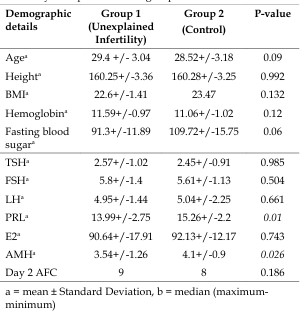
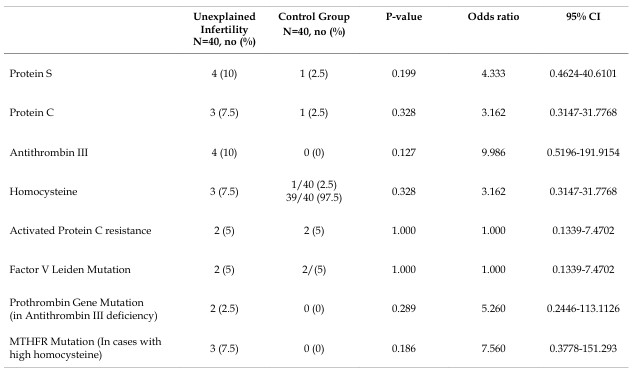
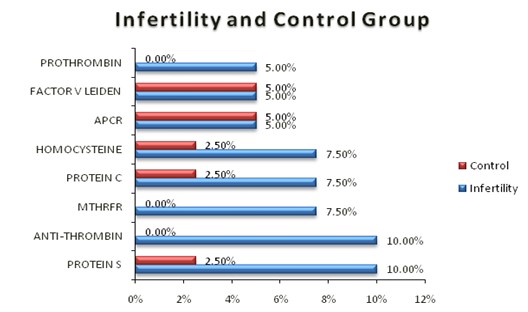
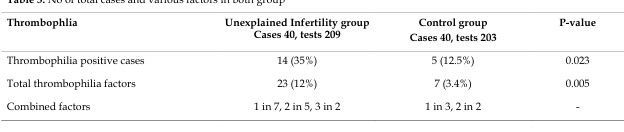
Objective: To find incidence of congenital thrombophilia in unexplained infertility versus fertile female population with intend to determine if thrombophilia is a possible cause and which type of thrombophilia is more prevalent in unexplained infertility. Methods: Study group (Group A) comprised of 40 infertile patients of age between 20 40 years in whom no cause of infertility was identified. The control group comprised of 40 healthy women with proven fertility, matched for age, with no history of thrombo-embolic events. Both the groups were tested for inherited thrombophilia included Protein C, Protein S, Anti-thrombin III, Activated Protein C Resistance, Homocysteine, factor V Leiden (PCR), Prothrombin G20210 G gene and M THFR (677c/T)gene mutation. Results: Overall 14 (35%) subjects in the unexplained infertility group, and 5 (12.5%) in the control group were detected with positive thrombophilic factor (p value-0.023). Out of 14 positive cases, 7/14(50%) had more than one factor (35% had 2 and 15% had 3 factors)thus 23 thrombophilia factors in 14 women in group 1 in comparision of onlt 7 in 5 in (2 with 2 factors)group2 (p=0.005). Out of 23, Protein S (10%) and Antithrombin III (10%) had the highest frequency followed by Homocysteine (7.5%), Protein C (7.5%), MTHFR gene mutation (7.5%), prothrombin 20210 (5%), Factor V Leiden (5%) and APCR (5%)in group1 Out of the 7 thrombophilia factors in controls, Factor V Leiden mutation and APCR had the highest frequency (5%) followed by Protein S, Protein C, and Homocysteine (2.5%). APCR and Factor V leiden were similar in both groups whereas Hyperhomocysteinaemia combined with MTHFR gene mutation was more in unexplained infertility andprothrombin gene was found only in unexplained infertility Conclusion: There is significant association of thrombophilia with unexplained infertility Hyperhomocystinaemia combined with MTHFR gene mutation and APCR with prothrombin gene mutation are more likely to be associated with unexplained infertility. Thrombophilia evaluation may be included along with other tests in evaluation of unexplained infertility.
References
- 1. Grandone E. Infertility and trombophilia.Thromb Res. 2005; 115(1):24-7.
- 2. Vaquero E, Lazzarin N, Caserta D, Valensise H, Baldi M, Moscarini M, Arduii D. Diagnostic evaluation of women experiencing repeated in vitro fertilization failure. Eur J GynecolReprodBiol 2006; 125(1):79-84
- 3. Glueck CJ, Awadalla S G, Philips H, Cameron D, Wang P, Fontaine RN. Polycistic ovary síndrome, infertility, familial trombophilia, recurrent loss of in vitro fertilized embryos, and miscarriage. Fertility and Sterility 2000; 74(2): 394-7.
- 4. Grandone E, Colaizzo D, Lo Bue A, Checola MG, Cittadini E, Margaglione M. Inherited thrombophilia and in vitro fertilization implantation failure. Fertility and Sterility 2001; 76 (1): 201-02.
- 5. Sarto A, Rocha M, Geller M, Capmany C, Martinez M, Quintans, Donaldson M, Pasqualini RS. Tratamiento con enoxaparinaadaptado a los programas de fertilidad en mujeres con abortorecurrente y trombofiliaMedicina (Buenos Aires) 2001; 61: 406-12.
- 6. Machac S, Lubusky M, Prochazka M, Streda R. Prevalence of inherited thrombophilia in patients with severe ovarian hyperstimulation syndrome. Biomed Pap Med FacUnivPalacky Olomouc Czech Repub. 2006; 150 (2): 289-92.
- 7. Buchholz T, Thaler CJ. Inherited thrombophilia: impact on human reproduction. Am J ReprodImmunol 2003; 50 (1): 20-32.
- 8. Azem F, Many A, Yovel I, Amit A, Lessing JB, Kupferminc MJ. Increased rates of trombophilia in women with repeated FIV failures. Human Reproduction 2004; 19 (2): 368-70.
- 9. Geva E, Amit A, Lerner-Geva L, Azem F, Yovel I, Lessing JB. Autoimmune disorders: another possible cause for in-vitro fertilization and embryo transfer failure. Hum Reprod1995; 10: 2560-2563.
- 10. Kujovich JL. Thrombophilia and pregnancy complications. Am J ObstetGynecol2004; 191: 412 424.
- 11. Martinelli I, Taioli E, Ragni G, Levi-Setti P, Passamonti SM, Battagliolo T, Lodigiani C, Mannucci PM. Embryo implantation after assisted reproductive procedures and maternal thrombophilia. Haematologica 2003; 88(7):789-93.
- 12. Lindhoff-Last E, Luxembourg B. Evidence-based indications for thrombophilia screening. VASA 2008;37:19–30.
- 13. Thaler CJ, Budiman H, Ruebsamen H, Nagel D, Lohse P. Effects of the common 677C > T mutation of the 5,10-methylenetetrahydrofolate reductase (MTHFR) gene on ovarian responsiveness to recombinant follicle-stimulating hormone. Am J ReprodImmunol 2006;55:251–8.
- 14. Hecht S, Pavlik R, Lohse P, Noss U, Friese K, Thaler CJ. Common 677C > T mutation of the 5,10-methylenetetrahydrofolate reductase gene affects follicular estradiol synthesis. FertilSteril 2009;91:56–61.
- 15. Bianca S,BarranoB,Cutuli N, Indaco L, Cataliotti A, Milana G, et al. Unexplained infertility and inherited thrombophilia. FertilSteril 2009;92.e4.
- 16. Kupferminc MJ, Eldor A, Steinman N, Many A, Bar Am A, Jaffa A, et al. Increased frequency of genetic thrombophilia in women with complications of pregnancy. N Engl J Med 1999; 340: 9-13.
- 17. Rey E, Kahn SR, David M, Shrier I. Thrombophilic disorders and fetal loss: a meta-analysis. Lancet 2003; 361: 901-908
- 18. Mousa HA, Alfirevic1 Z. Do placental lesions reflect thrombophilia state in women with adverse pregnancy outcome? Hum Reprod2000; 15: 1830 1833.
- 19. Rand JH, Wu XX, Guller S, Scher J, Andree HA, Lockwood CJ. Antiphospholipid immunoglobulin G antibodies reduce annexin-V levels on syncytiotrophoblast apical membranes and in culture media of placental villi. Am J ObstetGynecol1997; 177: 918-923
- 20. Safdarian L, Najmi Z, Aleyasin A, etal.Recurrent IVF failure and hereditary thrombophilia. Iran J Reprod Med Vol. 12. No. 7. pp: 467-470, July 2014
- 21. Qublan HS, Eid SS, Ababneh HÁ, AmarinZO, Smadi AZ, Al- Khafaji FF, KhaderYS. Acquired and inherited thrombophilia: implication in recurrent IVF and embryo tranfer failure. Hum Reprod. 2006; 21(10): 2694-8.
- 22. Kallen CB, Arici A. Immune testing in fertility practice: truth or deception? CurrOpinObstetGynecol 2003;15:225-231.l. Hum Reprod 2001;16:2403–2410
- 23. Casadei L, Puca F, Privitera L, Zamaro V, Emidi E. Inherited thrombophilia in infertile women: implication in unexplain infertility. FertilSteril 2010; 94(2): 755-757.
- 24. Bianca S. Barrano B. Cutuli N. Indaco L. Cataliotti A. Milana G. et al. Unexplained infertility and inherited thrombophilia. FertilSteril. 2009; (e4): doi: 10.1016/j.fertnstert.2009.02. 007.
- 25. CinziaFatini, Fatini C, Conti L, Turillazzi N, Cechi E S, Romanuoli I, Melanini M N, Cozzi C, Abbati R, Noc I unexplained infertility association with inherited thrombophilia. J.Thromb res 2012 129(5) el 185-188
- 26. CasadiaL,Privilera L, Emide E. Inherited Thrombophilia in infertile women. FertilSteril 2010. 94(2)p755-757
Data Sharing Statement
There are no additional data available. All raw data and code are available upon request.
Funding
This research received no funding.
Author Contributions
All authors contributed significantly to the work and approve its publication.
Ethics Declaration
This article does not involve any human or animal subjects, and therefore does not require ethics approval
Acknowledgements
We would like to express our gratitude to the patients, their families, and all those who have contributed to this study.
Conflicts of Interest
No conflicts of interest in this work.
About this article

Cite this article
Nutan Agarwal, Meenakshi Karan, Vidushi Kulshrestha et al. Association of Congenital Thrombophilia in Unexplained Infertility: By Chance or By Cause. Indian J Obstet Gynecol. 2024;12(2):77-84.
Licence:
Attribution-Non-commercial 4.0 International (CC BY-NC 4.0)This license enables reusers to distribute, remix, adapt, and build upon the material in any medium or format for noncommercial purposes only, and only so long as attribution is given to the creator.
| Received | Accepted | Published |
|---|---|---|
| April 21, 2024 | May 24, 2024 | June 30, 2024 |
DOI: https://doi.org/10.21088/ijog.2321.1636.12224.5
Keywords
Unexplained InfertilityCongenital Thrombophilia.Congenital Thrombophilia.Search for Similar Articles
Similar Articles
- Fibromyoma: A Clinical Dilemma
- Optimizing Obstetric Care: A Review of Indications and Outcomes for First-Time C...
- A Rare Case of Geriatric Endometrial Adenocarcinoma Presenting with Nonpuerperal...
- Relationship between Hypothyroidism and Gestational Diabetes Mellitus: A Prospec...
- Influence of Maternal Anthropometry and Hemoglobin on Neonatal Anthropometry
Article Level Metrics
Last UpdatedWednesday 09 September 2026, 18:51:33 (IST)
3515
Accesses
14
590
00
Citations
NA
NA
NA
Download citation
Article Keywords
Keyword Highlighting
Highlight selected keywords in the article text.
Timeline
| Received | April 21, 2024 |
| Accepted | May 24, 2024 |
| Published | June 30, 2024 |
licence
Attribution-Non-commercial 4.0 International (CC BY-NC 4.0)
This license enables reusers to distribute, remix, adapt, and build upon the material in any medium or format for noncommercial purposes only, and only so long as attribution is given to the creator.