Full Text (PDF)
Journal of Dermatology 11(1):p 15-22, Jan- June 2026. | DOI: 10.21088/jd.2582.3582.11126.2
Review Article
Artificial Intelligence in the Digital Transformation of Dermatology: Current Evidence, Applications, and Challenges
Author Information
Licence:
Attribution-Non-commercial 4.0 International (CC BY-NC 4.0)This license enables reusers to distribute, remix, adapt, and build upon the material in any medium or format for noncommercial purposes only, and only so long as attribution is given to the creator.
Journal of Dermatology 11(1):p 15-22, Jan- June 2026. | DOI: 10.21088/jd.2582.3582.11126.2
How Cite This Article:
Divya Yadav. Artificial Intelligence in the Digital Transformation of Dermatology: Current Evidence, Applications, and Challenges. J Derma. 2026; 11(1): 15-22.Timeline
Received : February 20, 2026
Accepted : March 22, 2026
Published : June 30, 2026
Abstract
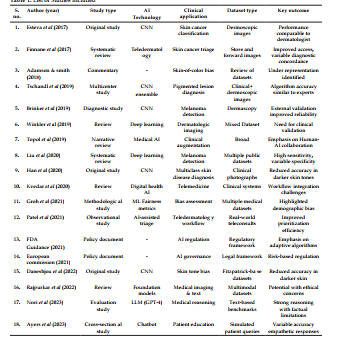
Artificial intelligence (AI) has emerged as a transformative force in dermatology, influencing diagnostic decision-making, broadening the reach of tele dermatology services, and reshaping patient education and clinician patient communication. Recent progress in deep learning has enabled image-analysis systems to demonstrate performance comparable to trained dermatologists for specific diagnostic tasks in controlled experimental settings. In parallel, large language models and conversational AI platforms are increasingly being explored for clinical triage, patient information delivery, and administrative functions. Despite these advances, translation into routine clinical practice remains constrained by several unresolved challenges. Real-world diagnostic performance is often inconsistent, prospective validation studies are limited, and many systems lack transparency or interpretability in their decision-making processes. Moreover, biases related to the underrepresentation of diverse skin tones and demographic populations within training datasets continue to raise concerns regarding equity and generalizability. Additional issues include patient safety, data protection, regulatory governance, and the potential for overreliance on automated tools in clinically critical scenarios. This review consolidates existing evidence on the applications of AI in dermatology, with particular attention to diagnostic accuracy, integration within teledermatology frameworks, and the growing role of AI-assisted patient education technologies. Special emphasis is placed on skin color–related bias, ethical and equitable implementation, and emerging regulatory and medico-legal challenges. The review also proposes practical recommendations and identifies key research priorities to support the responsible, effective, and inclusive adoption of AI in everyday dermatologic practice.
References
- 1. Esteva A., Kuprel B, Novoa RA, Ko J, Swetter SM, Blau HM, et al. Dermatologist-level classification of skin cancer with deep neural networks. Nature. 2017; 542: 115–118. Divya Yadav. Artificial Intelligence in the Digital Transformation of Dermatology: Current Evidence, Applications, and Challenges.22 RFP Journal of Dermatology RFP Journal of Dermatology / Volume 11 Number 1 / January - June 2026
- 2. Tschandl P, Codella N, Akay BN, Argenziano G, Braun RP, Cabo H, et al. Accuracy of machine learning vs human readers. Lancet Oncol. 2019; 20: 938–947.
- 3. Brinker TJ, Hekler A, Enk AH, et al. Deep neural networks in melanoma classification. Eur J Cancer. 2019; 119: 11–17.
- 4. Han SS, Park GH, Lim W, et al. Classification of skin diseases using deep learning. JAMA Dermatol. 2020; 156: 123–131.
- 5. Finnane A, Janda M, Soyer HP. Teledermatology for skin cancer management. JAMA Dermatol. 2017; 153: 319–327.
- 6. Liu Y, Jain A, Eng C, et al. A deep learning system for melanoma detection. Ann Oncol. 2020; 31: 468–477.
- 7. Patel J, Soyer HP, Rosen R, et al. AI-assisted teledermatology triage. Telemed J E Health. 2021; 27: 103–110.
- 8. Nori H, King N, McKinney SM, Carignan D, Horvitz E. Capabilities of GPT-4 on medical problems. arXiv. 2023; 2303. 13375.
- 9. Ayers JW, Poliak A, Dredze M, et al. Chatbots and health advice. JAMA Intern Med. 2023; 183: 589–596.
- 10. Adamson AS, Smith A. Machine learning and dermatologic disparities. JAMA Dermatol. 2018; 154: 1247–1248.
- 11. Daneshjou R, Smith MP, Sun MD, et al. AI performance disparities in dermatology. Sci Adv. 2022; 8: eabq6147.
- 12. Groh M, Harris C, Soenksen L, et al. Fairness in medical AI. Nat Med. 2021; 27: 117–125.
- 13. US Food and Drug Administration. Artificial intelligence/machine learning medical devices. FDA; 2021.
- 14. Winkler JK, Fink C, Toberer F, et al. Diagnostic performance of AI in dermatology. Br J Dermatol. 2019; 181: 124–131.
- 15. European Commission. Ethics guidelines for trustworthy AI. Brussels; 2021.
- 16. Kvedar J, Coye MJ, Everett W. Connected health and AI. Health Aff. 2020;39:199–206.
- 17. Rajpurkar P, Chen E, Banerjee O, Topol EJ. AI foundation models in medicine. Nat Med. 2022; 28: 31–38.
- 18. Topol EJ. High-performance medicine: AI and the future of care. Nat Med. 2019; 25: 44–56. 19. Kucuk R, et al. AI-generated dermatology patient education materials. J Am Acad Dermatol. 2024; 91: 345–352.
Data Sharing Statement
There are no additional data available. All raw data and code are available upon request.
Funding
This research received no funding.
Author Contributions
Whether all authors contributed significantly to the work and approve its publication.
About this article

Cite this article
Divya Yadav. Artificial Intelligence in the Digital Transformation of Dermatology: Current Evidence, Applications, and Challenges. J Derma. 2026; 11(1): 15-22.
Licence:
Attribution-Non-commercial 4.0 International (CC BY-NC 4.0)This license enables reusers to distribute, remix, adapt, and build upon the material in any medium or format for noncommercial purposes only, and only so long as attribution is given to the creator.
| Received | Accepted | Published |
|---|---|---|
| February 20, 2026 | March 22, 2026 | June 30, 2026 |
DOI: 10.21088/jd.2582.3582.11126.2
Keywords
TeledermatologyArtificial IntelligenceImage BasedSearch for Similar Articles
Similar Articles
- Delving into Wolf’s Isotopic Phenomenon: Tale of Two Cases of Psoriasis Localize...
- Pachydermoperiostosis, Complete Form: A Case Report of Rare Occurrence
- Role of Cyclical Negative Pressure Wound Therapy in Thermal Burns
- Behcets Disease in an Immunocompromised Female
- Tale of an Atypical Herpes Zoster Mimicking Ecthyma and Perforating Dermatosis i...
Article Level Metrics
Last UpdatedWednesday 21 October 2026, 02:26:22 (IST)
1724
Accesses
13
194
00
Citations
NA
NA
NA
Download citation
Article Keywords
Keyword Highlighting
Highlight selected keywords in the article text.
Timeline
| Received | February 20, 2026 |
| Accepted | March 22, 2026 |
| Published | June 30, 2026 |
licence
Attribution-Non-commercial 4.0 International (CC BY-NC 4.0)
This license enables reusers to distribute, remix, adapt, and build upon the material in any medium or format for noncommercial purposes only, and only so long as attribution is given to the creator.