Full Text (PDF)
Journal of Dermatology 11(1):p 23-26, Jan- June 2026. | DOI: 10.21088/jd.2582.3582.11126.3
Case Report
Role of Biocellulose Occlusive Dressing in Partial Thickness Burn Wound Management
Ravi Kumar Chittoria, Dhana Nadeeshwaran R.S, Kanav Gupta, Nagarjun S. Ghatti
Author Information
Licence:
Attribution-Non-commercial 4.0 International (CC BY-NC 4.0)This license enables reusers to distribute, remix, adapt, and build upon the material in any medium or format for noncommercial purposes only, and only so long as attribution is given to the creator.
Journal of Dermatology 11(1):p 23-26, Jan- June 2026. | DOI: 10.21088/jd.2582.3582.11126.3
How Cite This Article:
Dhana Nadeeshwaran R.S., Ravi Kumar Chittoria, Kanav Gupta, et al. Role of Biocellulose Occlusive Dressing in Partial Thickness Burn Wound Management. J Derma. 2026; 11(1): 23-26Timeline
Received : December 12, 2025
Accepted : January 13, 2026
Published : June 30, 2026
Abstract
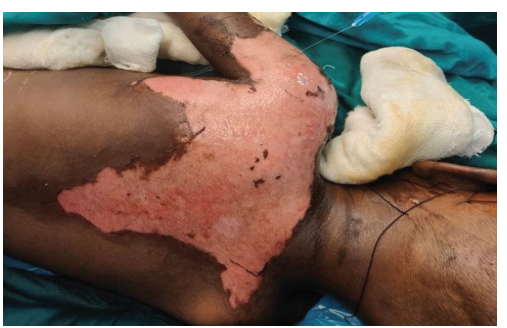
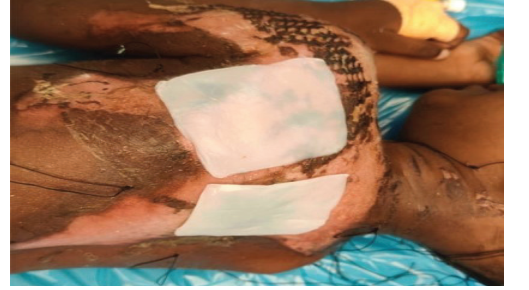
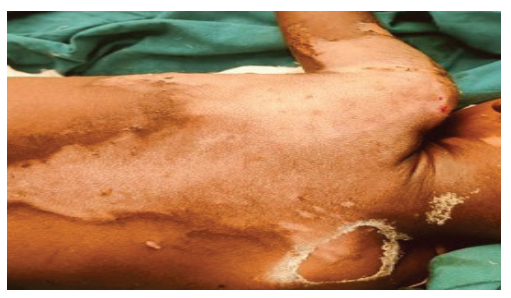
Scald burns are a common cause of morbidity, particularly in children and the elderly. Traditional management often involves regular dressing changes and topical antimicrobials, which can be painful and distressing. Biocellulose dressings have emerged as promising alternatives for partial-thickness burn wounds owing to their high moisture retention, biocompatibility, and ability to reduce pain while promoting rapid re-epithelialization. We report a case of a young male with partial-thickness scald burns successfully managed using biocellulose dressing. The dressing provided an optimal wound-healing environment, minimized the need for frequent dressing changes, and resulted in satisfactory functional and aesthetic outcomes
References
- 1. Fu L, Zhang J, Yang G. Present status and applications of bacterial cellulose-based materials for skin tissue repair. Carbohydr Polym. 2013; 92(2): 1432-42.
- 2. Czaja W, Krystynowicz A, Bielecki S, Brown RM. Microbial cellulose—the natural power to heal wounds. Biomaterials. 2006; 27(2): 145-51.
- 3. Alvarez GS, Moreira FF, Ponce L, Koga-Ito CY, Popat KC, Matsumoto T. Advances in biocellulose-based materials for wound healing. Adv Healthc Mater. 2020; 9(15): 2000734. Dhana Nadeeshwaran R.S., Ravi Kumar Chittoria, Kanav Gupta, et al. Role of Biocellulose Occlusive Dressing in Partial Thickness Burn Wound Management.26 RFP Journal of Dermatology RFP Journal of Dermatology / Volume 11 Number 1 / January - June 2026
- 4. Picheth GF, Pirich CL, Sierakowski MR, Woehl MA, Sakakibara CN, de Souza CF, et al. Bacterial cellulose in biomedical applications: a review. Int J Biol Macromol. 2017; 104(Pt A): 97-106.
- 5. Cocoheal. Product information leaflet. Coimbatore (India): Ardor Biomed India Pvt Ltd; 2025.
- 6. Mayrand D, Samson L, Hélie P, Vincent C, Mottard S, Guertin L. Clinical evaluation of a microbial cellulose wound dressing in the management of second-degree burns. J Burn Care Res. 2012; 33(3): e110-7.
- 7. Zajicek R, Matejovic T, Koller J, Vistejnova L, Suchanek J, Stiborova I, et al. Comparison of microbial cellulose and silver-impregnated dressings in the treatment of superficial partialthickness burns. Burns. 2019; 45(1): 146-52.
- 8. Revin VV, Liyaskina EV, Nazarkina YV, Bogatyreva AO, Shchankin MA. Bacterial cellulose and its applications in biomedicine and cosmetics. Polymers (Basel). 2018;10(3):347.
- 9. Czaja WK, Young DJ, Kawecki M, Brown RM. The future prospects of microbial cellulose in biomedical applications. Biomacromolecules. 2007; 8(1): 1-12.
- 10. Huang Y, Zhu C, Yang J, Nie Y, Chen C, Sun D. Recent advances in bacterial cellulose for biomedical applications. Int J Biol Macromol. 2014; 66: 166-74.
- 11. Wichai S, Chuysinuan P, Chaiarwut S, Ekabutr P, Supaphol P. Development of bacterial cellulose/alginate/chitosan composite sponges for wound dressing applications. Int J Biol Macromol. 2019; 131: 1090-100.
- 12. Ardor Biomed. Cocoheal bio-cellulose wound dressing [Internet]. Coimbatore (India): Ardor Biomed India Pvt Ltd; [cited 2025 Aug 27]. Available from: https://www.ardorbiomed. com/Productdetail.
Data Sharing Statement
There are no additional data available. All raw data and code are available upon request.
Funding
This research received no funding.
Author Contributions
All authors contributed significantly to the work and approve its publication.
Ethics Declaration
This article does not involve any human or animal subjects, and therefore does not require ethics approval.
Acknowledgements
We would like to express our gratitude to the patients, their families, and all those who have contributed to this study.
Conflicts of Interest
No conflicts of interest in this work.
About this article

Cite this article
Dhana Nadeeshwaran R.S., Ravi Kumar Chittoria, Kanav Gupta, et al. Role of Biocellulose Occlusive Dressing in Partial Thickness Burn Wound Management. J Derma. 2026; 11(1): 23-26
Licence:
Attribution-Non-commercial 4.0 International (CC BY-NC 4.0)This license enables reusers to distribute, remix, adapt, and build upon the material in any medium or format for noncommercial purposes only, and only so long as attribution is given to the creator.
| Received | Accepted | Published |
|---|---|---|
| December 12, 2025 | January 13, 2026 | June 30, 2026 |
DOI: 10.21088/jd.2582.3582.11126.3
Keywords
Scald burnsBiocellulose dressingBurn management •Wound healingMonolaurinSearch for Similar Articles
Similar Articles
- Delving into Wolf’s Isotopic Phenomenon: Tale of Two Cases of Psoriasis Localize...
- Pachydermoperiostosis, Complete Form: A Case Report of Rare Occurrence
- Role of Cyclical Negative Pressure Wound Therapy in Thermal Burns
- Behcets Disease in an Immunocompromised Female
- Tale of an Atypical Herpes Zoster Mimicking Ecthyma and Perforating Dermatosis i...
Article Level Metrics
Last UpdatedWednesday 21 October 2026, 03:47:54 (IST)
1724
Accesses
27
194
00
Citations
NA
NA
NA
Download citation
Article Keywords
Keyword Highlighting
Highlight selected keywords in the article text.
Timeline
| Received | December 12, 2025 |
| Accepted | January 13, 2026 |
| Published | June 30, 2026 |
licence
Attribution-Non-commercial 4.0 International (CC BY-NC 4.0)
This license enables reusers to distribute, remix, adapt, and build upon the material in any medium or format for noncommercial purposes only, and only so long as attribution is given to the creator.