Full Text (PDF)
Indian Journal of Forensic Medicine and Pathology 11(1):p 27-31, January - March 2018. | DOI: 10.21088/ijfmp.0974.3383.11118.5
Original Article
A Study of Health Profile of Sanitary Staff, Hazards Sustained and their Practice in Handling Biomedical Waste
Author: Dr. Madhusudan R Petkar, Sanjay D. Gaiwalea, Vandana S. Gundlac
Author Information
Licence:
Attribution-Non-commercial 4.0 International (CC BY-NC 4.0)This license enables reusers to distribute, remix, adapt, and build upon the material in any medium or format for noncommercial purposes only, and only so long as attribution is given to the creator
Indian Journal of Forensic Medicine and Pathology 11(1):p 27-31, January - March 2018. | DOI: 10.21088/ijfmp.0974.3383.11118.5
How Cite This Article:
Timeline
Received : December 12, 2017
Accepted : January 11, 2018
Published : January 30, 2018
Abstract
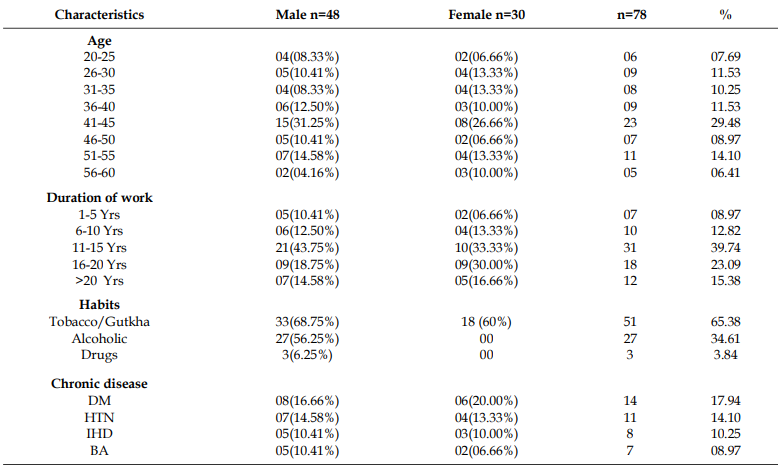
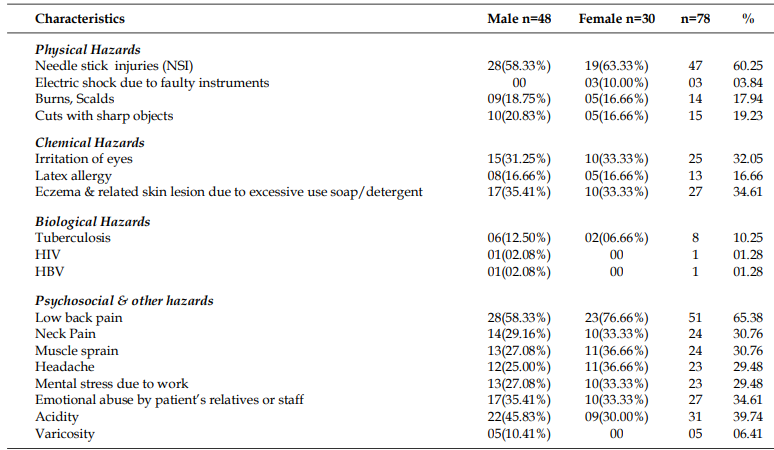
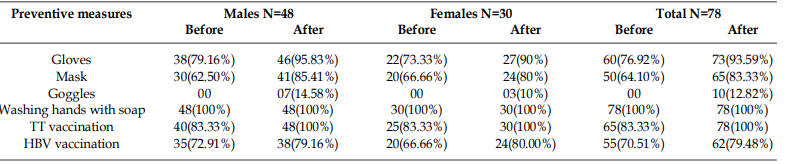
The proper handling and disposal of Bio-medical waste (BMW) is very imperative. There are well defined set of rules for handling BMW worldwide. In this descriptive observational cross-sectional study, 78 sanitary staff handling BMW participated. Maximum number of study participants (29.48%) belonged to age group of 41- 45 years. 65.38% BMW handling workers were addicted to tobacco either in the form of smoking/chewing/ misery/gutkha chewing while 34.61% male workers were alcoholic. 60.25% staff suffered needle stick injuries (NSI) and 19.23% staff were injured while handling sharp objects. It was observed that one worker was HIV positive and has given history of needle stick injury while one worker was found to be Hepatitis B positive. 65.38% study participants had complains of lower backache while 34.61% workers were emotionally disturbed and they were not satisfied with their job. After training the use of Personal Protective Equipments (PPE) like gloves, mask and goggles improved to 93.59%, 83.33% and 12.82% respectively. Training also was fruitful where the participants got themselves vaccinated 100% and 79.48% for Tetanus and Hepatitis B respectively
References
- 1. Ministry of Environment and Forests, Government of India. Biomedical Waste (Management and Handling) Rules, 1998. The Gazette of India, Extraordinary, Part II, Section 3, Subsection (ii). 1998 Jul 27;460.
- 2. Patil AD, Shekdar AV. Health-care waste management in India. J Environ Manage. 2001;63(2):211-20.
- 3. Mathur V, Dwivedi S, Hassan MA, Misra RP. Knowledge, attitude, and practices about biomedical waste management among healthcare personnel: a cross-sectional study. Indian J Community Med. 2011;36(2):143-5.
- 4. Mohankumar S, Kottaiveeran K. Hospital waste management and environmental problems in India. Int J Pharm Biol Arch. 2011;2(6):1621-6.
- 5. Central Pollution Control Board. Environmental standard and guidelines for management of hospital waste. New Delhi: Ministry of Environment and Forests; 1996.
- 6. Pruss A, Giroult E, Rushbrook P, editors. Safe management of wastes from health-care activities. Geneva: World Health Organization; 1999.
- 7. Rao PH. Report: hospital waste management – awareness and practices: a study of three states in India. Waste Manag Res. 2008;26(3):297-303.
- 8. Kishore J, Goel P, Sagar B, Joshi TK. Awareness about biomedical waste management and infection control among dentists of a teaching hospital in New Delhi, India. Indian J Dent Res. 2000;11(4):157-61.
- 9. Prüss-Üstün A, Rapiti E, Hutin Y. Estimation of the global burden of disease attributable to contaminated sharps injuries among health-care workers. Am J Ind Med. 2005;48(6):482-90.
- 10. National Institute for Occupational Safety and Health. NIOSH Alert: preventing needlestick injuries in health care settings. Cincinnati (OH): U.S. Department of Health and Human Services; 1999. Publication No.: 2000–108.
- 11. World Health Organization. The world health report 2002: reducing risks, promoting healthy life. Geneva: World Health Organization; 2002.
- 12. Musa S, Peek-Asa C, Young T, Jovanovic N. Needle stick injuries, sharp injuries and other occupational exposures to blood and body fluids among health care workers in a general hospital in Sarajevo, Bosnia and Herzegovina. Int J Occup Saf Health. 2014;4(1):31-7.
- 13. Lakbala P, Azar FE, Kamali H. Needlestick and sharp injuries among housekeeping workers in hospital of Shiraz, Iran. BMC Res Notes. 2012;5:276.
- 14. Chudasama RK, Rangoonwala M, Sheth A, Misra SKC, Kadri AM, Patel UV. Biomedical waste management: a study of knowledge, attitude and practice among health care personnel at tertiary care hospital in Rajkot. J Res Med Dent Sci. 2013;1(1):17-22.
Data Sharing Statement
There are no additional data available. All raw data and code are available upon request.
Funding
This research received no funding.
Author Contributions
Whether all authors contributed significantly to the work and approve its publication.
Ethics Declaration
This article does not involve any human or animal subjects, and therefore does not require ethics approval.
Acknowledgements
We would like to express our gratitude to the patients, their families, and all those who have contributed to this study.
Conflicts of Interest
The authors report no conflicts of interest in this work.
About this article

Cite this article
Licence:
Attribution-Non-commercial 4.0 International (CC BY-NC 4.0)This license enables reusers to distribute, remix, adapt, and build upon the material in any medium or format for noncommercial purposes only, and only so long as attribution is given to the creator
| Received | Accepted | Published |
|---|---|---|
| December 12, 2017 | January 11, 2018 | January 30, 2018 |
DOI: 10.21088/ijfmp.0974.3383.11118.5
Keywords
Bio-Medical WasteSanitary StaffNeedle Sticks InjuriesPersonal Protective EquipmentsVaccinationSearch for Similar Articles
Similar Articles
- Diatom Analysis in Thermophilic water bodies: A Study on Hot Water Springs of Ma...
- Morphometric Study of Supra-meatal Triangle and Mastoid process in the Adult dry...
- Histopathological Spectrum of Autopsy Cases: A One Year Retrospective Observatio...
- Forensic Differentiation of Manner of Death in Railway Fatalities: A FourCase Se...
- Understanding assault Patterns: A Cross-sectional study of Cases at Chri, Kelamb...
Article Level Metrics
Last UpdatedMonday 19 October 2026, 19:52:26 (IST)
16359
Accesses
8
3216
00
Citations
NA
NA
NA
Download citation
Article Keywords
Keyword Highlighting
Highlight selected keywords in the article text.
Timeline
| Received | December 12, 2017 |
| Accepted | January 11, 2018 |
| Published | January 30, 2018 |
licence
Attribution-Non-commercial 4.0 International (CC BY-NC 4.0)
This license enables reusers to distribute, remix, adapt, and build upon the material in any medium or format for noncommercial purposes only, and only so long as attribution is given to the creator