Full Text (PDF)
Indian Journal of Pathology: Research and Practice 11(1):p 9-16, January-March 2022. | DOI: https://doi.org/10.21088/ijprp.2278.148X.11122.1
Original Article
A Six year Study on Neuronal and Mixed Neuronal: Glial Tumours
Author Information
Licence:
Attribution-Non-commercial 4.0 International (CC BY-NC 4.0)This license enables reusers to distribute, remix, adapt, and build upon the material in any medium or format for noncommercial purposes only, and only so long as attribution is given to the creator.
Indian Journal of Pathology: Research and Practice 11(1):p 9-16, January-March 2022. | DOI: https://doi.org/10.21088/ijprp.2278.148X.11122.1
How Cite This Article:
Boopathi Rajkumar, K Rama/A Six year Study on Neuronal and Mixed Neuronal: Glial Tumours/J Pathol Res Pract 2022;11(1):9–16.Timeline
Received : October 16, 2021
Accepted : March 03, 2022
Published : March 30, 2022
Abstract
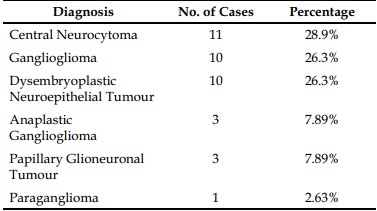
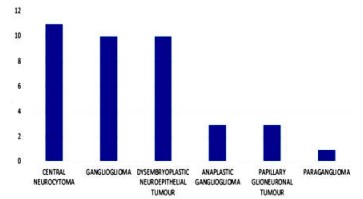
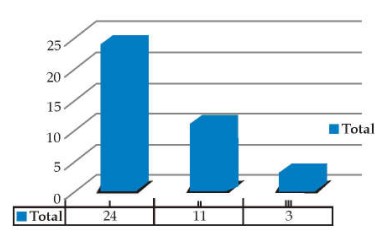
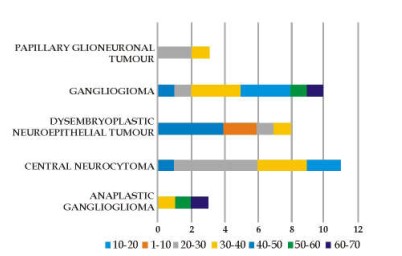
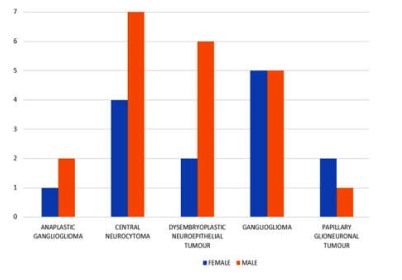
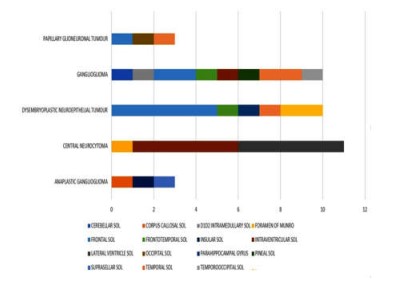
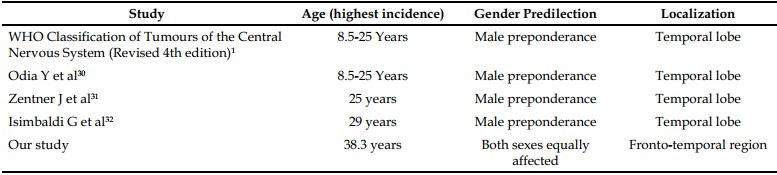
Context: In this study, we have analyzed the spectrum of Neuronal and mixed Neuronal-Glial tumours and their incidence, age distribution, gender distribution and site of occurrence at a Government tertiary care hospital over a period of six years. Aims: To assess the spectrum and prognosis of Neuronal and mixed Neuronal-Glial tumours and to review the slides from 2014 in accordance with the recent classification. Materials and Methods: This study includes cases from over a period of six years from 2014-2019, analyzed both retrospectively and prospectively. The slides were reviewed in accordance with the recent classification. Results: We identified 38 cases, which included 11 cases of Central Neurocytoma, 10 cases of Ganglioglioma, 10 cases of DysembryoplasticNeuroepithelial tumour, 3 cases of Anaplastic ganglioglioma, 3 cases of Papillary glioneuronal tumour and 1 case of Paraganglioma. 24 cases were WHO grade I, 11 cases grade II and 3 casesgrade III.Central Neurocytoma predominantly occurred in the age group 20–30 and commonly affected males. The commonest site was intraventricular region. Ganglioglioma predominantly occurred in the age group 30-50 and males and females were equally affected. The commonest site involved was fronto-temporal region. DysembryoplasticNeuroepithelial tumour occurred predominantly in the age group 10-20 years and commonly affected males. The commonest site was frontal region.Among the three cases of Papillary glioneuronal tumour, which are usually low grade neoplasms, one case presented with recurrence. Conclusion: The present study helps in gaining experience in the clinical and histological profile of these diverse tumours. Keymessages: A case of papillary glioneuronal tumour presented with recurrence which emphasizes the need for molecular profiling of these neoplasms for better understanding.
References
- 1. David N.louis, Hiroko Ohgaki, OtmarD.Wiestler, Webster K.Cavenee (Eds): WHO Classification of Tumours of the Central Nervous System (Revised 4th edition).IARC;Lyon 2016.
- 2. Hassoun J, Gambarelli D, Grisoli F, et al. Central neurocytoma. An electron-microscopic study of two cases. Acta Neuropathol 1982; 56:151-6.
- 3. Coca S, Moreno M, Martos JA, Rodriguez J, Barcena A, Vaquero J. Neurocytoma of spinal cord. Acta Neuropathol1994;87:537-40.
- 4. Figarella-Branger D, Soylemezoglu F, Kleihues P, Hassoun J. Central neurocytoma. In: Kleihues P, Cavenee WK. Pathology and genetics of tumors of the nervous system. Lyon: IARC Press; 2000.p.107-9.
- 5. Hassoun J, Söylemezoglu F, Gambarelli D, FigarellaBranger D, von Ammon K, Kleihues P. Central neurocytoma: a synopsis of clinical and histological features. Brain Pathol1993;3:297-306.
- 6. Kim DG, Chi JG, Park SH, et al. Intraventricular neurocytoma: clinicopathological analysis of seven cases. J Neurosurg1992;76:759-65.
- 7. Mrak RE. Malignant neurocytic tumor. Hum Pathol1994;25:747-52.
- 8. Kane AJ, Sughrue ME, Rutkowski MJ, et al. The molecular pathology of central neurocytomas. J Clin Neurosci2011;18:1–6.
- 9. Chen H, Zhou R, Liu J, et al. Central neurocytoma. J Clin Neurosci2012;19:849– 53.
- 10. Ishiuchi S, Tamura M. Central neurocytoma: an immunohistochemical, ultrastructural and cell culture study. Acta Neuropathol1997;94:425–35
- 11. Sim FJ, Keyoung HM, Goldman JE, et al. Neurocytoma is a tumor of adult neuronal progenitor cells. J Neurosci2006;26:12544–55
- 12. Tsuchida T, Matsumoto M, Shirayama Y, et al. Neuronal and glial characteristics of central neurocytoma: electron microscopical analysis of two cases. Acta Neuropathol1996;91:573–7
- 13. Rades D, Fehlauer F. Treatment options for central neurocytoma. Neurology 2002;59:1268–70
- 14. Rades D, Fehlauer F, Lamszus K, et al. Welldifferentiated neurocytoma: what is the best available treatment? Neuro-oncol2005;7:77–83.
- 15. Rades D, Schild SE. Treatment recommendations for the various subgroups of neurocytomas. J Neurooncol2006;77:305–9
- 16. Patel DM, Schmidt RF, Liu JK. Update on the diagnosis, pathogenesis, and treatment strategies for central neurocytoma. J Clin Neurosci. 2013;20(9):1193-1199. doi:10.1016/j.jocn.2013.01.001
- 17. Lee SJ, Bui TT, Chen CH, et al. Central Neurocytoma: A Review of Clinical Management and Histopathologic Features. Brain Tumor Res Treat. 2016;4(2):49-57. doi:10.14791/btrt.2016.4.2.49
- 18. Figarella-Branger D, Soylemezoglu F, Kleihues P, Hassoun J. Central neurocytoma. In: Kleihues P, Cavenee WK. Pathology and genetics of tumors of the nervous system. Lyon: IARC Press; 2000.p.107-9.
- 19. Sharma MC, Deb P, Sharma S, Sarkar C. Neurocytoma: a comprehensive review. Neurosurg Rev 2006;29:270-85; discussion 285.
- 20. Maiuri F, Spaziante R, De Caro ML, Cappabianca P, Giamundo A, Iaconetta G. Central neurocytoma: clinico-pathological study of 5 cases and review of the literature. Clin Neurol Neurosurg1995;97:219-28.
- 21. Vasiljevic A, François P, Loundou A, et al. Prognostic factors in central neurocytomas: a multicenter study of 71 cases. Am J Surg Pathol2012;36:220-7
- 22. Demierre B, Stichnoth FA, Hori A, et al. Intracerebral ganglioglioma. J Neurosurg 1986;65: 177-82.
- 23. Drake J, Hoffmann HJ, Kobayashi J, et al. Surgical management of children with temporal lobe epilepsy and mass lesions. Neurosurgery 1987;21:792-7.
- 24. Garrido E, Becker LF, Hoffman HJ, et al. Gangliogliomas in children. A clinicopathological study.Childs Brain 1978;4:339-46.
- 25. Kalyan-Raman UP, Olivero WC. Ganglioglioma: a correlative clinicopathological and radiological study of ten surgically treated cases with follow-up. Neurosurgery 1987;20:428-33.
- 26. Sutton LN, Packer RJ, Rorke LB, et al. Cerebral gangliogliomas during childhood. Neurosurgery 1983;13:124-8
- 27. Zulch KJ. Adoas of Gross Neurosurgical Pathology. Berlin: Springer, 1975:49-50.
- 28. Perkins OC. Ganglioglioma. Arch Pathol Lab Med 1926;2:11-7.
- 29. Jay V, Squire J, Blaser S, Hoffman HJ, Hwang P. Intracranial and spinal metastases from a ganglioglioma with unusual cytogenetic abnormalities in a patient with complex partial seizures.ChildsNerv Syst. 1997; 13: 550-555.
- 30. Odia Y. Gangliocytomas and Gangliogliomas: Review of Clinical,Pathologic and Genetic Features. Clin Oncol. 2016; 1: 1017
- 31. Zentner, J., Wolf, H. K., Ostertun, B., Hufnagel, A., Campos, M. G., Solymosi, L., & Schramm, J.(1994).Gangliogliomas: clinical, radiological, and histopathological findings in 51 patients. Journal of Neurology, Neurosurgery & Psychiatry, 57(12), 1497-1502.
- 32. Isimbaldi G, Sironi M, Tonnarelli GP, Roncoroni M, Declich P, Galli C. Ganglioglioma: a clinical and pathological study of 12 cases. Clin Neuropathol. 1996;15(4):192-199.
- 33. LangFF, EpsteinFJ, RansohoffJ, Allen JC, Wisoff J, Abbott IR, et al. (1993). Central nervous system gangliogliomas. Part 2: Clinical outcome. J Neurosurg. 79(6):867-73. PMID:8246055
- 34. Prayson RA, KhajaviK, Comair YG (1995). Cortical architectural abnormalities and MIB1 Immunoreactivity in gangliogliomas: a study of 60 patients with intracranial tumors. J Neuropathol Exp Neurol. 54(4):513-20. PMID:7541447
- 35. Thom M, Bliimcke I, Aronica E (2012). Longterm epilepsy-associated tumors. Brain Pathol.22(3):350-79.PMID:22497610.
- 36. Wolf HK, Muller MB, Spanle M, Zentner J, Schramm J, Wiestler OD (1994). Ganglioglioma: a detailed Histopathological and immunohistochemical analysis of 61 cases. Acta Neuropathol.88(2):166-73. PMID7985497
- 37. Blümcke I, Wiestler OD (2002). Gangliogliomas: an intriguing tumor entity associated with focal epilepsies. J Neuropathol Exp Neurol. 61 (7):575-84.PMID42125736
- 38. Hirose T, Scheithauer BW, Lopes MB, GerberHA, AltermattHJ, Vanden Berg SR(1997). Ganglioglioma: an ultrastructural and immunohistochemical study. Cancer. 79(5):989-1003.PMID:9041162
- 39. Jay V, Squire J, Becker LE, Humphreys R. Malignant transformation in a ganglioglioma with anaplastic neuronal and astrocytic components. Report of a case with flow cytometric and cytogenetic analysis. Cancer.1994; 73: 2862-2868.
- 40. Kawataki T, Sato E, Sato T, Kinouchi H. Anaplastic Ganglioglioma with malignant features in both neuronal and glial components - A case report. Neurol Med Chir. 2010; 50: 228-231.
- 41. Mittelbronn M, Schittenhelm J, Lemke D, Ritz R, Nägele T, Weller M, et al. Low grade ganglioglioma rapidly progressing to a WHO grade IV tumor showing malignant transformation in both astroglial and neuronal cell components. Neuropathology. 2007; 27: 463-467.
- 42. Daumas-Duport C, Scheithauer BW, Chodiewicz JP, Laws ER Jr, Vedrenne C. Dysembryoplastic neuroepithelial tumour: a surgically curable tumor of young patients with intractable partial seizures. Report of thirty-nine cases. Neurosurgery.1988;23:545-56
- 43. Sharma, Mehar & Jain, Deepali & Gupta, Aditya & Sarkar, Chitra & Suri, Vaishali & Garg, Ajay & Gaikwad, Sanjay & Chandra, Sarat. (2009). Dysembryoplastic neuroepithelial tumor: A clinicopathological study of 32 cases. Neurosurgical Review. 32. 161-170. 10.1007/s10143-008-0181-1.
- 44. Suh YL. Dysembryoplastic Neuroepithelial Tumors. J PatholTransl Med. 2015;49(6):438-449.doi:10.4132/jptm.2015.10.05
- 45. Agarwal S, Sharma MC, Singh G, Suri V, Sarkar C, Garg A, et al. (2012). Papillary glioneuronal tumor-a rare entity: report of four cases and brief review of literature. Childs Nerv Syst. 28(11):1897-904. PMID:22868530
- 46. Komori TMD, Scheithauer BW, Anthony DCMD, Rosenblum MK, McLendon RE, Scott RM, et al.Papillary glioneuronal tumor: a new variant of mixed neuronal-glial neoplasm. J Surg Pathol Oct.1998;22:1171–83.
- 47. Louis DN, Ohgaki H, Wiestler OD, Cavenee WK, Burger PC, Jouvet, A et al. The 2007 WHO classification of tumours of the central nervous system. Acta Neuropathol (Berl). 2007;114:97–109. doi:10.1007/s00401-007-0243-4.
Data Sharing Statement
There are no additional data available. All raw data and code are available upon request.
Funding
This research received no funding.
Author Contributions
All authors contributed significantly to the work and approve its publication.
Ethics Declaration
This article does not involve any human or animal subjects, and therefore does not require ethics approval.
Acknowledgements
We would like to express our gratitude to the patients, their families, and all those who have contributed to this study.
Conflicts of Interest
No conflicts of interest in this work.
About this article

Cite this article
Boopathi Rajkumar, K Rama/A Six year Study on Neuronal and Mixed Neuronal: Glial Tumours/J Pathol Res Pract 2022;11(1):9–16.
Licence:
Attribution-Non-commercial 4.0 International (CC BY-NC 4.0)This license enables reusers to distribute, remix, adapt, and build upon the material in any medium or format for noncommercial purposes only, and only so long as attribution is given to the creator.
| Received | Accepted | Published |
|---|---|---|
| October 16, 2021 | March 03, 2022 | March 30, 2022 |
DOI: https://doi.org/10.21088/ijprp.2278.148X.11122.1
Keywords
Neuronal and Mixed Neuronal-Glial tumoursCentral NeurocytomaDNETPapillary Glioneuronal tumourSearch for Similar Articles
Similar Articles
- Clinico-Pathological and Immunohistochemical Study of Primary CNS Tumors in a Te...
- The Role of SGLT2 Inhibitors in Cardiovascular Protection Beyond Diabetes: A Co...
- Epidermal Inclusion Cyst Presenting as 4th Ventricle Space Occupying Lesion: A R...
- Silent Retroperitoneal Seminoma Arising from an Occult Undescended Testis: Diagn...
- Scapular Metastasis of Oral Squamous Cell Carcinoma: A Case Report of an Unusual...
Article Level Metrics
Last UpdatedSaturday 17 October 2026, 10:27:11 (IST)
4177
Accesses
13
671
00
Citations
NA
NA
NA
Download citation
Article Keywords
Keyword Highlighting
Highlight selected keywords in the article text.
Timeline
| Received | October 16, 2021 |
| Accepted | March 03, 2022 |
| Published | March 30, 2022 |
licence
Attribution-Non-commercial 4.0 International (CC BY-NC 4.0)
This license enables reusers to distribute, remix, adapt, and build upon the material in any medium or format for noncommercial purposes only, and only so long as attribution is given to the creator.