Full Text (PDF)
Indian Journal of Anatomy 7(4):p 424-429, July - August 2018. | DOI: http://dx.doi.org/10.21088/ija.2320.0022.7418.13
Original Article
A Quantitative Study of Palmar Dermatoglyphics in Congenital Heart Diseases
Dr. Datta Nandanvankar, Assistant Professor, Department of Anatomy, SMBT Institute of Medical Sciences and Research Center, Dhamangaon, Tal. Igatpuri, Dist. Nashik, Maharashtra 422403, India , Vaishali S. Anturlikar1 , Datta Nandanvankar2 , Prashant Bhusari3
Author Information
Licence:
Indian Journal of Anatomy 7(4):p 424-429, July - August 2018. | DOI: http://dx.doi.org/10.21088/ija.2320.0022.7418.13
How Cite This Article:
Timeline
Received : N/A
Accepted : N/A
Published : N/A
Abstract
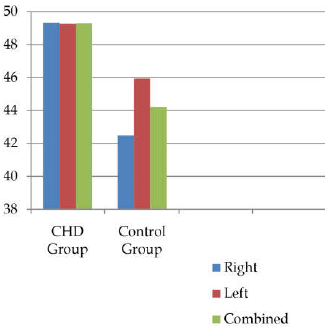
Introduction: Dermatoglyphics refers to the branch of science which studies the patterns of skin ridges present on fingers, toes and soles of human being. Since ancient times these ridge patterns and lines were used by palmists and future tellers for predicting the future. Recently the scope of dermatoglyphics has been amply recognized with expanding horizons of medical science in explaining certain diagnostic and aetiopathological riddle in various diseases, especially with heridofamilial background. The present study is undertaken to study the dermatoglyphic pattern in congenital heart diseases (CHD) and to compare it with previous studies. Materials & Methods: The cross sectional study with comparison group was designed. Hundred patients of congenital heart diseases (CHD) i.e. CHD group and hundred patients without CHD i.e. control group were examined during study period. Dermatoglyphic prints were obtained by using standard protocol method and finger tip patterns i.e. Arches, whorls, radial loops and ulnar loops were studied. The quantitative parameters like whorl loop index, triradial count, pattern intensity index and ‘atd’ angle were studied and analysed. Results: Among the quantitative parameters, whorl loop index, triradial count and pattern intensity index showed statistically insignificant difference in CHD group and control group. But ‘atd’ angle was increased significantly in CHD group as compared to control group. Conclusion: There was statistically significant increase in the values of ‘atd’ angle in CHD group as compared to control group.
References
No records found.
About this article

Cite this article
Licence:
| Received | Accepted | Published |
|---|---|---|
| N/A | N/A | N/A |
DOI: http://dx.doi.org/10.21088/ija.2320.0022.7418.13
Keywords
Dermatoglyphics; Whorl Loop Index; Triradial Count; Pattern Intensity Index; ‘ATD’ Angle.Search for Similar Articles
Similar Articles
- Supernumerary Pulmonary Vein: A Rare Anatomical Variation Observed During Cadave...
- Elongated Styloid Process: Anatomical Variations and Their Clinical Relevance: A...
- Bridging the Gap Between Dissection and Surgery: The Role of Soft Embalming in M...
- A Cadaveric Study of Retro Hepatic Segment of Inferior Vena Cava and Ostia Venae...
- Estimation of Stature from Forearm Length in Medical Undergraduate Students of a...
Article Level Metrics
Last UpdatedSunday 20 September 2026, 21:46:35 (IST)
5038
Accesses
4
601
00
Citations
NA
NA
NA
Download citation
Article Keywords
Keyword Highlighting
Highlight selected keywords in the article text.
Timeline
| Received | N/A |
| Accepted | N/A |
| Published | N/A |