Full Text (PDF)
Indian Journal of Forensic Medicine and Pathology 18((2 Suppl)):p 134-139, April-June 2025. | DOI: https://doi.org/10.21088/ijfmp.0974.3383.18225.13
Original Article
A Preliminary Study Investigating Class Characteristics in Gurumukhi Handwriting
Vinny Sharma, Anuwanshi Sharma
Author Information
Licence:
Attribution-Non-commercial 4.0 International (CC BY-NC 4.0)This license enables reusers to distribute, remix, adapt, and build upon the material in any medium or format for noncommercial purposes only, and only so long as attribution is given to the creator.
Indian Journal of Forensic Medicine and Pathology 18((2 Suppl)):p 134-139, April-June 2025. | DOI: https://doi.org/10.21088/ijfmp.0974.3383.18225.13
How Cite This Article:
Sharma A, Sharma V. A Preliminary Study Investigating Class Characteristics in the Gurumukhi Handwriting. Indian J Forensic Med Pathol. 2025;18(2 Suppl):134-139.Timeline
Received : April 01, 2024
Accepted : June 25, 2025
Published : June 30, 2025
Abstract
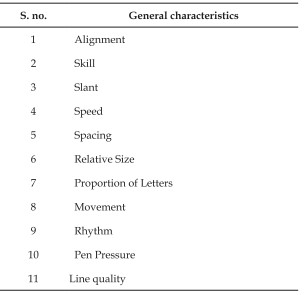
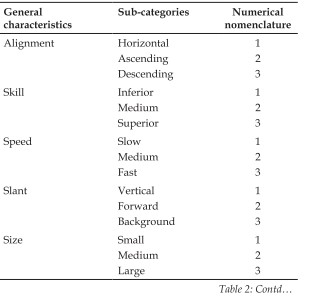
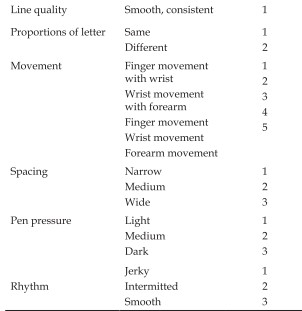
India has been praised for its diversity, particularly in terms of cast, ethos, dialects, religion, and calligraphies. Brahmi characters are ancient India’s primevalscript system, dating back to the first millennium BCE. The Gurumukhi script is the eleventh most widely used script in the world. The Gurumukhi script is written from left to right and from top to bottom. The common beginnings of the scripts, as well as their divergence, are significant and critical. It is undeniably impossible for an auditor to be familiar with eachcalligraphy, specifically in a nation state like India, where languages and scripts vary greatly. The aim of this paperdefines the class and individual features of Gurumukhi scripts, laying the groundwork for calligraphy forensic testing.
References
- 1. Harrison, W.R. Suspect documents, Praeger publishers; 1958
- 2. Osborn, A.S. Questioned documents, 2nd edn. Boyd printing company; 1929.
- 3. Hilton, O. Scientific examination of questioned documents, revised edn. CRC press; 1993.
- 4. Brewester, F. Contested documents & forgeries, the book company ltd; 1932.
- 5. Huber, R.A., Headrick, A.M. Handwriting identification: facts and fundamentals, CRC Press; 1999.
- 6. Kelly, J.S., Lindblom, B.S. Scientific examination of questioned documents, 2nd edn. CRC press; 2006.
- 7. Mehta, M.K. Identification of handwriting and cross – examination of the expert, 2nd edn. N. M. Tripathi publication; 1961.
- 8. Allen, D. Handwriting examination of unfamiliar scripts. International journal of forensic document examiners 1999; 5: 424.
- 9. Mathur, S. and Chaudhary, K.S. Examination of Handwritten Documents of Unfamiliar Scripts: A Forensic Viewpoint on Various Indian Languages. IMPACT: International Journal of Research in Applied 2014; 2: 4-137.
- 10. Mohamed, R. Statistical Examination of Common Characteristics for Disguised Handwriting amongst Malaysian. Health and the Environment Journal 2010; 1: 2-30.
- 11. Prasad, S. Handwriting Analysis Based on Segmentation Method for Prediction of Human Personality Using Support Vector Machine. International Journal of Computer Applications 2010; 8: 12-26.
- 12. Rahiman, A.M. HABIT: Handwriting Analysis Based Individualistic Traits Prediction. International Journal of Image Processing 2010; 7: 2-209.
- 13. Feder K.P., Majnemer A. Handwriting development, competency, and intervention. Developmental Medicine & Child Neurology 2007; 49(4): 312-7.
- 14. Graham S., Weintraub N. A review of handwriting research: Progress and prospects from 1980 to 1994. Educational psychology review 1996; 8: 7-87.
- 15. Srihari S.N., Cha S.H., Arora H., Lee S. Individuality of handwriting. Journal of forensic sciences 2002; 47(4): 856-72.
- 16. Tappert C.C., Suen C.Y., Wakahara T. The state of the art in online handwriting recognition. IEEE Transactions on pattern analysis and machine intelligence 1990; 12(8): 787-808.
- 17. Edelman S., Flash T. A model of handwriting. Biological cybernetics 1987; 57(1-2): 25-36.
- 18. Cornhill H., Case-Smith J. Factors that relate to good and poor handwriting. The American Journal of Occupational Therapy 1996; 50(9): 732-9.
- 19. Berninger V.W., Vaughan K.B., Abbott R.D., Abbott S.P., Rogan L.W., Brooks A., Reed E., Graham S. Treatment of handwriting problems in beginning writers: Transfer from handwriting to composition. Journal of educational Psychology 1997; 89(4): 652.
- 20. Van Galen G.P. Handwriting: Issues for a psychomotor theory. Human movement science 1991; 10(2-3): 165-91.
- 21. Graham S., Miller L. Handwriting research and practice: A unified approach. Focus on exceptional Children 1980; 13(2).
- 22. Said H.E., Tan T.N., Baker K.D. Personal identification based on handwriting. Pattern Recognition 2000; 33(1): 149-60.
- 23. Plamondon R., Maarse F.J. An evaluation of motor models of handwriting. IEEE Transactions on systems, man, and cybernetics 1989; 19(5): 1060-72.
- 24. Alston J., Taylor J. Handwriting: Theory, research and practice, New York: Nichols Publishing Company; 1987.
- 25. Vinny Sharma. Handwriting accents to reveal cultural identity of author: an Indian approach. Indian J forensic med Pathol 2021; 14: 168-173.
- 26. Ramsay J.O. Functional components of variation in handwriting. Journal of the American Statistical Association 2000; 95(449): 9-15
Data Sharing Statement
There are no additional data available. All raw data and code are available upon request.
Funding
This research received no funding.
Author Contributions
All authors contributed significantly to the work and approve its publication.
Ethics Declaration
This article does not involve any human or animal subjects, and therefore does not require ethics approval.
Acknowledgements
We would like to express our gratitude to the patients, their families, and all those who have contributed to this study.
Conflicts of Interest
No conflicts of interest in this work.
About this article

Cite this article
Sharma A, Sharma V. A Preliminary Study Investigating Class Characteristics in the Gurumukhi Handwriting. Indian J Forensic Med Pathol. 2025;18(2 Suppl):134-139.
Licence:
Attribution-Non-commercial 4.0 International (CC BY-NC 4.0)This license enables reusers to distribute, remix, adapt, and build upon the material in any medium or format for noncommercial purposes only, and only so long as attribution is given to the creator.
| Received | Accepted | Published |
|---|---|---|
| April 01, 2024 | June 25, 2025 | June 30, 2025 |
DOI: https://doi.org/10.21088/ijfmp.0974.3383.18225.13
Keywords
Forensic linguisticsHandwriting comparisonClass characteristicsSearch for Similar Articles
Similar Articles
- Diatom Analysis in Thermophilic water bodies: A Study on Hot Water Springs of Ma...
- Morphometric Study of Supra-meatal Triangle and Mastoid process in the Adult dry...
- Histopathological Spectrum of Autopsy Cases: A One Year Retrospective Observatio...
- Forensic Differentiation of Manner of Death in Railway Fatalities: A FourCase Se...
- Understanding assault Patterns: A Cross-sectional study of Cases at Chri, Kelamb...
Article Level Metrics
Last UpdatedSunday 18 October 2026, 15:53:20 (IST)
16279
Accesses
62
3209
00
Citations
NA
NA
NA
Download citation
Article Keywords
Keyword Highlighting
Highlight selected keywords in the article text.
Timeline
| Received | April 01, 2024 |
| Accepted | June 25, 2025 |
| Published | June 30, 2025 |
licence
Attribution-Non-commercial 4.0 International (CC BY-NC 4.0)
This license enables reusers to distribute, remix, adapt, and build upon the material in any medium or format for noncommercial purposes only, and only so long as attribution is given to the creator.