Full Text (PDF)
Journal of Plastic Surgery and Transplantation 3(1):p 35-441, January–June 2023. | DOI: NA
Review Article
Versatility of Negative Pressure Wound Dressings in Plastic Surgery
Author Information
Licence:
Attribution-Non-commercial 4.0 International (CC BY-NC 4.0)This license enables reusers to distribute, remix, adapt, and build upon the material in any medium or format for noncommercial purposes only, and only so long as attribution is given to the creator.
Journal of Plastic Surgery and Transplantation 3(1):p 35-441, January–June 2023. | DOI: NA
How Cite This Article:
Alexander LV. Versatility of Negative Pressure Wound Dressings in Plastic Surgery. J Plast Surg Transplant. 2023;3(1):35-41.Timeline
Received : May 25, 2023
Accepted : June 16, 2023
Published : June 15, 2023
Abstract
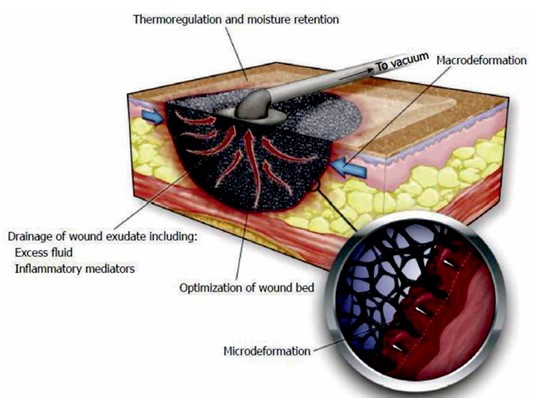
Negative wound dressing, also known as Vacuum-assisted closure (VAC) dressings, have become a staple for most plastic surgeons when managing difficult wounds. But now a days, the scope of VAC dressings has broadened and includes burn wounds, open fracture wounds, radiation wounds, post-surgical wounds, abdominal wounds and post-traumatic complex wounds. This review discusses the mechanism of action of VAC, applications, pros and cons of this technique and finally, the future directions and research that must be done to refine this technique.
References
- 1. Argenta LC, Morykwas MJ. Vacuum-assisted closure: a new method for wound control and treatment: clinical experience. Ann Plast Surg. 1997 Jun;38(6):563-76; discussion 577. PMID: 9188971.
- 2. Fleischmann W, Strecker W, Bombelli M, Kinzl L. Vakuumversiegelungzur Behandlung des Weichtei lschadensbeioffenenFrakturen [Vacuum sealing as treatment of soft tissue damage in open fractures]. Unfallchirurg. 1993 Sep;96(9):488-92. German. PMID: 8235687.
- 3. Panayi AC, Leavitt T, Orgill DP. Evidence based review of negative pressure wound therapy. World J Dermatol 2017; 6(1): 1-16
- 4. Gupta S, Ichioka S. Optimal use of negative pressure wound therapy in treating pressure ulcers. Int Wound J. 2012 Aug;9 Suppl 1(Suppl 1):8-16. doi: 10.1111/j.1742-481X.2012.01012.x. PMID: 22727135; PMCID: PMC7950901.
- 5. Tang AT, Ohri SK, Haw MP. Novel application of vacuum assisted closure technique to the treatment of sternotomy wound infection. Eur J Cardiothorac Surg. 2000 Apr;17(4):482 4. doi: 10.1016/s1010- 7940(00)00349-3. PMID: 10773574.
- 6. DeFranzo AJ, Marks MW, Argenta LC, Genecov DG. Vacuum-assisted closure for the treatment of degloving injuries. PlastReconstr Surg. 1999 Dec;104(7):2145 8. doi: 10.1097/00006534-199912000-00031. PMID: 11149782.
- 7. Smith LA, Barker DE, Chase CW, Somberg LB, Brock WB, Burns RP. Vacuum pack technique of temporary abdominal closure: a four-year experience. Am Surg. 1997 Dec;63(12):1102-7; discussion 1107-8. PMID: 9393260.
- 8. Kovacs L, Kloppel M, Geishauser S, Schmiedl S, Biemer E. Vacuum sealing: a new and promising regimen in the therapy of radiation ulcers. Br J Surgery. 1998; 85(7): 85-70.
- 9. Kairinos N, Solomons M, Hudson DA. Negativepressure wound therapy I: the paradox of negative-pressure wound therapy. PlastReconstr Surg. 2009 Feb;123(2):589-598.
- 10. Borgquist O, Ingemansson R, Malmsjö M. The influence of low and high pressure levels during negative-pressure wound therapy on wound contraction and fluid evacuation. PlastReconstr Surg. 2011 Feb;127(2):551-559.
- 11. Saxena V, Hwang CW, Huang S, Eichbaum Q, Ingber D, Orgill DP. Vacuum-assisted closure: microdeformations of wounds and cell proliferation. PlastReconstr Surg. 2004 Oct;114(5):1086-96; discussion 1097-8. doi: 10.1097/01.prs.0000135330.51408.97.
- 12. Urschel JD, Scott PG, Williams HT. The effect of mechanical stress on soft and hard tissue repair; a review. Br J Plast Surg. 1988 Mar;41(2):182-6. doi: 10.1016/0007 1226(88)90049-5.
- 13. Huang C, Leavitt T, Bayer LR, Orgill DP. Effect of negative pressure wound therapy on wound healing. CurrProbl Surg. 2014 Jul;51(7):301-31.
- 14. Lancerotto L, Bayer LR, Orgill DP. Mechanisms of action of microdeformational wound therapy. Semin Cell Dev Biol. 2012 Dec;23(9):987-92. doi: 10.1016/j. semcdb.2012.09.009.
- 15. Younan G, Ogawa R, Ramirez M, Helm D, Dastouri P, Orgill DP. Analysis of nerve and neuropeptide patterns in vacuum-assisted closure-treated diabetic murine wounds. PlastReconstr Surg. 2010 Jul;126(1):87-96.
- 16. Kheirabadi BS, Terrazas IB, Williams JF, Hanson MA, Dubick MA, Blackbourne LH. Negativepressure wound therapy: a hemostatic adjunct for control of coagulopathic hemorrhage in large soft tissue wounds. J Trauma Acute Care Surg. 2012 Nov;73(5):1188-94.
- 17. Greene AK, Puder M, Roy R, Arsenault D, Kwei S, Moses MA, Orgill DP. Microdeformational wound therapy: effects on angiogenesis and matrix metalloproteinases in chronic wounds of 3 debilitated patients. Ann Plast Surg. 2006 Apr;56(4):418-22.
- 18. Nuutila K, Siltanen A, Peura M, Harjula A, Nieminen T, Vuola J, Kankuri E, Aarnio P. Gene expression profiling of negative pressure-treated skin graft donor site wounds. Burns. 2013 Jun;39(4):687-93.
- 19. Morykwas MJ, Faler BJ, Pearce DJ, Argenta LC. Effects of varying levels of subatmospheric pressure on the rate of granulation tissue formation in experimental wounds in swine. Ann Plast Surg. 2001 Nov;47(5):547-51.
- 20. Morykwas MJ, Simpson J, Punger K, Argenta A, Kremers L, Argenta J. Vacuum assisted closure: state of basic research and physiologic foundation. PlastReconstr Surg. 2006 Jun;117(7 Suppl):121S- 126S.
- 21. Pappalardo V, Frattini F, Ardita V, Rausei S. Negative Pressure Therapy (NPWT) for Management of Surgical Wounds: Effects on Wound Healing and Analysis of Devices Evolution. Surg Technol Int. 2019 May 15;34:56-67.
- 22. Taylor M E, Ngaage L M, Wasicek P, et al. (May 11, 2021) Vacuum-Assisted Incisional Closure Therapy After Groin Reconstruction With Muscle Flap. Cureus 13(5): e14954. DOI 10.7759/cureus.14954.
- 23. Kamolz LP, Andel H, Haslik W, Winter W, Meissl G, Frey M. Use of subatmospheric pressure therapy to prevent burn wound progression in human: first experiences. Burns. 2004 May;30(3):253-8.
- 24. Honari S, Gibran NS, Engrav LH. Three years’ experience with 52 Integra (artificial skin) patients since FDA approval. J Burn Care Rehabil 2000; 21: 190.
- 25. Eyvaz K, Kement M, Balin S, Acar H, Kündeş F, Karaoz A, Civil O, Eser M, Kaptanoglu L, Vural S, Bildik N. Clinical evaluation of negative-pressure wound therapy in the management of electrical burns. Ulus Travma Acil CerrahiDerg. 2018 Sep;24(5):456-461.
- 26. Roberts DJ, Zygun DA, Grendar J, Ball CG, Robertson HL, Ouellet JF, Cheatham ML, Kirkpatrick AW. Negative-pressure wound therapy for critically ill adults with open abdominal wounds: a systematic review. J Trauma Acute Care Surg. 2012 Sep;73(3): 629-39. doi: 10.1097/ TA.0b013e31825c130e. PMID: 22929494.
- 27. Hamaguchi R, Shekar PS, Johnson JA, Orgill DP. Current Management of Sternal Wounds. PlastReconstr Surg. 2021 Dec 1;148(6):1012e-1025e. doi: 10.1097/ PRS.0000000000008510. PMID: 34847131.
- 28. Petkar KS, Dhanraj P, Kingsly PM, Sreekar H, Lakshmanarao A, Lamba S, Shetty R, Zachariah JR. A prospective randomized controlled trial comparing negative pressure dressing and conventional dressing methods on split-thickness skin grafts in burned patients. Burns. 2011 Sep;37(6):925-9.
- 29. Moisidis E, Heath T, Boorer C, Ho K, Deva AK. A prospective, blinded, randomized, controlled clinical trial of topical negative pressure use in skin grafting. PlastReconstr Surg. 2004 Sep 15;114(4):917-22.
- 30. Meara JG, Guo L, Smith JD, Pribaz JJ, Breuing KH, Orgill DP. Vacuum-assisted closure in the treatment of degloving injuries. Ann Plast Surg. 1999 Jun;42(6):589-94. doi: 10.1097/00000637- 199906000-00002.
- 31. Vaienti L, Gazzola R, Benanti E, Leone F, Marchesi A, Parodi PC, Riccio M. Failure by congestion of pedicled and free flaps for reconstruction of lower limbs after trauma: the role of negativepressure wound therapy. J OrthopTraumatol. 2013 Sep;14(3):213-7.
- 32. Stinner DJ, Waterman SM, Masini BD, Wenke JC. Silver dressings augment the ability of negative pressure wound therapy to reduce bacteria in a contaminated open fracture model. J Trauma. 2011 Jul;71(1 Suppl):S147-50. doi: 10.1097/ TA.0b013e318221944a.
- 33. Kim PJ, Attinger CE, Steinberg JS, Evans KK, Lehner B, Willy C, Lavery L, Wolvos T, Orgill D, Ennis W, Lantis J, Gabriel A, Schultz G. Negativepressure wound therapy with instillation: international consensus guidelines. PlastReconstr Surg. 2013 Dec;132(6):1569-1579. doi: 10.1097/ PRS.0b013e3182a80586.
- 34. Scimeca CL, Bharara M, Fisher TK, Kimbriel H, Mills JL, Armstrong DG. Novel use of insulin in continuous-instillation negative pressure wound therapy as “wound chemotherapy”. J Diabetes Sci Technol 2010; 4: 820-824
- 35. Eldenburg E, Pfaffenberger M, Gabriel A. Closure of a Complex Lower Extremity Wound With the Use of Multiple Negative Pressure Therapy Modalities. Cureus. 2020 Jul 17;12(7):e9247. doi: 10.7759/cureus.9247.
- 36. Semsarzadeh NN, Tadisina KK, Maddox J, Chopra K, Singh DP. Closed Incision Negative-Pressure Therapy Is Associated with Decreased Surgical-Site Infections: A Meta-Analysis. PlastReconstr Surg 2015; 136: 592-602.
- 37. Stannard JP, Volgas DA, McGwin G 3rd, Stewart RL, Obremskey W, Moore T, Anglen JO. Incisional negative pressure wound therapy after high-risk lower extremity fractures. J Orthop Trauma. 2012 Jan;26(1):37 42. doi: 10.1097/ BOT.0b013e318216b1e5.
- 38. Wilkes RP, Kilpad DV, Zhao Y, Kazala R, McNulty A. Closed incision management with negative pressure wound therapy (CIM): biomechanics. Surg Innov. 2012 Mar;19(1): 67-75. doi: 10.1177/1553350611414920.
- 39. Agarwal P, Kukrele R, Sharma D. Vacuum assisted closure (VAC)/negative pressure wound therapy (NPWT) for difficult wounds: A review. J Clin Orthop Trauma. 2019 Sep-Oct;10(5):845-848. doi: 10.1016/j. jcot.2019.06.015.
Data Sharing Statement
There are no additional data available. All raw data and code are available upon request.
Funding
This research received no funding.
Author Contributions
All authors contributed significantly to the work and approve its publication.
Ethics Declaration
This article does not involve any human or animal subjects, and therefore does not require ethics approval.
Acknowledgements
We would like to express our gratitude to the patients, their families, and all those who have contributed to this study.
Conflicts of Interest
No conflicts of interest in this work.
About this article

Cite this article
Alexander LV. Versatility of Negative Pressure Wound Dressings in Plastic Surgery. J Plast Surg Transplant. 2023;3(1):35-41.
Licence:
Attribution-Non-commercial 4.0 International (CC BY-NC 4.0)This license enables reusers to distribute, remix, adapt, and build upon the material in any medium or format for noncommercial purposes only, and only so long as attribution is given to the creator.
| Received | Accepted | Published |
|---|---|---|
| May 25, 2023 | June 16, 2023 | June 15, 2023 |
DOI: NA
Keywords
Search for Similar Articles
Similar Articles
- Application of Amnion Allograft in Treatment of Thermal Burns
- Bio-cellulose Dressing in the Management of Deep Second-Degree Burns: Our Experi...
- Autologous Whole Blood Clot Matrix in the Management of SecondDegree Burns
- CT Image Reconstruction & 3D Reconstruction CT in Plastic Surgery: A Review
- Out of Love and Affection: A Medicolegal Paradox for Denying Gains Vs Pleading C...
Article Level Metrics
Last UpdatedSaturday 24 October 2026, 22:37:05 (IST)
1122
Accesses
11
539
00
Citations
NA
NA
NA
Download citation
Article Keywords
Keyword Highlighting
Highlight selected keywords in the article text.
Timeline
| Received | May 25, 2023 |
| Accepted | June 16, 2023 |
| Published | June 15, 2023 |
licence
Attribution-Non-commercial 4.0 International (CC BY-NC 4.0)
This license enables reusers to distribute, remix, adapt, and build upon the material in any medium or format for noncommercial purposes only, and only so long as attribution is given to the creator.