Full Text (PDF)
Indian Journal of Cancer Education and Research 12(2):p 51-56, July- Dec. 2024. | DOI: http://dx.doi.org/10.21088/ijcer.2321.9815.12224.1
Original Article
Use of High Dose Rate Surface Mould Brachytherapy in Oral and Skin Malignancies: A Single Institute Retrospective Study
Virendra Bhandari, null, Dipshi Agrawal1 Amresh Kumar2 null, Ashar Iqbal Lodi3 null, Virendra Bhandari4 null, Neha Singh Rajput null
Author Information
Licence:
Attribution-Non-commercial 4.0 International (CC BY-NC 4.0)This license enables reusers to distribute, remix, adapt, and build upon the material in any medium or format for noncommercial purposes only, and only so long as attribution is given to the creator.
Indian Journal of Cancer Education and Research 12(2):p 51-56, July- Dec. 2024. | DOI: http://dx.doi.org/10.21088/ijcer.2321.9815.12224.1
How Cite This Article:
Dipshi Agrawal Amresh Kumar, et al., Use of High Dose Rate Surface Mould Brachytherapy in Oral and Skin Malignancies: A Single Institute Retrospective Study. Ind J Canc Educ Res 2024;12(2):51-56.
Timeline
Received : July 01, 2024
Accepted : July 17, 2024
Published : July 31, 2024
Abstract
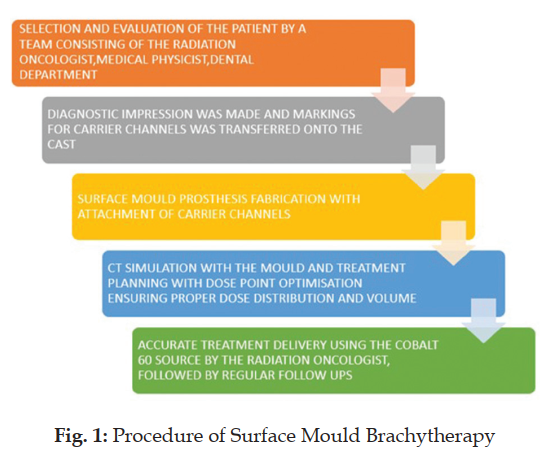
Aim: Use of Surface Mould Brachytherapy in the treatment of skin and oral malignancies at our institution. Background: SMB offers a good therapeutic ratio helping in dose escalation of irradiationand higher Biologically equivalent doses. In this study, we share our institutional experience with SMB in different types of cancers. Materials and Methods: 15 Patients with oral, skin, and penile malignancies treated with SMB were analyzed from Jan 2019 to Sept 2023. Treatment was delivered using HDR Co 60 source with a customized mouldto a median dose of 48Gy in the radical setting and 15Gy as a boost with 2.5-3Gy/# twice a day. The treatment-related toxicities and response were noted. Results: 15 patients with various malignancies were evaluated. Eight patients received SMB alone while 7 patients external beam radiotherapy with SMB Boost. A Complete: Partial response ratio of about 80:20 was achieved. There were 3 local failures all in hard Palate patients. The acute toxicity outcomes were as follows - 12 patients of Grade 1 and 3 patients of Grade 2 toxicities. Late toxicities reported were Grade 1 in six patients, Grade 2 in 5 patients, and Grade 3 in one patient. Conclusion: Surface mould brachytherapy provides maximum local tumor control, is well-tolerated, and is a non-invasive, outpatient procedure for treatment in both radical settings and as a boost. It results in organ and function preservation and is a good alternative option for patients who are unwilling for surgery and who present with comorbidities.
References
- 1. Svoboda VH, Kovarik J, Morris F. High doserate microselectronmolds in the treatment of skin
- 2. Allan E, Stanton A, Pye D et al. Fractionated high dose rate brachytherapy olds – a precise treatment for carcinoma of the pinna. RadiotherOncol 1998; 48: 277-281.
- 3. Guix B, Finestres F, Tello J et al. Treatment of skin carcinomas of the face by high-dose-rate
- 4. Maroñas M, Guinot JL, Arribas L et al. Treatment of facial cutaneous carcinoma with high-dose rate contact brachytherapy with customized molds. Brachytherapy 2011; 10: 221-227.
- 5. Kudoh T, Ikushima H, Kudoh K et al. High-doserate brachytherapy for patients with maxillary gingival carcinoma using a novel customized intraoral mold technique. Oral Surg Oral Med Oral Pathol Oral RadiolEndod 2010; 109: e102-108.
- 6. Ariji E, Hayashi N, Kimura Y et al. Customized mold brachy therapy for oral carcinomas through use of high-dose-rate remote afterloading apparatus. Oral Surg Oral Med Oral Pathol Oral RadiolEndod 1999; 87: 508-512.
- 7. Mukherji A, Mourougan S, Saravannan K, et al.Dosimetric analysis and clinical outcomes in CTbased mould brachytherapy in early oral cancers in patients unfit for surgery. J Contemp Brachytherapy 2015; 7: 147-153.
- 8. Takeda M, Shibuya H, Inoue T. The efficacy of gold198 grain mold therapy for mucosal carcinomas of the oral cavity. Acta Oncol 1996; 35: 463-467.
- 9. Budrukkar A, Dasgupta A, Pandit P, Laskar SG, Murthy V, Upreti RR, Gupta T, Dholam K, Agarwal JP. Clinical outcomes with high-dose-rate surface mould brachytherapy for intra-oral and skin malignancies involving head and neck region. Journal of Contemporary Brachytherapy. 2017 Mar 23;9(3):242-50.
- 10. Nishimura Y, Yokoe Y, Nagata, Y, Okajima K, Nishida M, Hiraoka M. High-dose-rate brachytherapy using molds for oral cavity cancer. The technique and its limitations. Int J Clin Oncol 1998; 3: 351-356.
- 11. Unetsubo T, Matsuzaki H, Takemoto M, Katsui K, Hara M, Katayama N, Waki T, Kanazawa S, Asaumi JI. High-dose-rate brachytherapy using molds for lip and oral cavity tumors. Radiation Oncology. 2015 Dec;10(1):1-8.
- 12. Marbán M, Crook J, Keyes M, Dubash R, Batchelar D. High-dose-rate brachytherapy for localized penile cancer: evolution of a technique. Brachytherapy. 2020 Mar 1;19(2):201-9.
- 13. Clark CM, Furniss M, Mackay-Wiggan JM. Basal cell carcinoma: an evidence based treatment update. Am J Clin Dermatol. 2014 Jul:15(3):197-216.
- 14. Delishaj D, Laliscia C, Manfredi B, Ursino S, Pasqualetti F, Lombardo E, Perrone F, Morganti R, Paiar F, Fabrini MG. Non-melanoma skin cancer treated with high-dose-rate brachytherapy and Valencia applicator in elderly patients: a retrospective case series. Journal of contemporary brachytherapy. 2015 Dec 1;7(6):437-44
Data Sharing Statement
There are no additional data available. All raw data and code are available upon request.
Funding
This research received no funding.
Author Contributions
All authors contributed significantly to the work and approve its publication.
Ethics Declaration
This article does not involve any human or animal subjects, and therefore does not require ethics approval.
Acknowledgements
We would like to express our gratitude to the patients, their families, and all those who have contributed to this study.
Conflicts of Interest
No conflicts of interest in this work.
About this article

Cite this article
Dipshi Agrawal Amresh Kumar, et al., Use of High Dose Rate Surface Mould Brachytherapy in Oral and Skin Malignancies: A Single Institute Retrospective Study. Ind J Canc Educ Res 2024;12(2):51-56.
Licence:
Attribution-Non-commercial 4.0 International (CC BY-NC 4.0)This license enables reusers to distribute, remix, adapt, and build upon the material in any medium or format for noncommercial purposes only, and only so long as attribution is given to the creator.
| Received | Accepted | Published |
|---|---|---|
| July 01, 2024 | July 17, 2024 | July 31, 2024 |
DOI: http://dx.doi.org/10.21088/ijcer.2321.9815.12224.1
Keywords
HDR BrachytherapySurface mouldoral cancersskin malignanciesSurface mouldoral cancersskin malignanciesSearch for Similar Articles
Similar Articles
- Unusual Presentation of Solitary Metastasis to the Right Metacarpal Bone in Rena...
- Technical Feasibility and Planning Challenges of Delivering Total Body Irradiat...
- Excellent Response Rates with Bortezomib - Cyclophosphamide – Dexamethasone (VCD...
- Optimizing Postoperative Radiation Therapy in Ewing’s Sarcoma with Lung Metasta...
- Current Therapeutic Strategies Targeting Tyrosine Kinase Receptor in Colon Canc...
Article Level Metrics
Last UpdatedWednesday 30 September 2026, 08:35:18 (IST)
1909
Accesses
23
289
00
Citations
NA
NA
NA
Download citation
Article Keywords
Keyword Highlighting
Highlight selected keywords in the article text.
Timeline
| Received | July 01, 2024 |
| Accepted | July 17, 2024 |
| Published | July 31, 2024 |
licence
Attribution-Non-commercial 4.0 International (CC BY-NC 4.0)
This license enables reusers to distribute, remix, adapt, and build upon the material in any medium or format for noncommercial purposes only, and only so long as attribution is given to the creator.