Full Text (PDF)
Indian Journal of Cancer Education and Research 12(2):p 57-62, July- Dec. 2024. | DOI: https://doi.org/10.21088/ijcer.2321.9815.12224.2
Original Article
Targeted Mutation Panel in NSCLC: A Single Center Experience
Meena Pangarkar, null, Meena A. Pangarkar1 null, Koshu Badlani2 null
Author Information
Licence:
Attribution-Non-commercial 4.0 International (CC BY-NC 4.0)This license enables reusers to distribute, remix, adapt, and build upon the material in any medium or format for noncommercial purposes only, and only so long as attribution is given to the creator.
Indian Journal of Cancer Education and Research 12(2):p 57-62, July- Dec. 2024. | DOI: https://doi.org/10.21088/ijcer.2321.9815.12224.2
How Cite This Article:
Meena A. Pangarkar, Koshu Badlani. Targeted Mutation Panel in NSCLC: A Single Center Experience. Ind J Canc Educ Res 2024;12(2):57-62.
Timeline
Received : July 05, 2024
Accepted : July 19, 2024
Published : August 11, 2024
Abstract
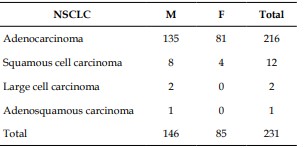
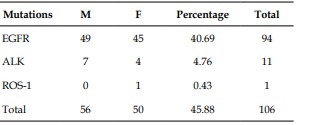
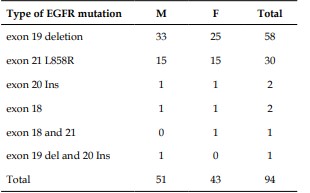
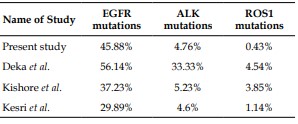
Introduction: Non Small Cell Lung Carcinoma (NSCLC) is one of the top ranking cancers in both males and female patients across India. Majority of cases are in advanced stage at presentation. Recent advances in molecular techniques and drug discovery have made the mutation analysis of this carcinoma a part of standard investigation before treatment in NSCLC. In view of cost constraints, a targeted gene panel test is advised for all cases.The purpose of this study is to document the application of this practice at a single tertiary cancer care center in central India. Material and Methods: Two hundred and thirty one cases of NSCLC were reported at our hospital from January 2019 till December 2023. Triage testing was done initially for Epidermal growth factor receptor (EGFR) gene mutations by ARMS RT-PCR/ Targeted NGS. Subsequently EGFR negative cases were tested for Analysis of Anaplastic lymphoma receptor tyrosine kinase gene (ALK), Repressor of Silencing 1 (ROS1) gene by immunohistochemistry (IHC). Results: 106 cases were found to have tested positive for these mutations, 56 were males and 50 were females. The average age for male patients was 60.17 yrs and for female patients was 56.3 yrs. EGFR mutations were found in 40.69% cases, out of which exon 19 deletion and exon 21 L858R were the most frequent (38.09%). Rare cases of single and compound mutations were also seen. ALK and ROS1 gene rearrangements were found in 4.76% and 0.43% respectively. EGFR, ALK and ROS1 mutations were mutually exclusive. Conclusion: Targeted gene mutation testing is a very significant investigation in patients with advanced NSCLC, as it results in tailoring and optimising the treatment for individual patients and offers hope for the best outcome.
References
- 1. Navneet Singh, Sushma Agrawal, Sabita Jiwnani, Divya Khosla, Prabhat S. Malik, Anant Mohan,
- 2. Mohan A, Garg A, Gupta A, Sahu S, Choudhari C, Vashistha V, Ansari A, Pandey R, Bhalla AS,
- 3. Kaur H, Sehgal IS, Bal A, Gupta N, Behera D, Das A, Singh N. Evolving epidemiology of lung cancer
- 4. Deka H, Mahanta N, Kalita NK, Goswami BC. Mutational Profiling by Next-Generation Sequencing in Patients with Metastatic Non-Small Cell Lung Carcinoma: Our Experience. South Asian
- 5. Raman R, Ramamohan V, Rathore A, Jain D, Mohan A, Vashistha V. Prevalence of highly actionable
- 6. Kishore RR, Pan V. Correlation between ALK, ROS1 Biomarkers and EGFR Oncogene Mutations
- 7. Thomas R, Balaram G, Varayathu H, Ghorpade SN, Kowsik PV, Dharman B, Thomas BE,
- 8. Kesri R, Goyal H, Gupta G, Bharti D, Sharma R. Prevalence and Clinicopathologic Risk Factors for
- 9. Pao, W. and Miller, V.A. (2005) Epidermal growth factor receptor mutations, small molecule kinase inhibitors, and non-smallcell lung cancer: current knowledge and future directions. J. Clin. Oncol. 23, 2556
- 10. Howlader N, Forjaz G, Mooradian MJ, Meza R, Kong CY, Cronin KA, Mariotto AB, Lowy DR, Feuer EJ. The effect of advances in lung-cancer treatment on population mortality. New England Journal of Medicine. 2020 Aug 13;383(7):640-9.
- 11. Sequist, L.V., et al. (2008) First-line gefitinib in patients with advanced non-small cell lung cancer harboring8 somatic EGFR mutations. J. Clin. Oncol. 15, 2442.
- 12. Porta, R. et al. (2008) Erlotinib customization based on epidermal growth factor receptor (EGFR) mutations in stage IV nonsmall-cell lung cancer (NSCLC) patients (p). J. Clin. Oncol. 26(May 20 suppl), abstr 8038.
- 13. Pillai RN, Ramalingam SS. The biology and clinical features of non-small cell lung cancers with EML4-ALK translocation. Current Oncology Reports. 2012 Apr;14(2):105-110.
- 14. Camidge DR, Bang YJ, Kwak EL, Iafrate AJ, VarellaGarcia M, Fox SB, Riely GJ, Solomon B, Ou SH, Kim DW, Salgia R, Fidias P, Engelman JA, Gandhi L, Jänne PA, Costa DB, Shapiro GI, Lorusso P, Ruffner K, Stephenson P, Tang Y, Wilner K, Clark JW, Shaw AT. Activity and safety of crizotinib in patients with ALK-positive non-small-cell lung cancer: updated results from a phase 1 study. Lancet Oncol. 2012 Oct;13(10):1011-9.
- 15. Sholl LM, Sun H, Butaney M, Zhang C, Lee C, Jänne PA, Rodig SJ. ROS1 immunohistochemistry for detection of ROS1-rearranged lung adenocarcinomas. Am J Surg Pathol. 2013 Sep;37(9):1441-9. doi: 10.1097/PAS.0b013e3182960fa7.
- 16. Li H, Durbin R. Fast and accurate short read alignment with Burrows-Wheeler transform. Bioinformatics. 2009 Jul 15;25(14):1754-60.
- 17. Meyer LR, Zweig AS, Hinrichs AS, Karolchik D, Kuhn RM, Wong M, Sloan CA, Rosenbloom KR, Roe G, Rhead B, Raney BJ, Pohl A, Malladi VS, Li CH, Lee BT, Learned K, Kirkup V, Hsu F, Heitner S, Harte RA, Haeussler M, Guruvadoo L, Goldman M, Giardine BM, Fujita PA, Dreszer TR, Diekhans M, Cline MS, Clawson H, Barber GP, Haussler D, Kent WJ. The UCSC Genome Browser database: extensions and updates 2013. Nucleic Acids Res. 2013 Jan;41(Database issue):D64-9.
- 18. Kendig KI, Baheti S, Bockol MA, Drucker TM, Hart SN, Heldenbrand JR, Hernaez M, Hudson ME, Kalmbach MT, Klee EW, Mattson NR, Ross CA, Taschuk M, Wieben ED, Wiepert M, Wildman DE, Mainzer LS. Sentieon DNASeq Variant Calling Workflow Demonstrates Strong Computational Performance and Accuracy. Front Genet. 2019 Aug 20;10:736
- 19. Li MM, Datto M, Duncavage EJ, Kulkarni S, Lindeman NI, Roy S, Tsimberidou AM, VnencakJones CL, Wolff DJ, Younes A, Nikiforova MN. Standards and Guidelines for the Interpretation and
- 20. Shi Y, Li J, Zhang S, Wang M, Yang S, Li N, et al. Molecular epidemiology of EGFR mutations in
- 21. Singh V, Nambirajan A, Malik PS, Thulkar S, Pandey RM, Luthra K, Arava S, Ray R, Mohan A,
- 22. Lynch TJ, Bell DW, Sordella R, Gurubhagavatula S, Okimoto RA, Brannigan BW, Harris PL, Haserlat
- 23. Dungo RT, Keating GM. Afatinib: first global approval. Drugs. 2013 Sep;73(13):1503-15.
- 24. Cheng Y, He Y, Li W, Zhang HL, Zhou Q, Wang B, Liu C, Walding A, Saggese M, Huang X, Fan M, Wang J, Ramalingam SS. Osimertinib Versus Comparator EGFR TKI as First-Line Treatment for EGFR-Mutated Advanced NSCLC: FLAURA China, A Randomized Study. Target Oncol. 2021 Mar;16(2):165-176.
- 25. Noronha V, Prabhash K, Thavamani A, Chougule A, Purandare N, Joshi A, et al. EGFR mutations in Indian lung cancer patients: Clinical correlation and outcome to EGFR targeted therapy. PLoS One 2013;8:e61561.
- 26. Chougule A, Prabhash K, Noronha V, Joshi A, Thavamani A, Chandrani P, et al. Frequency of EGFR mutations in 907 lung adenocarcinoma patients of Indian ethnicity. PLoS One 2013;8:e76164.
- 27. Doval DC, Azam S, Batra U, Choudhury KD, Talwar V, Gupta SK, et al. Epidermal growth factor receptor mutation in lung adenocarcinoma in India: A single center study. J Carcinog 2013;12:12.
- 28. Meador CB, Sequist LV, Piotrowska Z. Targeting EGFR Exon 20 Insertions in Non-Small Cell Lung Cancer: Recent Advances and Clinical Updates. Cancer Discov. 2021 Sep;11(9):2145-2157
- 29. Xu H, Yang G, Li W, Li J, Hao X, Xing P, Yang Y, Wang Y. EGFR Exon 18 Mutations in Advanced Non-Small Cell Lung Cancer: A Real-World Study on Diverse Treatment Patterns and Clinical Outcomes. Front Oncol. 2021 Sep 2;11:713483.
Data Sharing Statement
There are no additional data available. All raw data and code are available upon request.
Funding
This research received no funding.
Author Contributions
All authors contributed significantly to the work and approve its publication.
Ethics Declaration
This article does not involve any human or animal subjects, and therefore does not require ethics approval.
Acknowledgements
We would like to express our gratitude to the patients, their families, and all those who have contributed to this study.
About this article

Cite this article
Meena A. Pangarkar, Koshu Badlani. Targeted Mutation Panel in NSCLC: A Single Center Experience. Ind J Canc Educ Res 2024;12(2):57-62.
Licence:
Attribution-Non-commercial 4.0 International (CC BY-NC 4.0)This license enables reusers to distribute, remix, adapt, and build upon the material in any medium or format for noncommercial purposes only, and only so long as attribution is given to the creator.
| Received | Accepted | Published |
|---|---|---|
| July 05, 2024 | July 19, 2024 | August 11, 2024 |
DOI: https://doi.org/10.21088/ijcer.2321.9815.12224.2
Keywords
Mutation testLung carcinomaEGFRALKROS1.Lung carcinomaEGFRALKROS1.Search for Similar Articles
Similar Articles
- Unusual Presentation of Solitary Metastasis to the Right Metacarpal Bone in Rena...
- Technical Feasibility and Planning Challenges of Delivering Total Body Irradiat...
- Excellent Response Rates with Bortezomib - Cyclophosphamide – Dexamethasone (VCD...
- Optimizing Postoperative Radiation Therapy in Ewing’s Sarcoma with Lung Metasta...
- Current Therapeutic Strategies Targeting Tyrosine Kinase Receptor in Colon Canc...
Article Level Metrics
Last UpdatedWednesday 30 September 2026, 08:33:54 (IST)
1909
Accesses
13
289
00
Citations
NA
NA
NA
Download citation
Article Keywords
Keyword Highlighting
Highlight selected keywords in the article text.
Timeline
| Received | July 05, 2024 |
| Accepted | July 19, 2024 |
| Published | August 11, 2024 |
licence
Attribution-Non-commercial 4.0 International (CC BY-NC 4.0)
This license enables reusers to distribute, remix, adapt, and build upon the material in any medium or format for noncommercial purposes only, and only so long as attribution is given to the creator.