Full Text (PDF)
Indian Journal of Cancer Education and Research 13(1):p 35-38, Jan-June 2025. | DOI: https://doi.org/10.21088/ijcer.2455.8621.10125.5
Case Report
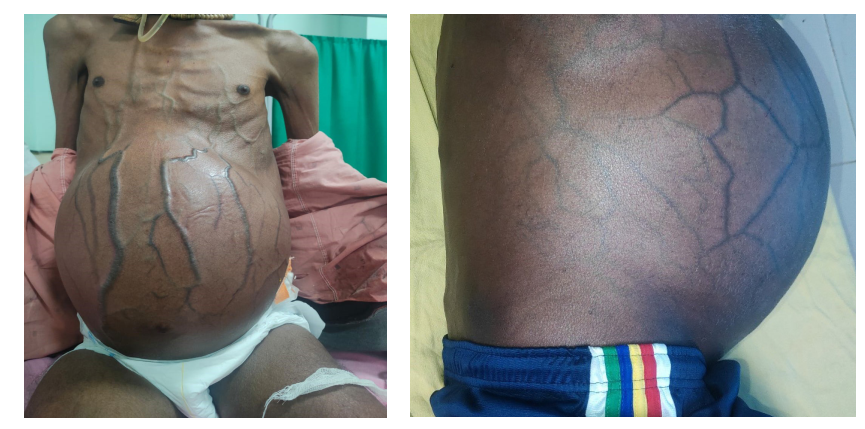
Unusual abdominal wall Varicosity: A Diagnostic Dilemma
Seema P Mahant,, Sagar Khadanga, Shubham Lodha
Author Information
Licence:
Attribution-Non-commercial 4.0 International (CC BY-NC 4.0)This license enables reusers to distribute, remix, adapt, and build upon the material in any medium or format for noncommercial purposes only, and only so long as attribution is given to the creator.
Indian Journal of Cancer Education and Research 13(1):p 35-38, Jan-June 2025. | DOI: https://doi.org/10.21088/ijcer.2455.8621.10125.5
How Cite This Article:
Seema P Mahant, Sagar Khadanga, Shubham Lodha. Unusual abdominal wall Varicosity: A Diagnostic Dilemma. Indian Journal of Cancer Education and Research. 2025; 13(1): 35-38.Timeline
Received : February 11, 2025
Accepted : May 08, 2025
Published : June 30, 2025
Abstract
Abdominal wall varicosity manifests as enlarged, winding veins on the anterior abdominal wall that is prominent enough to assess blood flow direction. While this condition can stem from several underlying causes, careful clinical examination can help distinguish between cirrhosis with portal hypertension and obstruction of the inferior vena cava (IVC) or superior vena cava (SVC). Clinical Assessment To determine blood flow direction in these veins, clinicians should follow a systematic approach: 1. Identify a vein segment free of branches for at least 3 cm 2. Place two fingers close together over the middle of this segment 3. Move both fingers in opposite directions to “milk” and completely empty the vein 4. Release one finger and observe the speed and direction of blood flow 5. Repeat the procedure in the opposite direction Budd-Chiari Syndrome Connection Budd-Chiari syndrome (BCS), while uncommon, should be considered when evaluating abdominal wall varicosity. This condition occurs when hepatic venous outflow becomes obstructed. The underlying causes typically fall into two categories: • Inherited hypercoagulable states • Acquired prothrombotic conditions Over half of BCS cases stem from acquired prothrombotic states, particularly myeloproliferative disorders including: • Polycythemia vera • Paroxysmal nocturnal hemoglobinuria • Essential thrombocytosis • Agnogenic myeloid metaplasia • Myelofibrosis Clinical Presentation The manifestation of BCS varies significantly, ranging from asymptomatic cases to acute hepatic failure. The severity depends on two key factors: • The extent and speed of hepatic vein occlusion • The development of venous collateral circulation to decompress liver sinusoids Notably, when large abdominal veins (typically the inferior vena cava or portal vein) become thrombosis, collateral vessels may develop in the abdominal wall. These collaterals can lead to visible abdominal varicosities during physical examination, serving as an important diagnostic indicator.
References
- 1. Hamulyák, E. N. et al. A systematic review of antithrombotic treatment of venous thromboembolism in patients with myeloproliferative neoplasms. Blood Adv 5, 113–121 (2021)
- 2. Găman, M.-A. et al. Budd-Chiari syndrome in myeloproliferative neoplasms: A review of literature. World J Clin Oncol 14, 99–116 (2023)
- 3. Darwish Murad, S. et al. Etiology, management, and outcome of the Budd-Chiari syndrome. Ann Intern Med 151, 167–175 (2009).
- 4. Smalberg, J. H. et al. Myeloproliferative neoplasms in Budd-Chiari syndrome and portal vein thrombosis: a meta-analysis. Blood 120, 4921–4928 (2012)
Data Sharing Statement
There are no additional data available. All raw data and code are available upon request.
Funding
This research received no funding.
Author Contributions
All authors contributed significantly to the work and approve its publication.
Ethics Declaration
This article does not involve any human or animal subjects, and therefore does not require ethics approval.
Acknowledgements
We would like to express our gratitude to the patients, their families, and all those who have contributed to this study.
Conflicts of Interest
No conflicts of interest.
About this article

Cite this article
Seema P Mahant, Sagar Khadanga, Shubham Lodha. Unusual abdominal wall Varicosity: A Diagnostic Dilemma. Indian Journal of Cancer Education and Research. 2025; 13(1): 35-38.
Licence:
Attribution-Non-commercial 4.0 International (CC BY-NC 4.0)This license enables reusers to distribute, remix, adapt, and build upon the material in any medium or format for noncommercial purposes only, and only so long as attribution is given to the creator.
| Received | Accepted | Published |
|---|---|---|
| February 11, 2025 | May 08, 2025 | June 30, 2025 |
DOI: https://doi.org/10.21088/ijcer.2455.8621.10125.5
Keywords
Abdominal wall varicosityBudd-Chiari syndrome (BCSPolycythemia veraPolycythemia vera (PV)JAK2V617F tyrosine kinaseSearch for Similar Articles
Similar Articles
- Unusual Presentation of Solitary Metastasis to the Right Metacarpal Bone in Rena...
- Technical Feasibility and Planning Challenges of Delivering Total Body Irradiat...
- Excellent Response Rates with Bortezomib - Cyclophosphamide – Dexamethasone (VCD...
- Optimizing Postoperative Radiation Therapy in Ewing’s Sarcoma with Lung Metasta...
- Current Therapeutic Strategies Targeting Tyrosine Kinase Receptor in Colon Canc...
Article Level Metrics
Last UpdatedWednesday 30 September 2026, 08:33:59 (IST)
1909
Accesses
16
289
00
Citations
NA
NA
NA
Download citation
Article Keywords
Keyword Highlighting
Highlight selected keywords in the article text.
Timeline
| Received | February 11, 2025 |
| Accepted | May 08, 2025 |
| Published | June 30, 2025 |
licence
Attribution-Non-commercial 4.0 International (CC BY-NC 4.0)
This license enables reusers to distribute, remix, adapt, and build upon the material in any medium or format for noncommercial purposes only, and only so long as attribution is given to the creator.