Full Text (PDF)
International Journal of Food, Nutrition & Dietetics 11(3):p 89-94, September - December 2023. | DOI: https://doi.org/10.21088/ijfnd.2322.0775.11323.1
Original Article
Type of Fats and Oils used, Physical Activity Levels, Dietary Habit and Lipid Profile of Coronary Artery Subjects
Shweatha H.E., Suhaima Sultana
Author Information
Licence:
Attribution-Non-commercial 4.0 International (CC BY-NC 4.0)This license enables reusers to distribute, remix, adapt, and build upon the material in any medium or format for noncommercial purposes only, and only so long as attribution is given to the creator.
International Journal of Food, Nutrition & Dietetics 11(3):p 89-94, September - December 2023. | DOI: https://doi.org/10.21088/ijfnd.2322.0775.11323.1
How Cite This Article:
Suhaima Sultana, Shweatha H.E./Type of Fats and Oils used, Physical Activity Levels, Dietary Habit and Lipid Profile of Coronary Artery Subjects/Int J Food Nutr Diet. 2023;11(3):89–94.Timeline
Received : May 31, 2023
Accepted : June 30, 2023
Published : December 30, 2023
Abstract
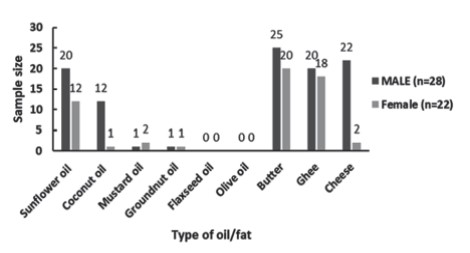
Dietary fats comprise of saturated and unsaturated fats. High consumption of saturated fats is implicated in coronary artery diseases. With this background the current research work was envisaged with an intention of knowing the type of fats and oils consumed by CAD subjects, as dietary fats and oils are the vehicle for saturated and unsaturated fatty acids in our diet. The polyunsaturated fatty acids especially omega 3 has shown cholesterol lowering action therefore encouraged to be consumed by CAD subjects. This study was conducted to identity the consumption pattern of fats and oils rich in omega 3 fatty acids. The results show that the majority of cardiac subjects neither consumed or were aware of nutritional benefits of omega fatty acids. Lipid profile was collected to know the lipid profile of the subjects and it showed that majority of subjects were dyslipidemic.
References
- 1. Brown JC, Gerhardt TE, Kwon E. Risk Factors for Coronary Artery Disease. In: Stat Pearls. Stat Pearls Publishing, Treasure Island (FL); 2022. PMID: 32119297.
- 2. Ezzati M., Lopez A.D., Rodgers A. World Health Organisation; Geneva: 2004. Comparative Quantification of Health Risks. Global and Regional Burden of Disease Attributable to Major Risk Factors. [Google Scholar].
- 3. Hajar, R., 2017. Risk factors for coronary artery disease: historical perspectives. Heart views: the official journal of the Gulf Heart Association, 18(3), p.109.
- 4. Libby, P. and Ridker, P.M., 2006. Inflammation and atherothrombosis: from population biology and bench research to clinical practice. Journal of the American College of Cardiology, 48(9S), pp.A33-A46.
- 5. Simopoulos, A.P. and Cleland, L.G. eds., 2003. Omega-6/omega-3 essential fatty acid ratio: the scientific evidence (Vol. 92). Karger Medical and Scientific Publishers.
- 6. Kannel, W.B., 2002. The Framingham Study: historical insight on the impact of cardiovascular risk factors in men versus women. The journal of gender-specific medicine: JGSM: the official journal of the Partnership for Women's Health at Columbia, 5(2), pp.27-37.
- 7. Koolhaas, C.M., Dhana, K., Schoufour, J.D., Ikram, M.A., Kavousi, M. and Franco, O.H., 2017. Impact of physical activity on the association of overweight and obesity with cardiovascular disease: The Rotterdam Study. European journal of preventive cardiology, 24(9), pp.934-941.
- 8. Maynard, S.J., Menown, I.B.A. and Adgey, A.A.J., 2000. Troponin T or troponin I as cardiac markers in ischaemic heart disease. Heart, 83(4), pp.371-373.
- 9. Sharma, S., Jackson, P.G. and Makan, J., 2004. Cardiac troponins. Journal of clinical pathology, 57(10), pp.1025-1026.
- 10. Filatov, V.L., Katrukha, A.G., Bulargina, T.V. and Gusev, N.B., 1999. Troponin: structure, properties, and mechanism of functioning. Biochemistry c/c of Biokhimiia, 64, pp.969-985.
- 11. Glenn, A.J., Lo, K., Jenkins, D.J., Boucher, B.A., Hanley, A.J., Kendall, C.W., Manson, J.E., Vitolins, M.Z., Snetselaar, L.G., Liu, S. and Sievenpiper, J.L., 2021. Relationship Between a Plant Based Dietary Portfolio and Risk of Cardiovascular Disease: Findings From the Women's Health Initiative Prospective Cohort Study. Journal of the American Heart Association, 10(16), p.e021515.
- 12. Aljaloud, K.S., Hughes, A.R. and Galloway, S.D., 2022. Impact of physical activity on adiposity and risk markers for cardiovascular and metabolic disease. American Journal of Men's Health, 16(2), p.15579883221092289.
- 13. Xu, W.H., Zhang, X.L., Gao, Y.T., Xiang, Y.B., Gao, L.F., Zheng, W. and Shu, X.O., 2007. Joint effect of cigarette smoking and alcohol consumption on mortality. Preventive medicine, 45(4), pp.313-319.
- 14. Mensink, R.P. and World Health Organization, 2016. Effects of saturated fatty acids on serum lipids and lipoproteins: a systematic review and regression analysis.
- 15. Amat Sairin, M., Abd Aziz, S., Yoke Mun, C., Khaled, A.Y. and Rokhani, F.Z., 2022. Analysis and prediction of the major fatty acids in vegetable oils using dielectric spectroscopy at 5–30 MHz.Plos one, 17(5), p.e0268827.
- 16. Whelan, J. and Fritsche, K., 2013. Linoleic acid. Advances in nutrition, 4(3), pp.311-312.
- 17. Aronson, J.K., 2003. Side Effects of Drugs Annual: A world-wide yearly survey of new data and trends in adverse drug reactions. Elsevier.
Data Sharing Statement
There are no additional data available. All raw data and code are available upon request.
Funding
This research received no funding.
Author Contributions
All authors contributed significantly to the work and approve its publication.
Ethics Declaration
This article does not involve any human or animal subjects, and therefore does not require ethics approval.
Acknowledgements
We would like to express our gratitude to the patients, their families, and all those who have contributed to this study.
Conflicts of Interest
No conflicts of interest in this work.
About this article

Cite this article
Suhaima Sultana, Shweatha H.E./Type of Fats and Oils used, Physical Activity Levels, Dietary Habit and Lipid Profile of Coronary Artery Subjects/Int J Food Nutr Diet. 2023;11(3):89–94.
Licence:
Attribution-Non-commercial 4.0 International (CC BY-NC 4.0)This license enables reusers to distribute, remix, adapt, and build upon the material in any medium or format for noncommercial purposes only, and only so long as attribution is given to the creator.
| Received | Accepted | Published |
|---|---|---|
| May 31, 2023 | June 30, 2023 | December 30, 2023 |
DOI: https://doi.org/10.21088/ijfnd.2322.0775.11323.1
Keywords
CADFatsOilsOmega-3Omega-6Search for Similar Articles
Similar Articles
- Smart and Sustainable Packaging Approaches for Reducing Heavy Metal Contaminatio...
- Traditional Rhythms for Modern Health: Seed Cycling in the Management of Women’s...
- School-Based Nutrition Education Improves Knowledge and Consumption of Omega-3-R...
- Nutrition as Precision Therapy in Rare Genetic Diseases: Moving beyond Supportiv...
- A Review on Health Risks Associated with the Repetitive use of Cooking Oil and D...
Article Level Metrics
Last UpdatedTuesday 08 September 2026, 04:47:47 (IST)
1810
Accesses
4
248
00
Citations
NA
NA
NA
Download citation
Article Keywords
Keyword Highlighting
Highlight selected keywords in the article text.
Timeline
| Received | May 31, 2023 |
| Accepted | June 30, 2023 |
| Published | December 30, 2023 |
licence
Attribution-Non-commercial 4.0 International (CC BY-NC 4.0)
This license enables reusers to distribute, remix, adapt, and build upon the material in any medium or format for noncommercial purposes only, and only so long as attribution is given to the creator.