Full Text (PDF)
International Journal of Food, Nutrition & Dietetics 14(2):p 61-74, May-August 2026. | DOI: https://doi.org/10.21088/ijfnd.2348.9987.14226.2
Original Article
School-Based Nutrition Education Improves Knowledge and Consumption of Omega-3-Rich Foods Among Rural Adolescent Girls
Inderpreet Kaur Sall, Poonam Bakhetia
Author Information
Licence:
Attribution-Non-commercial 4.0 International (CC BY-NC 4.0)This license enables reusers to distribute, remix, adapt, and build upon the material in any medium or format for noncommercial purposes only, and only so long as attribution is given to the creator.
International Journal of Food, Nutrition & Dietetics 14(2):p 61-74, May-August 2026. | DOI: https://doi.org/10.21088/ijfnd.2348.9987.14226.2
How Cite This Article:
Inderpreet Kaur Sall, Poonam Bakhetia. School-Based Nutrition Education Improves Knowledge and Consumption of Omega-3-Rich Foods Among Rural Adolescent Girls. Int J Food Nutr Diet. 2026; 14(2): 61–74.Timeline
Received : May 27, 2026
Accepted : June 30, 2026
Published : August 30, 2026
Abstract
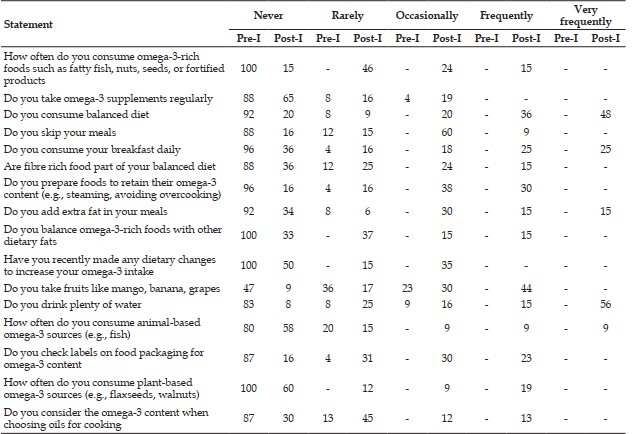
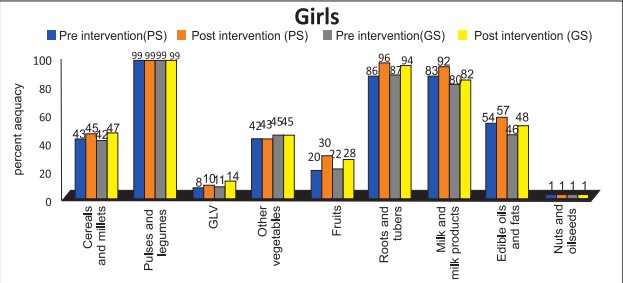
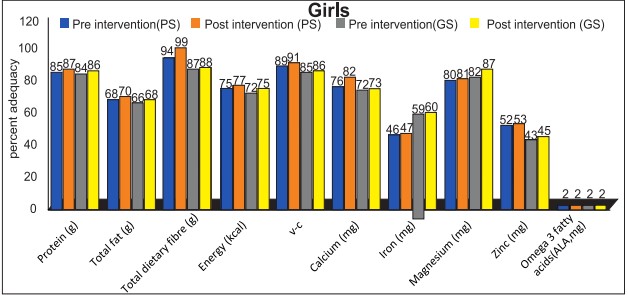
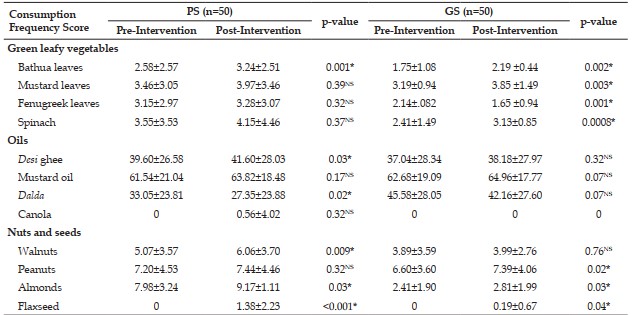
Background: Omega-3 fatty acids are essential nutrients required for cognitive development, immunity, and overall health. However, inadequate intake and poor awareness regarding omega-3-rich foods are commonly observed among adolescent in rural India. Objective: The study aimed to assess the efficacy of a nutrition education intervention on knowledge and dietary practices related to omega-3 fatty acids among adolescent girls studying in rural schools of Ludhiana district, Punjab. Methods: An intervention-based study was conducted among 100 adolescent girls aged 16–17 years, equally selected from one Government School (GS) and one Private School (PS). Baseline information on socio-demographic profile, anthropometric measurements, dietary intake, consumption frequency score (CFS), and knowledge, attitude, and practices (KAP) related to omega-3 fatty acids was collected using structured questionnaires and dietary pattern and food intake was collected using 24-hour dietary recall method for three non-consecutive days. A nutrition education programme was carried out for 120 days, which included lectures, demonstrations, distribution of pamphlets, quizzes, and counselling sessions. After completion of the intervention, the participants were reassessed using the same methods. The collected data were analysed using mean, standard deviation, paired t-test, independent t-test, and Pearson correlation analysis. Results: Baseline findings revealed poor dietary diversity, inadequate intake of omega-3-rich foods, and low awareness regarding omega-3 fatty acids among participants. Intake of nuts and oilseeds was negligible, while omega-3 intake was considerably lower than recommended levels. Following the intervention, significant improvement was observed in KAP scores (p<0.05). Increased consumption frequency of omega-3-rich foods such as flaxseed and nuts along with improved dietary diversity was also reported. Conclusion: The nutrition education intervention effectively improved knowledge and dietary practices related to omega-3 fatty acids among adolescent girls. Schoolbased nutrition education programs may help promote healthier dietary behaviors among rural adolescents.
References
- 1. UNICEF. South Asia – Youth-led action. UNICEF South Asia – Youth-led action. Published 2024. Accessed May 24, 2026.
- 2. Misra A, Singhal N, Khurana L. Obesity, the metabolic syndrome, and type 2 diabetes in developing countries: Role of dietary fats and oils. J Am Coll Nutr. 2010;29:289-301. https:// doi.org/10.1080/07315724.2010.10719844
- 3. Karageorgou D, Rova U, Christakopoulos P, et al. Benefits of supplementation with microbial omega-3 fatty acids on human health and the current market scenario for fish-free omega-3 fatty acid. Trends Food Sci Technol. 2023;136:169-80. https://doi.org/10.1016/j. tifs.2023.04.018
- 4. Chilton FH, Manichaikul A, Yang C, et al. Interpreting clinical trials with omega-3 supplements in the context of ancestry and FADS genetic variation. Front Nutr. 2022;8:808054. https://doi.org/10.3389/ fnut.2021.808054
- 5. Dhiman A, Chopra R, Singh PK, et al. Amelioration of nutritional properties of bakery fat using omega-3 fatty acid-rich edible oils: A review. J Sci Food Agric. 2024;104:3175- 84. doi: 10.1002/jsfa.13225
- 6. Asher A, Tintle NL, Myers M, et al. Blood omega-3 fatty acids and death from COVID-19: A pilot study. Prostaglandins Leukot Essent Fatty Acids. 2021;166:102250. https://doi. org/10.1016/j.plefa.2021.102250
- 7. Saidaiah P, Banu Z, Khan AA, et al. A comprehensive review of omega-3 fatty acids: Sources, industrial applications, and health benefits. Ann Phytomed. 2024;13:209-25. http://dx.doi.org/10.54085/ap.2024.13.1.20
- 8. Kar A, Ghosh P, Patra P, et al. Omega-3 fatty acids mediated cellular signaling and its regulation in human health. Clin Nutr Open Sci. 2023;52:72-86. https://doi.org/10.1016/j. nutos.2023.10.004
- 9. Robitaille K, Guertin MH, Jamshidi A, et al. A phase IIb randomized placebo-controlled trial testing the effect of MAG-EPA long-chain omega-3 fatty acid dietary supplement on prostate cancer proliferation. Commun Med (Lond). 2024;4:456. https://doi.org/10.1038/ s43856-024-00456-4.
- 10. Wang Y, Li J and Zhang M 2018. Omega-3 fatty acid intake and awareness among adolescents. Public Health Nutr 21:2450-2457.
- 11. Iqra Nazir PB, Puspendu Bikash Maity MA, Animesh Das SS. Significant role of fish nutrients with special emphasis to essential fatty acid in human nutrition. Int J Curr Microbiol Appl Sci. 2021;10:2034-46. https:// doi.org/10.20546/ijcmas.2021.1002.243
- 12. Tyagi R, Rastogi RP, Babich O, et al. New perspectives of omega-3 fatty acids from diatoms. Syst Microbiol Biomanuf. 2024; 4:528-41.
- 13. Kannan N, Rao AS, Nair A. Microbial production of omega-3 fatty acids: An overview. J Appl Microbiol. 2021;131:2114-30. https://doi.org/10.1111/jam.15034
- 14. Saini RK, Prasad P, Sreedhar RV, et al. Omega-3 polyunsaturated fatty acids (PUFAs): Emerging plant and microbial sources, oxidative stability, bioavailability, and health benefits—A review. Antioxidants (Basel). 2021;10:1627. https:// doi.org/10.3390/antiox10101627
- 15. Prasad P, Anjali P, Sreedhar RV. Plant-based stearidonic acid as sustainable source of omega-3 fatty acid with functional outcomes on human health. Crit Rev Food Sci Nutr. 2021;61:1725-37. https://doi.org/10.1080/104 08398.2020.1765137
- 16. Velangi A and Sharma R 2024. Obesity prevalence and dietary patterns among urban Indian populations. Indian J Community Med 49:88-94.
- 17. Gurumallu SC, AlRamadneh TN, Sarjan HN, et al. Synergistic hypoglycemic and hypolipidemic effects of ω-3 and ω-6 fatty acids from Indian flax and sesame seed oils in streptozotocin-induced diabetic rats. Phytomed Plus. 2022;2:100284. https://doi. org/10.1016/j.phyplu.2022.100284
- 18. Sharrif ZM, Bukhari S, Othman N, et al. Nutrition education intervention improves nutrition knowledge, attitude, and practices of primary school children: A pilot study. Int Electron J Health Educ. 2018;11:119-32.
- 19. Shweta A, Gayatri R, Vishnu PV. Awareness on balanced diet and eating practices among college students. Drug Invent Today. 2018;10:1408-10.
- 20. Maluccio J, Hoddinott J, Behrman JR, et al. The impact of improving nutrition during early childhood on education among Guatemalan adults. Econ J. 2009;119:734-63. https://doi. org/10.1111/j.1468-0297.2009.02220.x
- 21. WHO. Promoting mental health: Concepts, emerging evidence, practice (Summary Report). WHO Mental Health Report 2004. Published 2004. Accessed May 24, 2026.
- 22. WHO. Waist circumference and waist-hip ratio: Report of a WHO Expert Consultation. WHO Waist Circumference and Waist-Hip Ratio Report. Published 2008. Accessed May 24, 2026.
- 23. Indian Council of Medical Research. Dietary guidelines for Indians: A manual. National Institute of Nutrition, Hyderabad. 2010. Available from: ICMR Dietary Guidelines for Indians PDF. Accessed May 24, 2026
- 24. Ashwell M, Hsieh SD. Six reasons why the waist-to-height ratio is a rapid and effective global indicator for health risks of obesity and how its use could simplify the international public health message on obesity. Int J Food Sci Nutr. 2005;56:303-7. https://doi. org/10.1080/09637480500195066
- 25. Indian Council of Medical Research. Recommended dietary allowances and estimated average requirements: Nutrient requirements for Indians. Hyderabad: National Institute of Nutrition; 2023.
- 26. Story M, Neumark-Sztainer D, French S. Individual and environmental influences on adolescent eating behaviors. J Am Diet Assoc. 2002;102(Suppl 3):S40-S51. https://doi. org/10.1016/S0002-8223(02)90421-9
- 27. Santra A, Rai S, Misra P, et al. Comparison of different anthropometric indicators for assessment of nutritional status among adolescent girls in an urban resettlement colony in New Delhi: A cross-sectional study. Cureus. 2023;15. DOI: 10.7759/cureus.37242
- 28. Małgorzewicz K, Wasilewski A, Myśliwczyk D, et al. Knowledge of obesity and the elements of a healthy diet among secondary school students. Children (Basel). 2025;12:1628. https://doi.org/10.3390/children12121628
- 29. Jha SS, Dobe M, Taklikar C, Lahiri A. Schoolbased intervention on behavioral intention of adolescents regarding healthy diet in India. Front Public Health. 2023;11:1094960. doi: 10.3389/fpubh.2023.1094960
- 30. Kaur S, Kumar R, Lakshmi PVM, Kaur M. Effectiveness of a school-based behavioural change intervention in reducing chronic disease risk factors in Chandigarh, India: A cluster-randomised controlled trial. Lancet Reg Health Southeast Asia. 2024;21:100353. doi: 10.1016/j.lansea.2024.100353.
- 31. Fall CH, Abera M, Chopra H, et al. Anthropometric nutritional status and social and dietary characteristics of African and Indian adolescents taking part in the TALENT (Transforming Adolescent Lives through Nutrition) qualitative study. Public Health Nutr. 2021;24:5249-60. doi:10.1017/ S1368980020001901.
- 32. Dempsey M, Rockwell MS, Wentz LM. The influence of dietary and supplemental omega-3 fatty acids on the omega-3 index: A scoping review. Font Nutr. 2023;10:1072653. doi: 10.3389/fnut.2023.1072653
Data Sharing Statement
There are no additional data available. All raw data and code are available upon request.
Funding
This research received no funding.
Author Contributions
All authors contributed significantly to the work and approve its publication.
Ethics Declaration
This article does not involve any human or animal subjects, and therefore does not require ethics approval.
Acknowledgements
We would like to express our gratitude to the patients, their families, and all those who have contributed to this study.
Conflicts of Interest
No conflicts of interest in this work.
About this article

Cite this article
Inderpreet Kaur Sall, Poonam Bakhetia. School-Based Nutrition Education Improves Knowledge and Consumption of Omega-3-Rich Foods Among Rural Adolescent Girls. Int J Food Nutr Diet. 2026; 14(2): 61–74.
Licence:
Attribution-Non-commercial 4.0 International (CC BY-NC 4.0)This license enables reusers to distribute, remix, adapt, and build upon the material in any medium or format for noncommercial purposes only, and only so long as attribution is given to the creator.
| Received | Accepted | Published |
|---|---|---|
| May 27, 2026 | June 30, 2026 | August 30, 2026 |
DOI: https://doi.org/10.21088/ijfnd.2348.9987.14226.2
Keywords
Omega-3 Fatty AcidsAdolescent GirlsNutrition EducationDietary PracticesRural SchoolsSearch for Similar Articles
Similar Articles
- Smart and Sustainable Packaging Approaches for Reducing Heavy Metal Contaminatio...
- Traditional Rhythms for Modern Health: Seed Cycling in the Management of Women’s...
- Nutrition as Precision Therapy in Rare Genetic Diseases: Moving beyond Supportiv...
- A Review on Health Risks Associated with the Repetitive use of Cooking Oil and D...
- Evaluating the Impact of School Meal Policies on Nutritional Outcomes Among Chil...
Article Level Metrics
Last UpdatedSaturday 17 October 2026, 09:48:08 (IST)
2139
Accesses
37
357
00
Citations
NA
NA
NA
Download citation
Article Keywords
Keyword Highlighting
Highlight selected keywords in the article text.
Timeline
| Received | May 27, 2026 |
| Accepted | June 30, 2026 |
| Published | August 30, 2026 |
licence
Attribution-Non-commercial 4.0 International (CC BY-NC 4.0)
This license enables reusers to distribute, remix, adapt, and build upon the material in any medium or format for noncommercial purposes only, and only so long as attribution is given to the creator.