Full Text (PDF)
International Journal of Food, Nutrition & Dietetics 14(2):p 84-90, May-August 2026. | DOI: https://doi.org/10.21088/ijfnd.2348.9987.14226.4
Review Article
Smart and Sustainable Packaging Approaches for Reducing Heavy Metal Contamination in Foods: A Comprehensive Review
Neelesh Kumar Maurya, Sunidhi Srivastava
Author Information
Licence:
Attribution-Non-commercial 4.0 International (CC BY-NC 4.0)This license enables reusers to distribute, remix, adapt, and build upon the material in any medium or format for noncommercial purposes only, and only so long as attribution is given to the creator.
International Journal of Food, Nutrition & Dietetics 14(2):p 84-90, May-August 2026. | DOI: https://doi.org/10.21088/ijfnd.2348.9987.14226.4
How Cite This Article:
Sunidhi Srivastava, Neelesh Kumar Maurya. Smart and Sustainable Packaging Approaches for Reducing Heavy Metal Contamination in Foods: A Comprehensive Review. Int J Food Nutr Diet. 2026; 14 (2): 84–90Timeline
Received : June 01, 2026
Accepted : July 06, 2026
Published : August 30, 2026
Abstract
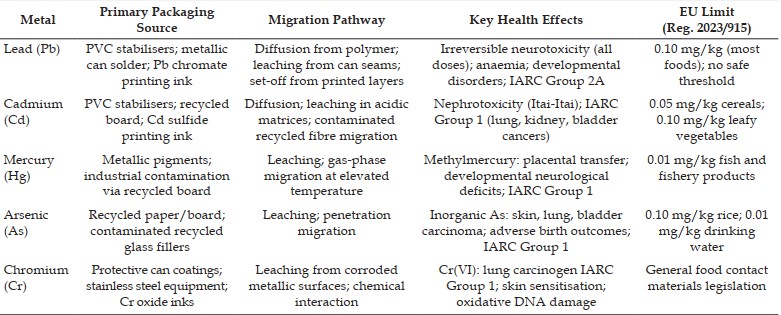
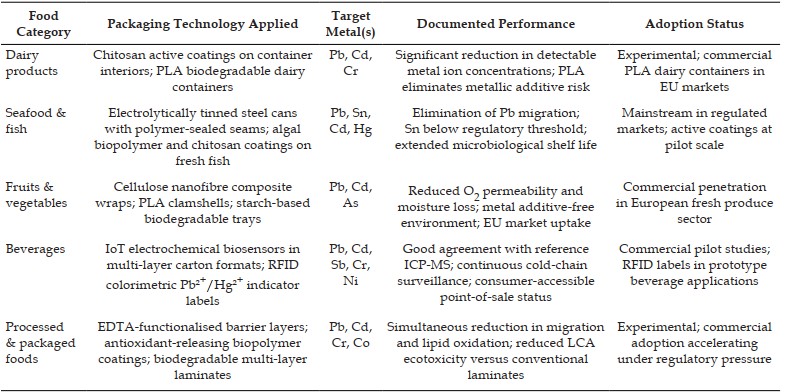
Heavy metal contamination of food via lead (Pb), cadmium (Cd), mercury (Hg), arsenic (As), and chromium (Cr), represents a persistent global public health crisis, with food packaging materials themselves serving as a documented contamination source through diffusion, leaching, and chemical interaction migration mechanisms. This review systematically examines emerging smart and sustainable packaging technologies designed to prevent, detect, and remediate heavy metal contamination. Active packaging strategies (chelating agents, metal-scavenging biopolymer films, adsorbent systems, antioxidant-releasing materials) are evaluated alongside intelligent packaging technologies (colorimetric sensors, nanomaterial biosensors, IoT/RFID real-time monitoring). The role of nanotechnology in amplifying active and sensing performance is critically assessed, with attention to nanotoxicity concerns and evolving regulatory frameworks. Sustainable alternatives such as polylactic acid (PLA), starch, cellulose, chitosan, proteins, and PHAs are evaluated for combined food safety and environmental benefits supported by life cycle assessment. Applications across dairy, seafood, fruits and vegetables, beverages, and processed foods are discussed with reference to experimental findings and commercial case studies.
References
- 1. Mititelu, M., Neacșu, S. M., Busnatu, Ș. S., Scafa-Udriște, A., Andronic, O., Lăcraru, A. E., ... & Olteanu, G. (2025). Assessing heavy metal contamination in food: Implications for human health and environmental safety. Toxics, 13(5), 333.
- 2. Gupta, R. K., Pipliya, S., Karunanithi, S., Eswaran U, G. M., Kumar, S., Mandliya, S., ... & Kovács, B. (2024). Migration of chemical compounds from packaging materials into packaged foods: Interaction, mechanism, assessment, and regulations. Foods, 13(19), 3125.
- 3. Bhatlawande, A., Ghatge, P., Shinde, A., Bhinge, S., & Bhatlawande, S. (2024). Unlocking the future of smart food packaging: Biosensors, IoT, and nanomaterials. Food Science and Biotechnology, 33(6), 1315–1331. https://doi. org/10.1007/s10068-023-01486-9.
- 4. Tarannum, Nazia, Aditi Gautam, Tanu Chauhan, and Deepak Kumar.
- 5. Gong, Y., Chen, X., Yi, R., & Chen, L. (2021). Application of nanotechnology in analysis and removal of heavy metals in food and water resources. Nanomaterials, 11(7), 1792. https:// doi.org/10.3390/nano11071792.
- 6. Jahangiri, S., Mohanty, A. K., & Misra, M. (2024). Sustainable biodegradable coatings for food packaging: Challenges and opportunities. Green Chemistry, 26, 4934–4974. https://doi. org/10.1039/D3GC02647G.
- 7. Nguyen, V. T., Bach, L. G., Dang, C. H., Nguyen, T. H., Nguyen, T. D., & Nguyen, T. L. H. (2023). Analytical techniques for determination of heavy metal migration from plastic food packaging using ICP-MS. Food Science and Nutrition, 11(7), 3798–3809. https:// doi.org/10.1002/fsn3.3391.
- 8. Rajan, S.S. and Wani, K.M., 2025. A review of smart food and packaging technologies: revolutionizing nutrition and sustainability. Food and Humanity, 4, p.100593.
- 9. Perera, K.Y., Jaiswal, A.K. and Jaiswal, S., 2023. Biopolymer-based sustainable food packaging materials: challenges, solutions, and applications. Foods, 12(12), p.2422.
- 10. Seref, B., Basyigit, B., Yilmaz, M. T., & Ozdemir, K. S. (2025). Food packaging and chemical migration: A food safety perspective. Journal of Food Science. https://doi.org/10.1111/1750- 3841.70265.
- 11. Davidescu, M.A., Pânzaru, C., Mădescu, B.M., Poroșnicu, I., Simeanu, C., Usturoi, A., Matei, M. and Doliș, M.G., 2025. Advances and Challenges in Smart Packaging Technologies for the Food Industry: Trends, Applications, and Sustainability Considerations. Foods, 14(24), p.4347.
- 12. Kourkopoulos, A., Sijm, D.T.H.M. and Vrolijk, M., 2025. Migration of toxic elements from recycled paper food contact materials to food simulants: compatibility and influence of sample preparation methods. Food Quality and Safety, 9, p.fyaf002.
- 13. Westlake, J. R., Tran, M. W., Jiang, Y., Zhang, X., Burrows, A. D., & Xie, M. (2023). Biodegradable biopolymers for active packaging: Demand, development and directions. Sustainable Food Technology, 1, 50–72. https://doi.org/10.1039/ D2FB00004K.
- 14. Jogaiah, S., Mujtaba, A.G., Mujtaba, M., De Britto, S., Geetha, N., Belorkar, S.A. and Shetty, H.S., 2025. Chitosan-metal and metal oxide nanocomposites for active and intelligent food packaging; a comprehensive review of emerging trends and associated challenges. Carbohydrate Polymers, 357, p.123459.
- 15. Huang, Y., Mei, L., Chen, X., & Wang, Q. (2018). Recent developments in food packaging based on nanomaterials. Nanomaterials, 8(10), 830. https://doi.org/10.3390/nano8100830
- 16. Popadyuk, N., Popadyuk, A., Tarnavchyk, I., Budishevska, O., Kohut, A., Voronov, A. and Voronov, S., 2016. Synthesis of covalently cross-linked colloidosomes from peroxidized Pickering emulsions. Coatings, 6(4), p.52.
- 17. Lauer, M.K. and Smith, R.C., 2020. Recent advances in starch-based films toward food packaging applications: Physicochemical, mechanical, and functional properties. Comprehensive Reviews in Food Science and Food Safety, 19(6), pp.3031-3083.
- 18. Dhall, R. K. (2013). Advances in edible coatings for fresh fruits and vegetables: A review. Critical Reviews in Food Science and Nutrition, 53(5), 435–450. https://doi.org/10.1080/1040 8398.2010.541568.
- 19. Peelman, N., Ragaert, P., De Meulenaer, B., Adons, D., Peeters, R., Cardon, L., Van Impe, F., & Devlieghere, F. (2013). Application of bioplastics for food packaging. Trends in Food Science & Technology, 32(2), 128–141. https:// doi.org/10.1016/j.tifs.2013.05.017.
- 20. Zhang, P., Meng, W., Wei, L., Li, Y., Xiao, H., He, Y., Yang, F., Han, X. and Shu, W., 2024. Rational design of a NIR fluorescent probe and its application in food detection of viscosity and biosystem imaging. Food Chemistry, 460, p.140527.
- 21. Nile, S. H., Baskar, V., Selvaraj, D., Nile, A., Xiao, J., & Kai, G. (2020). Nanotechnologies in food science: Applications, recent trends, and future perspectives. Nano-Micro Letters, 12(1), 45. https://doi.org/10.1007/s40820-020-0383-4.
- 22. Yakoubi, S. (2025). Sustainable revolution: AIdriven enhancements for composite polymer processing and optimization in intelligent food packaging. Food and Bioprocess Technology, 18(1), 82-107.
Data Sharing Statement
There are no additional data available. All raw data and code are available upon request.
Funding
This research received no funding.
Author Contributions
All authors contributed significantly to the work and approve its publication.
Ethics Declaration
This article does not involve any human or animal subjects, and therefore does not require ethics approval.
Acknowledgements
We would like to express our gratitude to the patients, their families, and all those who have contributed to this study.
Conflicts of Interest
No conflicts of interest in this work.
About this article

Cite this article
Sunidhi Srivastava, Neelesh Kumar Maurya. Smart and Sustainable Packaging Approaches for Reducing Heavy Metal Contamination in Foods: A Comprehensive Review. Int J Food Nutr Diet. 2026; 14 (2): 84–90
Licence:
Attribution-Non-commercial 4.0 International (CC BY-NC 4.0)This license enables reusers to distribute, remix, adapt, and build upon the material in any medium or format for noncommercial purposes only, and only so long as attribution is given to the creator.
| Received | Accepted | Published |
|---|---|---|
| June 01, 2026 | July 06, 2026 | August 30, 2026 |
DOI: https://doi.org/10.21088/ijfnd.2348.9987.14226.4
Keywords
Heavy MetalScalabilityCostSensor SelectivityRegulatory HarmonisationAi Food Safety SolutionsSearch for Similar Articles
Similar Articles
- Traditional Rhythms for Modern Health: Seed Cycling in the Management of Women’s...
- School-Based Nutrition Education Improves Knowledge and Consumption of Omega-3-R...
- Nutrition as Precision Therapy in Rare Genetic Diseases: Moving beyond Supportiv...
- A Review on Health Risks Associated with the Repetitive use of Cooking Oil and D...
- Evaluating the Impact of School Meal Policies on Nutritional Outcomes Among Chil...
Article Level Metrics
Last UpdatedMonday 19 October 2026, 15:58:10 (IST)
2167
Accesses
26
359
00
Citations
NA
NA
NA
Download citation
Article Keywords
Keyword Highlighting
Highlight selected keywords in the article text.
Timeline
| Received | June 01, 2026 |
| Accepted | July 06, 2026 |
| Published | August 30, 2026 |
licence
Attribution-Non-commercial 4.0 International (CC BY-NC 4.0)
This license enables reusers to distribute, remix, adapt, and build upon the material in any medium or format for noncommercial purposes only, and only so long as attribution is given to the creator.