Full Text (PDF)
International Journal of Food, Nutrition & Dietetics 14(2):p 75-83, May-August 2026. | DOI: https://doi.org/10.21088/ijfnd.2348.9987.14226.3
Review Article
Traditional Rhythms for Modern Health: Seed Cycling in the Management of Women’s Wellness
Yusra Mahak Siddiqui, Nikita Tyagi
Author Information
Licence:
Attribution-Non-commercial 4.0 International (CC BY-NC 4.0)This license enables reusers to distribute, remix, adapt, and build upon the material in any medium or format for noncommercial purposes only, and only so long as attribution is given to the creator.
International Journal of Food, Nutrition & Dietetics 14(2):p 75-83, May-August 2026. | DOI: https://doi.org/10.21088/ijfnd.2348.9987.14226.3
How Cite This Article:
Yusra Mahak Siddiqui, Nikita Tyagi. Traditional Rhythms for Modern Health: Seed Cycling in the Management of Women’s Wellness. Int J Food Nutr Diet. 2026; 14 (2): 75–83.Timeline
Received : May 21, 2026
Accepted : June 26, 2026
Published : August 30, 2026
Abstract
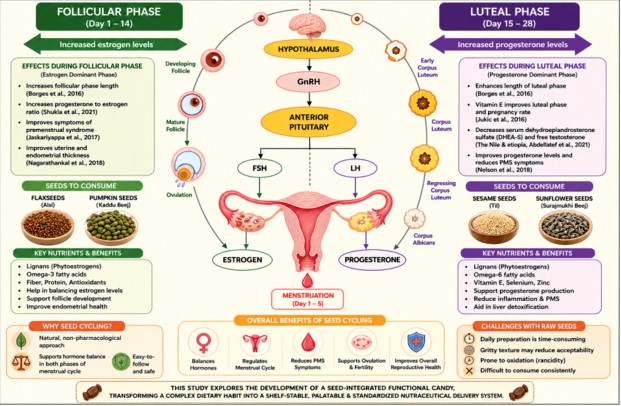
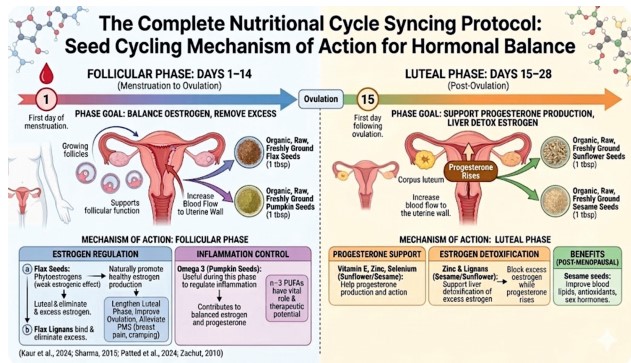
The present review assesses Seed Cycling as traditional Bhartiya practice of dietary intervention for better management of menstrual irregularity and dysmenorrhea in the contemporary scenario with hormonal imbalances (Estrogen, Progesterone, LH and FSH) increasing because of environmental lifestyle stressors, this research proposes a rhythmic nutritional management strategy. During the follicular period, it is recommended that consume pumpkin seeds and flax seeds. Similarly, during the luteal stage, it is recommended that include sunflower and sesame seeds into diet to help maintain hormonal balance. These seeds contain lignan, phytoestrogen, antioxidants, omega-3, protein, carbs, and a variety of vital minerals such as calcium, manganese, iron, zinc, and copper which reduce inflammation and support hormone production. This methodical seed rotation acts as a noninvasive link between traditional nutritional knowledge and modern reproductive health care The review concludes that seed cycling represents a feasible, reviewbased management strategy for restoring hormonal homeostasis and optimizing holistic wellness among women.
References
- 1. Thiyagarajan, D. K., Basit, H., & Jeanmonod, R. (2024). Physiology, menstrual cycle. In StatPearls [Internet]. StatPearls Publishing.
- 2. Ninama, R. (2019). A study of problems faced by adolescent girls during menstruation. Journal of Education and Human Development, 8(1),
- 3. Wasnik, V. R., Dhumale, D., & Jawarkar, A. K. (2015). A study of the menstrual pattern and problems among rural school going adolescent girls of Amravati district of Maharashtra, India. Int J Res Med Sci, 33(55), 1252-6.
- 4. Rogan, M. M., & Black, K. E. (2023). Dietary energy intake across the menstrual cycle: a narrative review. Nutrition reviews, 81(7), 869-886
- 5. Lee JC, Yu BK, Byeon JH, Lee KH, Min JH, Park SH, et al. A study on the menstruation of Korean adolescent girls in Seoul. Korean J Pediatr 2011;54:2016
- 6. Murray, C. M., & Orr, C. J. (2020). Hormonal regulation of the menstrual cycle and ovulation. In Maternal-Fetal and Neonatal Endocrinology (pp. 159-167). Academic Press.
- 7. Hodari, L. Seed Cycling Guide for Hormone Balance.
- 8. Draper, C. F., Duisters, K., Weger, B., Chakrabarti, A., Harms, A. C., Brennan, L., ... & Van Der Greef, J. (2018). Menstrual cycle rhythmicity: metabolic patterns in healthy women. Scientific reports, 8(1), 14568.
- 9. Works, H. P., NY, N., Rupa, O., & Patient, F. A. Q. (2022). A Guide to Seed Cycling for Hormonal Balance. Nutrition.
- 10. Priyanka, Veenu Sangwan, Raveena Rani, Rekha Yadav, Neha Bajal. Role of seed cycling diet during menstrual dysfunction. Int J Agric Extension Social Dev 2024;7(7S):91-95. DOI: 10.33545/26180723.2024.v7.i7Sb.779
- 11. Mahapatra, D., Baro, J., & Das, M. (2023). Advantages of seed cycling diet in menstrual dysfunctions: A review based explanation. The Pharma Innovation Journal, 12(4), 931-939.
- 12. Sourinejad, H., Reisi, D. Z., Beigi, M., Adib, M. E., & Hadian, M. (2019). The use of flaxseed in gynecology: a review article
- 13. Kataria K, Dhar A, Srivastava A, Kumar S, Goyal A. A systematic review of current understanding and management of mastalgia. Indian J Surg. 2014;76:217 222.
- 14. Oner G, Muderris II. Efficacy of omega-3 in the treatment of polycystic ovary syndrome. J Obstet Gynaecol. 2013;33(3):289-291.
- 15. Ajith, K. (2024). Effect of Seed Cycling on Polycystic Ovary Syndrome Freire, E. (2025). Seed Cycling as Therapy to Treat Polycystic Ovarian Syndrome: A Review of the Literature
- 16. Datta S, Sinha B, Bhattacharjee S, Seal T. Nutritional composition, mineral content, antioxidant activity and quantitative estimation of water soluble vitamins and phenolics by RPHPLC in some lesser used wild edible plants. Heliyon. 2019;5(3):e01431.
- 17. Rabbani, A., Irfan, T., Azmat, S., & Rubab, I. (2025). Effect of Pumpkin Seed on Male and Female Reproductive Health. Pakistan Journal of Medical & Cardiological Review, 4(3), 590-604.
- 18. Tian X, Diaz FJ. Zinc depletion causes multiple defects in ovarian function during the periovulatory period in mice. Endocrinology. 2012;153(2):873-886. Doi: 10.1210/en.2011- 1599.
- 19. Mahapatra, D., Baro, J., & Das, M. (2023). Advantages of seed cycling diet in menstrual dysfunctions: A review based explanation. The Pharma Innovation Journal, 12(4), 931-939.
- 20. Kaur, H., Anitha, C., Ghatnatti, V., Patil, S., & Kadeangadi, D. (2024). Evaluation of effect of seed cycling on anthropometric, biochemical, hormonal and nutritional parameters in the women diagnosed with polycystic ovarian syndrome-a cohort interventional study design. Journal of Natural Remedies, 24, 1547-59.
- 21. Sharma, A., & Thakur, R. (2025). A Review on Treatment Approaches for PCOD & PCOS. Journal of Advance and Future Research, 3(4), 315-326.
- 22. Patted, P. G., Masareddy, R. S., Patil, A. S., Kanabargi, R. R., & Bhat, C. T. (2024). Omega-3 fatty acids: a comprehensive scientific review of their sources, functions and health benefits. Future Journal of Pharmaceutical Sciences, 10(1), 94.
- 23. Zachut, M., Dekel, I., Lehrer, H., Arieli, A., Arav, A., Livshitz, L., Yakoby, S., & Moallem, U. (2010). Effects of dietary fats differing in n-6:n-3 ratio fed to high-yielding dairy cows on fatty acid composition of ovarian compartments, follicular status, and oocyte quality. Journal of dairy science, 93(2), 529–545. https://doi.org/10.3168/jds.2009-2167
- 24. Rasheed, N., Ahmed, A., Nosheen, F., Imran, A., Islam, F., Noreen, R., ... & Amer Ali, Y. (2023). Effectiveness of combined seeds (pumpkin, sunflower, sesame, flaxseed): As adjacent therapy to treat polycystic ovary syndrome in females. Food Science & Nutrition, 11(6), 3385- 3393
- 25. Sharma P, Longvah T. Nigella (Nigella sativa) seed. In: Oilseeds: Health Attributes and Food Applications. 2021. doi: 10.1007/978–981-15– 4194-0_13.
- 26. Dhamija, P., More, A., Choudhary, N., Wadhe, T., Barai, J., & Shah, D. (2025). Seed cycling and hormonal balance: a case study of successful fertility intervention in polycystic ovarian syndrome. Journal of Pharmacy and Bioallied Sciences, 17(Suppl 1), S1030-S1033
- 27. Pradeep, S., & Shrivastava, V. Effect of Seeds Rotation on Polycystic Ovarian Syndrome–A Community Based Study.
- 28. Nagarajan, D. R., Jacob, D. M., Mufti, M. M., Rajesh, S., & Dube, R. (2025). Efficacy of Seed Cycling as an Integrative Therapy for Premenstrual Syndrome and Polycystic Ovary Syndrome in Reproductive-Aged Women: A Systematic Review. stress, 5(9), 11.
- 29. Zafar, M., Rabail, R., Bibi, S., Jebreen, A., Khan, M. A., & Aadil, R. M. (2024). Seed cycling: Approach for polycystic ovarian syndrome. Food and Humanity, 2, 100274.
- 30. Freire, E. (2025). Seed Cycling as Therapy to Treat Polycystic Ovarian Syndrome: A Review of the Literature.
- 31. Chauhan, S., Kumar, P., Patel, R., Srivastava, S., Simon, D. J., & Muhammad, T. (2021). Association of lifestyle factors with menstrual problems and its treatment-seeking behavior among adolescent girls. Clinical Epidemiology and Global Health, 12, 100905.
Data Sharing Statement
There are no additional data available. All raw data and code are available upon request.
Funding
This research received no funding.
Author Contributions
All authors contributed significantly to the work and approve its publication.
Ethics Declaration
This article does not involve any human or animal subjects, and therefore does not require ethics approval.
Acknowledgements
We would like to express our gratitude to the patients, their families, and all those who have contributed to this study.
Conflicts of Interest
No conflicts of interest in this work.
About this article

Cite this article
Yusra Mahak Siddiqui, Nikita Tyagi. Traditional Rhythms for Modern Health: Seed Cycling in the Management of Women’s Wellness. Int J Food Nutr Diet. 2026; 14 (2): 75–83.
Licence:
Attribution-Non-commercial 4.0 International (CC BY-NC 4.0)This license enables reusers to distribute, remix, adapt, and build upon the material in any medium or format for noncommercial purposes only, and only so long as attribution is given to the creator.
| Received | Accepted | Published |
|---|---|---|
| May 21, 2026 | June 26, 2026 | August 30, 2026 |
DOI: https://doi.org/10.21088/ijfnd.2348.9987.14226.3
Keywords
Menstrual cycleModern health careSeed cyclingHormonal ImbalanceTraditional therapySearch for Similar Articles
Similar Articles
- Smart and Sustainable Packaging Approaches for Reducing Heavy Metal Contaminatio...
- School-Based Nutrition Education Improves Knowledge and Consumption of Omega-3-R...
- Nutrition as Precision Therapy in Rare Genetic Diseases: Moving beyond Supportiv...
- A Review on Health Risks Associated with the Repetitive use of Cooking Oil and D...
- Evaluating the Impact of School Meal Policies on Nutritional Outcomes Among Chil...
Article Level Metrics
Last UpdatedSaturday 17 October 2026, 09:47:21 (IST)
2139
Accesses
31
357
00
Citations
NA
NA
NA
Download citation
Article Keywords
Keyword Highlighting
Highlight selected keywords in the article text.
Timeline
| Received | May 21, 2026 |
| Accepted | June 26, 2026 |
| Published | August 30, 2026 |
licence
Attribution-Non-commercial 4.0 International (CC BY-NC 4.0)
This license enables reusers to distribute, remix, adapt, and build upon the material in any medium or format for noncommercial purposes only, and only so long as attribution is given to the creator.