Full Text (PDF)
Indian Journal of Research in Anthropology 9(2):p 81-86, July-December 2023. | DOI: https://doi.org/10.21088/ijra.2454.9118.9223.4
Original Article
Tribal Development through Formal Education among Agarias of Chhattisgarh
Author Information
Licence:
Attribution-Non-commercial 4.0 International (CC BY-NC 4.0)This license enables reusers to distribute, remix, adapt, and build upon the material in any medium or format for noncommercial purposes only, and only so long as attribution is given to the creator.
Indian Journal of Research in Anthropology 9(2):p 81-86, July-December 2023. | DOI: https://doi.org/10.21088/ijra.2454.9118.9223.4
How Cite This Article:
Amit Soni, Ranu Soni/Tribal Development through Formal Education among Agarias of Chhattisgarh/Indian J Res Anthropol 2023;9(2):81-86.Timeline
Received : December 13, 2023
Accepted : December 29, 2023
Published : December 30, 2023
Abstract
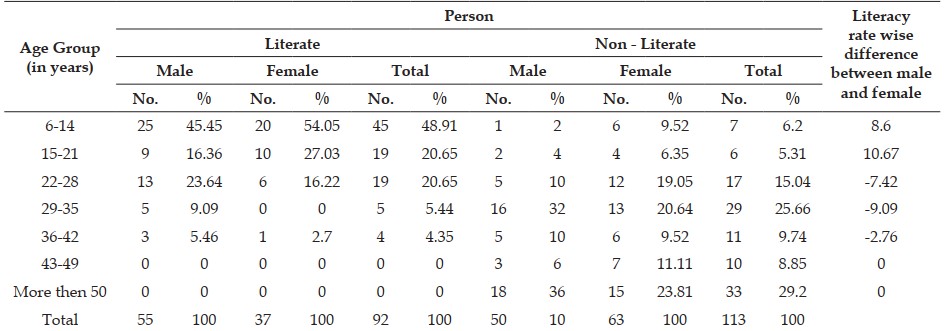
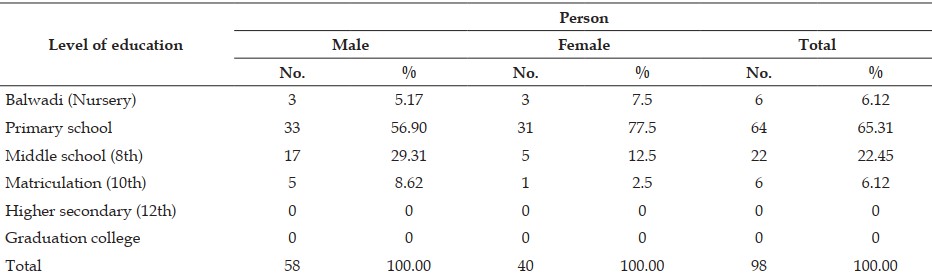
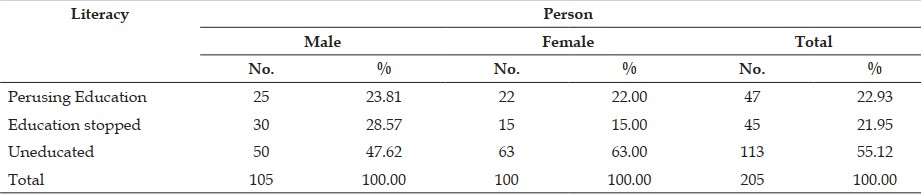
Education is a powerful means of development in any community. Various formal and nonformal forms of education exist in different societies. Education has been institutionalized in the form of formal education in the schools and higher educational institutions in the remote and tribal areas gradually with the changing educational policies and programmes in the independent India with the advent of developing educational infrastructure and awareness in the remote areas. This resulted in the gradual increase in the percentage of literacy rate. But, perhaps few groups could not come up effectively in full pace along with their cohabits and become part of this developing change in their villages and surroundings, due to their situational demerits. Agaria tribe is one of such groups residing in the adjacent part of Madhya Pradesh and Chhattisgarh. A survey of Agaria tribe in done utilizing the scientific research methods in the few pockets of this area ranging from Dindori district in Madhya Pradesh to Kawardh and Bilaspur districts in Chhattisgarh. This paper includes the situational analysis of socio-economic and educational status of the Agaria people residing in the districts of Chhattisgarh.
References
- 1. A. Soni, Educational System and Tribals: A Rethinking, in Indian Tribal Life, C. Sahu, Ed., New Delhi, Sarup & Sons, 2001, pp. 86-93.
- 2. R. V. Russell and Hiralal, Agaria, in The Tribes and Castes of the Central Proviences of India, vol. 2, Nagpur, Government Printing Press, 1916, pp. 3-8.
- 3. V. Elwin, The Agaria, Oxford: Humphrey Milford, Oxford University Press, 1942.
- 4. V. Elwin, The Tribal Art of Middle India, London: Oxford University Press, 1951.
- 5. S. Bhattacharya, Iron Smelters and Indigenous Iron and Steel Industry in India, New Delhi: Crafts Museum, 1970.
- 6. K. Chattopadhyay, Indian Craft Tradition, New Delhi: Director of Publications, Govt. of India, 1980.
- 7. K. S. Singh, Ed., People of India - The Scheduled Tribes, vol. 3, Kolkata: Anthropological Survey of India, 1992.
- 8. P. C. Mehta, Agaria, in The Ethnographic Atlas of Indian Tribes, Michigan, Discovery Publishing House, 2004.
- 9. N. Mahawar, Art and Crafts of Chhattisgarh, New Delhi: Banyan Tree Books Pvt. Ltd., 2014.
- 10. T. K. Vaishnav,Chhattisgarh ke Janjatiya Paridrishya, Raipur, Adijati Anusandhan Avam Prashikshan Sansthan, 2007.
- 11. Registrar General & Census Comissioner of Census of India, Census of India 2011, 2011. [Online]. Available: http://www.censusindia.gov.in/2011census/PCA/SC_ST/. [Accessed 22 June 2017].
- 12. A. Soni, Iron-metal Craft Economy of the Agaria Tribe of Chhattisgarh, in Recent Researches on the Tribes of Central India, vol. 2, B. Tripathy and B. K. Mohanta, Eds., New Delhi, Aayu Publications, 2016, pp. 370-375.
- 13. A. Soni, Ethnographic Studies on Tribes of Chhattisgarh, in Approaches of Tribal Development, C. Sahu, Ed., New Delhi, Adhyayan Publishers & Distributors, 2009, pp. 219-231.
- 14. A. Soni, Status and Empowerment of Central Indian Tribal Women, Indian Journal of Research in Anthropology, vol. 5, no. 1, pp. 5-10, January-June 2019.
- 15. A. Soni, Tribal Needs and Expectations: National Policy for Education, Indian Journal of Research in Anthropology, vol. 3, no. 2, pp. 115-120, July-December 2017.
Data Sharing Statement
There are no additional data available. All raw data and code are available upon request.
Funding
This research received no funding.
Author Contributions
All authors contributed significantly to the work and approve its publication.
Ethics Declaration
This article does not involve any human or animal subjects, and therefore does not require ethics approval.
Acknowledgements
We would like to express our gratitude to the patients, their families, and all those who have contributed to this study.
Conflicts of Interest
No conflicts of interest in this work.
About this article

Cite this article
Amit Soni, Ranu Soni/Tribal Development through Formal Education among Agarias of Chhattisgarh/Indian J Res Anthropol 2023;9(2):81-86.
Licence:
Attribution-Non-commercial 4.0 International (CC BY-NC 4.0)This license enables reusers to distribute, remix, adapt, and build upon the material in any medium or format for noncommercial purposes only, and only so long as attribution is given to the creator.
| Received | Accepted | Published |
|---|---|---|
| December 13, 2023 | December 29, 2023 | December 30, 2023 |
DOI: https://doi.org/10.21088/ijra.2454.9118.9223.4
Keywords
Formal EducationLiteracy RateGirl EducationInfrastructureSchool DropoutSearch for Similar Articles
Similar Articles
- Contemporary Issues and Challenges in Women’s Weavers in the Varanasi Silk Saree...
- Understanding through Traversing the Corridors of History: Richness of Indian He...
- Challenges and Opportunities in Digital Preservation of Intangible Culture Herit...
- Assessment of Nutritional Indicators: A Comparative Study among Pre-School Child...
- Prenatal and Postnatal Health-Seeking Behaviour among the Muria Tribe of Bastar...
Article Level Metrics
Last UpdatedTuesday 08 September 2026, 20:58:53 (IST)
1819
Accesses
7
413
00
Citations
NA
NA
NA
Download citation
Article Keywords
Keyword Highlighting
Highlight selected keywords in the article text.
Timeline
| Received | December 13, 2023 |
| Accepted | December 29, 2023 |
| Published | December 30, 2023 |
licence
Attribution-Non-commercial 4.0 International (CC BY-NC 4.0)
This license enables reusers to distribute, remix, adapt, and build upon the material in any medium or format for noncommercial purposes only, and only so long as attribution is given to the creator.