Full Text (PDF)
Indian Journal of Research in Anthropology 11(2):p 155-163, July - Dec 2025. | DOI: https://rfppl.co.in/10.21088/ijra.2454.9118.11225.8
Original Article
Prenatal and Postnatal Health-Seeking Behaviour among the Muria Tribe of Bastar Region in Chhattisgarh, India
Pooja Pratiksha Swain, Swapan Kumar Kolay
Author Information
Licence:
Attribution-Non-commercial 4.0 International (CC BY-NC 4.0)This license
enables reusers to distribute, remix, adapt, and build upon the material in any
medium or format for noncommercial purposes only, and only so long as
attribution is given to the creator.
Indian Journal of Research in Anthropology 11(2):p 155-163, July - Dec 2025. | DOI: https://rfppl.co.in/10.21088/ijra.2454.9118.11225.8
How Cite This Article:
Pooja Pratiksha Swain, Swapan Kumar Kolay. Prenatal and Postnatal Health-Seeking Behaviour among the Muria Tribe of Bastar Region in Chhattisgarh, India. Ind J Res Anthropol 2025; 11(2): 155-163.Timeline
Received : July 11, 2025
Accepted : September 27, 2025
Published : December 30, 2025
Abstract
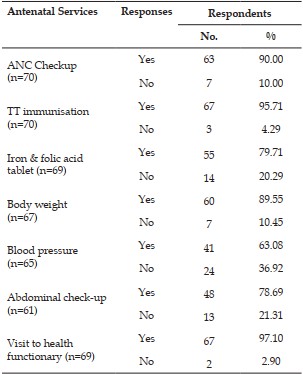
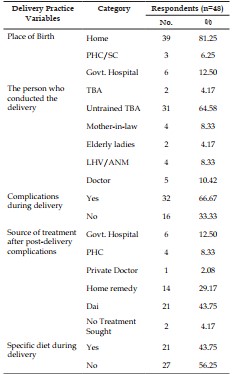
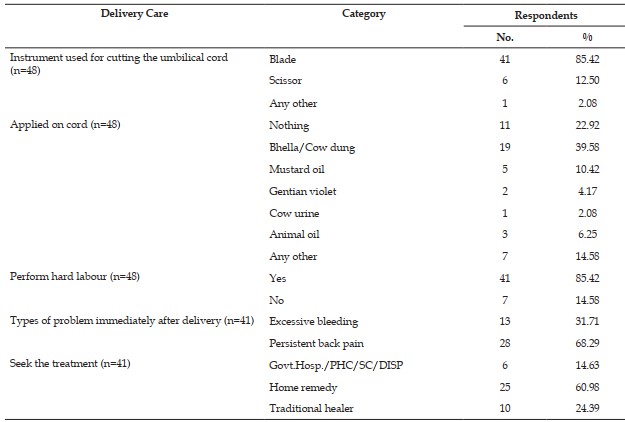
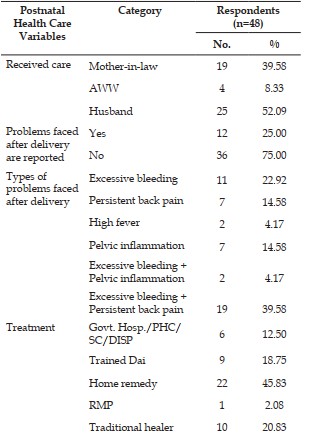
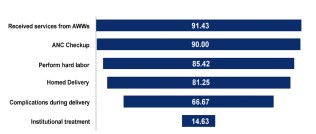
Maternal health-seeking behaviour is influenced by cultural beliefs, healthcare accessibility, and traditional norms, particularly among tribal communities. This study explores prenatal and postnatal health-seeking behaviour among the Muria women in Gunpur village of Bastar district, Chhattisgarh. It also examines the cultural influences shaping their maternal healthcare choices. Using a mixed-methods approach, data were collected through interviews, focus group discussions, observations, and case studies with a purposive sample of 70 ever-married women, including pregnant and postpartum women (up to two years). The study found that prenatal check-ups were commonly availed, and healthcare functionaries, particularly Anganwadi Workers, played a significant role in maternal care. However, institutional deliveries were notably low, with the majority of births occurring at home, primarily assisted by untrained traditional birth attendants. Cultural beliefs, including the influence of family deities and spirits, played a crucial role in shaping childbirth practices and contributed to the preference for home births. Despite a high prevalence of delivery-related complications, medical intervention was sought in only a few cases, with many women relying on traditional birth attendants and home remedies. Postnatal care remained inadequate, and only a small proportion received assistance from healthcare workers. Common postpartum complications, such as excessive bleeding and persistent back pain, were frequently reported, yet institutional healthcare was rarely sought, with traditional healing practices being the preferred option. The findings underscore the urgent need for enhanced maternal healthcare interventions, a stronger role for trained health functionaries, and greater awareness of the benefits of institutional deliveries and postnatal care in tribal communities.
References
- 1. Altman, R., Sidney, K., & De Costa, A. et al. (2017). Is institutional delivery protective against neonatal mortality among poor or tribal women? A cohort study from Gujarat, India. Matern Child Health J, 21, 1065–1072. https://doi.org/10.1007/s10995-016-2202-y.
- 2. Bhardwaj, N., Yunus, M., Hasan, S. B., & Zaheer, M. (1990). Role of traditional birth attendants in maternal care services - A rural study. Indian Journal of Maternal and Child Health, 1(1), 29–30.
- 3. Contractor, S.Q., Das, A., & Dasgupta, J. (2018). Beyond the template: The needs of tribal women and their experiences with maternity services in Odisha, India. Int J Equity Health, 17, 134. https://doi.org/10.1186/s12939-018- 0850-9.
- 4. Debata, I., Ranganath, T.S. (2023). Evaluation of the performance of Anganwadi workers in delivering integrated child development services in the rural field practice area of a tertiary medical college in South India. Cureus, 15(1), e34079. https://doi.org/10.7759/ cureus.34079.
- 5. Dehury, R.K., Pati, A., & Dehury, P. (2018). Traditional practices and beliefs in postpartum care: Tribal women in Maharashtra. Antyajaa Indian Journal of Women and Social Change, 3(1), 49–63. https://doi. org/10.1177/2455632718778391.
- 6. Garces, A., McClure, E.M., Chomba, E., Patel, A., Pasha, O., Tshefu, A., Esamai, F., Goudar, S., Lokangaka, A., Hambidge, K.M., Wright, L.L., Koso-Thomas, M., Bose, C., Carlo, W.A., Liechty, E.A., Hibberd, P.L., Bucher, S., Whitworth, R., & Goldenberg, R.L. (2012). Home birth attendants in low-income countries: Who are they and what do they do? BMC Pregnancy and Childbirth, 12(1). https:// doi.org/10.1186/1471-2393-12-34.
- 7. Girotra, S., Malik, M., Roy, S., & Basu, S. (2023). Utilization and determinants of adequate quality antenatal care services in India: Evidence from the National Family Health Survey (NFHS-5) (2019-21). BMC Pregnancy and Childbirth, 23(1). https://doi.org/10.1186/ s12884-023-06117-z.
- 8. Islam, M.A., Nahar, M.T., Siddiquee, T., Toma, A.S., Hoque, F., & Hossain, M.Z. (2024). Prevalence and determinants of utilizing skilled birth attendance during home delivery of pregnant women in India: Evidence from the Indian Demographic and Health Survey 2015–16. PLoS ONE, 19(3), e0295389. https:// doi.org/10.1371/journal.pone.0295389.
- 9. John, A., Nisbett, N., Barnett, I., Avula, R., & Menon, P. (2020). Factors influencing the performance of community health workers: A qualitative study of Anganwadi Workers from Bihar, India. PLoS ONE, 15(11), e0242460. https://doi.org/10.1371/journal. pone.0242460.
- 10. Kaur, Banjot (2019). Economic Survey 2018-19: Healthcare still inaccessible in rural India. Down to Earth. https://www.downtoearth.org.in/ health/economic-survey-2018-19-healthcarestill inaccessible-in-rural-india-65443?.
- 11. Kolay, S.K. (1997). Community participation in mother-child-health activities in tribal areas: Suggestion through Micro-planning. Vanyajati, XLV (4).
- 12. Kolay, S.K., & Mahant, S.D. (2015). Sociocultural barriers in the adoption of safe reproductive and child health practices: A case study among tribals in Bastar. International Journal of Research in Social Sciences, 5(1), 722– 733. http://www.indianjournals.com/ijor.as px?target=ijor:ijrss&volume=5&issue=1&artic le=053.
- 13. Kolay, S.K., Bairagy, R. (2014). Maternal and child health care practices and their associated socio-cultural and environmental factors: Micro level study among Muria Tribe in Bastar District of Chhattisgarh. In J. Dash, P.K. Patra, & K.C. Satpathy (Eds.), Ethnomedicinal practices in tribal areas. New Delhi: SSDN Publisher & Distributors.
- 14. Kolay, S.K., Saini, K., & Adak, D.K. (2008). Some aspects of mother child health and family planning practices among Kheria- A primitive tribe of West Bengal. In D.K. Adak, A. Chattopadhyay, & P. Bharti (Eds.), People of contemporary West Bengal. New Delhi: Mohit Publications.
- 15. Madankar, M., Kakade, N., Basa, L., & Sabri, B. (2024). Exploring maternal and child health among tribal communities in India: A life course perspective. Global Journal of Health Science, 16(2), 31. https://doi.org/10.5539/ gjhs.v16n2p31.
- 16. Madell, R. (2015). Pregnancy care. Healthline. https://www.healthline.com/health/ pregnancy-care.
- 17. Ministry of Women and Child Development, Government of India. (2021). POSHAN Abhiyaan: National Nutrition Mission. Retrieved from https://icds-wcd.nic.in/ poshanabhiyaan.php.
- 18. National Institute of Child Health and Human Development. (2017). What is prenatal care and why is it important? https://www. nichd.nih.gov/health/topics/pregnancy/ conditioninfo/prenatal-care.
- 19. World Health Organization (2019). Maternal health. https://www.who.int/health-topics/ maternal-health.
- 20. Ziegler, S.E. (2012). Development of a nextgeneration automated DICOM processing system in a PACS-Less research environment. Journal of Digital Imaging, 25(5), 670–677. https://doi.org/10.1007/s10278-012-9482-6.
Data Sharing Statement
There are no additional data available. All raw data and code are available upon request.
Funding
This research received no funding.
Author Contributions
All authors contributed significantly to the work and approve its publication.
Ethics Declaration
This article does not involve any human or animal subjects, and therefore does not require ethics approval.
Acknowledgements
We would like to express our gratitude to the patients, their families, and all those who have contributed to this study.
Conflicts of Interest
No conflicts of interest in this work.
About this article

Cite this article
Pooja Pratiksha Swain, Swapan Kumar Kolay. Prenatal and Postnatal Health-Seeking Behaviour among the Muria Tribe of Bastar Region in Chhattisgarh, India. Ind J Res Anthropol 2025; 11(2): 155-163.
Licence:
Attribution-Non-commercial 4.0 International (CC BY-NC 4.0)This license
enables reusers to distribute, remix, adapt, and build upon the material in any
medium or format for noncommercial purposes only, and only so long as
attribution is given to the creator.
| Received | Accepted | Published |
|---|---|---|
| July 11, 2025 | September 27, 2025 | December 30, 2025 |
DOI: https://rfppl.co.in/10.21088/ijra.2454.9118.11225.8
Keywords
Search for Similar Articles
Similar Articles
- Contemporary Issues and Challenges in Women’s Weavers in the Varanasi Silk Saree...
- Understanding through Traversing the Corridors of History: Richness of Indian He...
- Challenges and Opportunities in Digital Preservation of Intangible Culture Herit...
- Assessment of Nutritional Indicators: A Comparative Study among Pre-School Child...
- Nutritional Status and Anthropometric Variations among Railway Colony Children i...
Article Level Metrics
Last UpdatedThursday 22 October 2026, 12:30:47 (IST)
2445
Accesses
13
529
00
Citations
NA
NA
NA
Download citation
Article Keywords
Keyword Highlighting
Highlight selected keywords in the article text.
Timeline
| Received | July 11, 2025 |
| Accepted | September 27, 2025 |
| Published | December 30, 2025 |
licence
Attribution-Non-commercial 4.0 International (CC BY-NC 4.0)
This license
enables reusers to distribute, remix, adapt, and build upon the material in any
medium or format for noncommercial purposes only, and only so long as
attribution is given to the creator.