Full Text (PDF)
Indian Journal of Research in Anthropology 11(2):p 147-154, July - Dec 2025. | DOI: https://doi.org/10.21088/ijra.2454.9118.11225.7
Original Article
Nutritional Status and Anthropometric Variations among Railway Colony Children in North 24 Parganas, West Bengal: A Cross-Sectional Study
Ashish Mukhopadhyay, Sarnali Sarkar, Farhin Khanam, Mithu Bhadra
Author Information
Licence:
Attribution-Non-commercial 4.0 International (CC BY-NC 4.0)This license enables reusers to distribute, remix, adapt, and build upon the material in any medium or format for noncommercial purposes only, and only so long as attribution is given to the creator.
Indian Journal of Research in Anthropology 11(2):p 147-154, July - Dec 2025. | DOI: https://doi.org/10.21088/ijra.2454.9118.11225.7
How Cite This Article:
Sarnali Sarkar, Farhin Khanam, Mithu Bhadra, et al. Nutritional Status and Anthropometric Variations among Railway Colony Children in North 24 Parganas, West Bengal: A Cross-Sectional Study. Ind J Res Anthropol 2025; 11(2): 147-154.Timeline
Received : June 02, 2025
Accepted : July 21, 2025
Published : June 30, 2025
Abstract
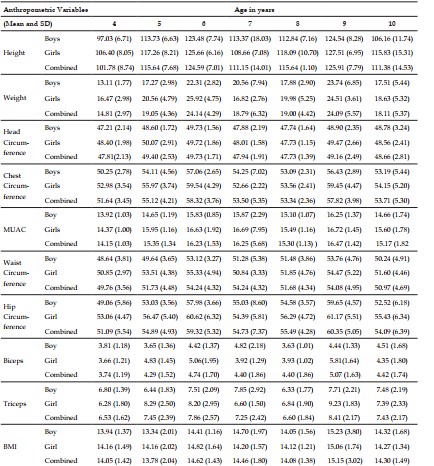
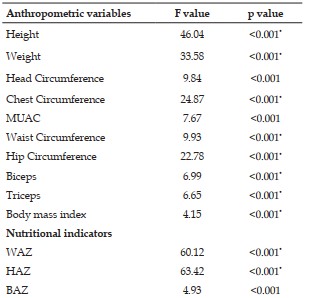
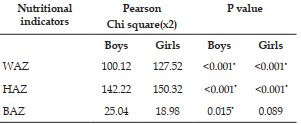
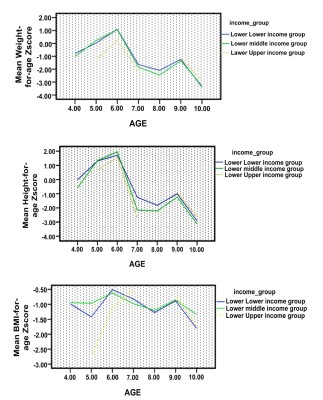
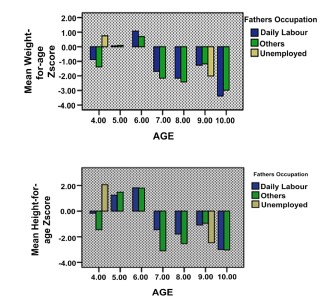
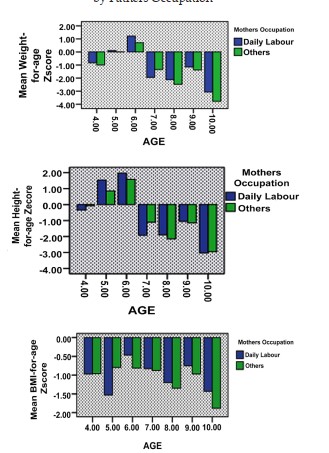
Nutrition plays a crucial role in a child’s growth that has long-term effect in their health. In India malnutrition in children remain a significant public health concern. The children especially who belongs to economically weaker section suffers in this problem. The study aims to investigate how anthropometric measures and nutritional status varies with age among the children of railway colony. A total of 509 children aged 4-10 years were selected from railway colony of North 24 parganas. Result shows that with the increasing of age the nutritional status decline. Based on one-way ANOVA all anthropometric measures and nutritional indicators varied significantly with age ( P<0.001). In the present study it is found that the older age is in nutritionally vulnerable condition than Younger age.
References
- 1. Jaleel, A., Saha, S.B., Arlappa, N., Banerjee, M., Chaudhuri, S. N., Mondal, M., Sreeramakrishna, K., & Babu, R. (2025). Nutritional Status of Children Under Five Years in the Slums of West Bengal, India: A Cross-Sectional Study on Prevalence, Characteristics, and Determinants, Nutrients 17(5), 853 https://doi.org/10.3390/ nu17050853
- 2. Kaur, S., Sachdev, H.P.S., Dwivedi, S.N., Lakshmy, R., & Kapil, U. (2008). Prevalence of overweight and obesity amongst school children in Delhi, India. Asia Pacific Journal of Clinical Nutrition, 17(4), 592–596.
- 3. Khadilkar, V., & Khadilkar, A. (2015). Revised Indian Academy of Pediatrics 2015 growth charts for height, weight and body mass index for 5-18-year-old Indian children. Indian Journal of Endocrinology and Metabolism, 19(4), 470. https://doi.org/10.4103/2230-8210.159028
- 4. Kumar Patsa, M. (2021). Relationship Between Nutritional Status and Academic Performance of Primary School Children in Rural Bankura Region of West Bengal, India. Bioscience Biotechnology Research Communications, 14(2), 686–691. https://doi.org/10.21786/bbrc/14.2.37
- 5. Kundu, R.N., Chatterjee, A., Bharati, S., Pal, M., Hossain, Md. G., & Bharati, P. (2024). Zonal Distribution and Determinants of Stunting, Wasting, Underweight, and Thinness among the Indian Under-Five Children: Findings from NFHS-5. In M. Pal, Md. G. Hossain, R. A. Mahumud, & P. Bharati (Eds.), Public Health and Nutrition (pp. 63–84). Springer Nature Singapore. https://doi.org/10.1007/978-981-97-7890-4_6
- 6. Maiti, S., Chattterjee, K., Ali, K.M., Ghosh, D., & Paul, S. (2011). Assessment of nutritional status of Rural Early Adolescent School Girls In Dantan-II Block, Paschim Medinipur District, West Bengal. National Journal of Community Medicine 2(1), 14-18.
- 7. Mukhopadhyay, A., Bhadra, M., & Bose, K. (2005). Anthropometric Assessment of Nutritional Status of Adolescents of Kolkata, West Bengal. Journal of Human Ecology, 18(3), 213–216. https:// doi.org/10.1080/09709274.2005.11905832
- 8. Pal, A., Manna, S., Dalui, R., Mukhopadhyay, R., & Dhara, P.C. (2021). Undernutrition and associated factors among children aged 5–10 years in West Bengal, India: A communitybased cross-sectional study. Egyptian Pediatric Association Gazette, 69(1), 40. https://doi. org/10.1186/s43054-021-00087-7
- 9. Poulain, T., Vogel, M., Sobek, C., Hilbert, A., Körner, A., & Kiess, W. (2019). Associations Between Socio-Economic Status and Child Health: Findings of a Large German Cohort Study. International Journal of Environmental Research and Public Health, 16(5), 677. https:// doi.org/10.3390/ijerph16050677
- 10. Rajpal, S., Kim, R., Joe, W., & Subramanian, S.V. (2020). Stunting among Preschool Children in India: Temporal Analysis of Age-Specific Wealth Inequalities. International Journal of Environmental Research and Public Health, 17(13), 4702. https://doi.org/10.3390/ijerph17134702
- 11. Roy, K., Dasgupta, A., Roychoudhury, N., Bandyopadhyay, L., Mandal, S., & Paul, B. (2018). Assessment of under nutrition with composite index of anthropometric failure (CIAF) among under-five children in a rural area of West Bengal, India. International Journal of Contemporary Pediatrics, 5(4), 1651. https:// doi.org/10.18203/2349-3291.ijcp20182583
- 12. Sengupta, R., Ghorai, N., & Basu, S.K. (2016). Linear Growth and Development of School Students aged 8-16 years from Rural West Bengal India: Using Height Weight and BMI as Anthropometric Indices.FUW Trends in Science & Technology Journal, 1(2), 313-320.
- 13. Swaminathan, S., Hemalatha, R., Pandey, A., Kassebaum, N.J., Laxmaiah, A., Longvah, T., Lodha, R., Ramji, S., Kumar, G.A., Afshin, A., Gupta, S. S., Kar, A., Khera, A.K., Mathai, M., Awasthi, S., Rasaily, R., Varghese, C.M., Millear, A.I., Manguerra, H., … Dandona, L. (2019). The burden of child and maternal malnutrition and trends in its indicators in the states of India: The Global Burden of Disease Study 1990–2017. The Lancet Child & Adolescent Health, 3(12), 855–870. https://doi. org/10.1016/S2352-4642(19)30273-1
- 14. World Health Organization. (2006). WHO child growth standards: length/height-for-age, weight-for-age, weight-for-length, weight-forheight and body mass index-for-age: methods and development. In WHO child growth standards: length/height-for-age, weight-for-age, weight-for-length, weight-for-height and body mass index-for-age: methods and development.
Data Sharing Statement
There are no additional data available. All raw data and code are available upon request.
Funding
This research received no funding.
Author Contributions
All authors contributed significantly to the work and approve its publication.
Ethics Declaration
This article does not involve any human or animal subjects, and therefore does not require ethics approval.
Acknowledgements
We would like to express our gratitude to the patients, their families, and all those who have contributed to this study.
Conflicts of Interest
No conflicts of interest in this work.
About this article

Cite this article
Sarnali Sarkar, Farhin Khanam, Mithu Bhadra, et al. Nutritional Status and Anthropometric Variations among Railway Colony Children in North 24 Parganas, West Bengal: A Cross-Sectional Study. Ind J Res Anthropol 2025; 11(2): 147-154.
Licence:
Attribution-Non-commercial 4.0 International (CC BY-NC 4.0)This license enables reusers to distribute, remix, adapt, and build upon the material in any medium or format for noncommercial purposes only, and only so long as attribution is given to the creator.
| Received | Accepted | Published |
|---|---|---|
| June 02, 2025 | July 21, 2025 | June 30, 2025 |
DOI: https://doi.org/10.21088/ijra.2454.9118.11225.7
Keywords
HeightWeightHead circumferenceChest CircumferenceMid-Upper Arm Circumference Waist CircumferenceHip CircumferenceBicepsTricepsBody mass indexWeight-for-Age Z-scoreHeight-for-Age Z-scoreBody Mass Index-for-Age Z-scoreSearch for Similar Articles
Similar Articles
- Contemporary Issues and Challenges in Women’s Weavers in the Varanasi Silk Saree...
- Understanding through Traversing the Corridors of History: Richness of Indian He...
- Challenges and Opportunities in Digital Preservation of Intangible Culture Herit...
- Assessment of Nutritional Indicators: A Comparative Study among Pre-School Child...
- Prenatal and Postnatal Health-Seeking Behaviour among the Muria Tribe of Bastar...
Article Level Metrics
Last UpdatedThursday 22 October 2026, 13:37:03 (IST)
2446
Accesses
13
529
00
Citations
NA
NA
NA
Download citation
Article Keywords
Keyword Highlighting
Highlight selected keywords in the article text.
Timeline
| Received | June 02, 2025 |
| Accepted | July 21, 2025 |
| Published | June 30, 2025 |
licence
Attribution-Non-commercial 4.0 International (CC BY-NC 4.0)
This license enables reusers to distribute, remix, adapt, and build upon the material in any medium or format for noncommercial purposes only, and only so long as attribution is given to the creator.