Full Text (PDF)
Indian Journal of Research in Anthropology 11(2):p 165-173, July - Dec 2025. | DOI: https://doi.org/10.21088/ijra.2454.9118.11225.9
Original Article
Assessment of Nutritional Indicators: A Comparative Study among Pre-School Children of Birhor and Kawar Tribe of Korba District, Chhattisgarh, India
Swapan Kumar Kolay, Dhansay null, A.N. Sharma, Sarvendra Yadav, Sonia Kaushal
Author Information
Licence:
Attribution-Non-commercial 4.0 International (CC BY-NC 4.0)This license enables reusers to distribute, remix, adapt, and build upon the material in any medium or format for noncommercial purposes only, and only so long as attribution is given to the creator.
Indian Journal of Research in Anthropology 11(2):p 165-173, July - Dec 2025. | DOI: https://doi.org/10.21088/ijra.2454.9118.11225.9
How Cite This Article:
Dhansay, A.N. Sharma, Sarvendra Yadav, et al. Assessment of Nutritional Indicators: A Comparative Study among Pre-School Children of Birhor and Kawar Tribe of Korba District, Chhattisgarh, India. Ind J Res Anthropol 2025; 11(2): 165-173.Timeline
Received : July 21, 2025
Accepted : October 22, 2025
Published : November 30, 2025
Abstract
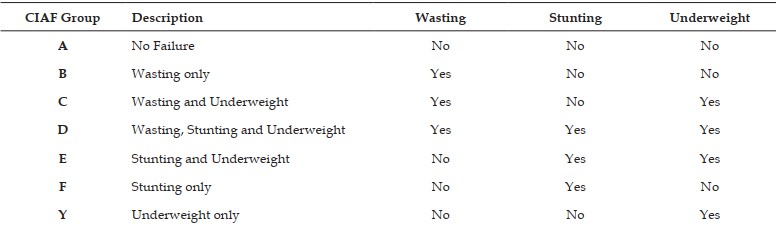
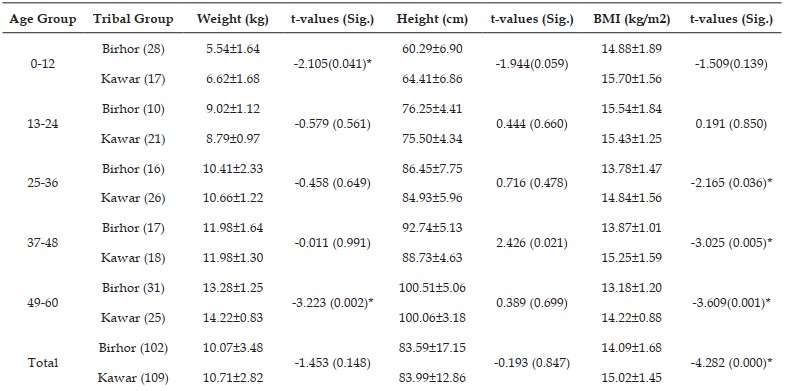
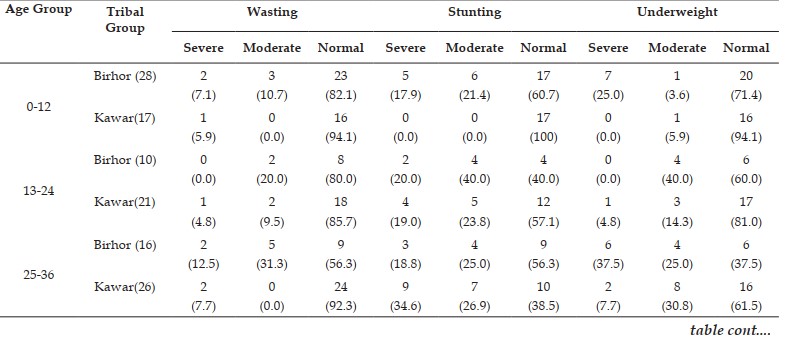
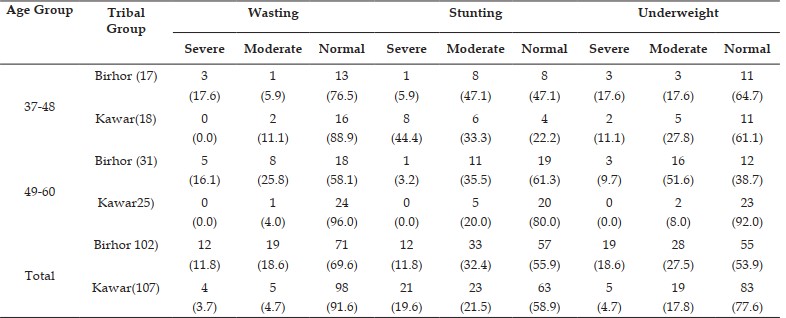
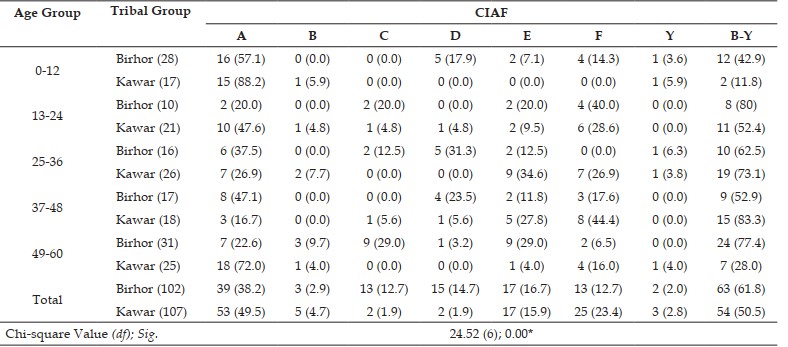
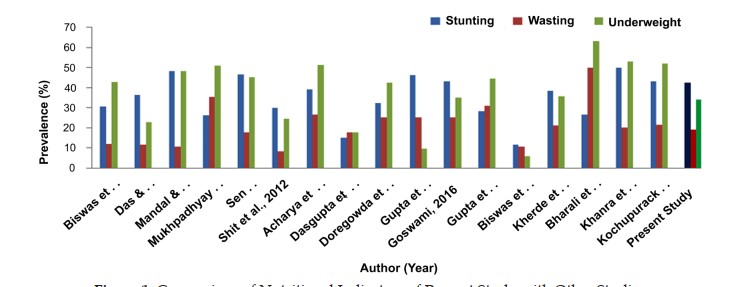
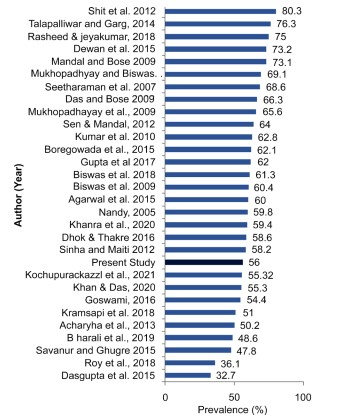
The future strength of every developing country is judged by the wealth and health of its people. Nutritional inequality leads to other forms of social inequalities. Hence nutritional inequalities have great importance in the public health dimension to identify the more underprivileged communities. Thus, the study aims to evaluate the prevalence of nutritional indicators i.e., stunting, wasting, underweight and anthropometric failure among preschool children of two tribal communities of Korba district, Chhattisgarh, India. A total of 209 [102 Birhor (PVTG) and 107 Kawar (non-PVTG)] preschool children were randomly selected and anthropometrically measured through standard procedure and techniques. The nutritional indicators i.e., wasting, stunting and underweight were assessed by WHO (2006) classification, then categorised into different anthropometric failures (Nandy et al., 2005). The age, sex and tribe combined prevalence of wasting; stunting and underweight were 19.2%, 42.6% and 34.0% respectively. Similarly, the prevalence of one or more types of anthropometric failure (B-Y) was 56% among studied children. The prevalence of nutritional indicators [wasting (χ2=16.37; p<0.05) and underweight (χ2=15.46; p<0.05)] and anthropometric failure (χ2=24.52; p<0.05) was found significantly higher among Birhor children than Kawar children. The study concluded that the nutritional status of studied children was disastrous and the primitive tribal group are more deprived, facing severe nutrition insecurity.
References
- 1. Acharya, A., Mandal, G.C., & Bose, K. (2013). Overall burden of undernutrition measured by a Composite Index in rural preschool children in Purba Medinipur, West Bengal, India. Anthropological Review, 76(1), 109–116. https:// doi.org/10.2478/anre-2013-0005.
- 2. Agarwal, D., Misra, S.K., Chaudhary, S.S., & Prakash, G. (2015). Are we Underestimating the Real Burden of Malnutrition ? An Experience From Community-Based Study. Indian Journal of Community Medicine, 40(4), 268–272. https:// doi.org/10.4103/0970-0218.164401.
- 3. Bharali, N., Singh, K.N., & Mondal, N. (2019). Composite Index of Anthropometric Failure (CIAF) among Sonowal Kachari tribal preschool children of flood affected region of Assam, India. Anthropological Review, 82(2), 163–176. https://doi.org/10.2478/anre-2019- 0012.
- 4. Biswas, S., Bise, K., Mukhopadhyay, & Bhadra, M. (2009). Prevalence of undernutrition among pre-school children of Chapra, Nadia District, West Bengal, India, measured by composite index of anthropometric failure (CIAF). Anthrop. Anz., 67(3), 269–279.
- 5. Biswas, S., Giri, S.P., & Bose, K. (2018). Assessment of nutritional status by composite index of anthropometric failure ( CIAF ): a study among preschool children of Sagar Block, South 24 Parganas District, West Bengal, India. Anthropological Review, 81(3), 269–277. https://doi.org/10.2478/anre-2018-0022.
- 6. Boregowda, G. S., Soni, G.P., Jain, K., & Agrawal, S. (2015). Assessment of Under Nutrition Using Composite Index of Anthropometric Failure (CIAF) amongst Toddlers Residing in Urban Slums of Raipur City, Chhattisgarh, India. Journal of Clinical and Diagnostic Research, 9(7), LC04–LC06. https://doi.org/10.7860/ JCDR/2015/12822.6197.
- 7. Das, S., & Bose, K. (2009). Report on “ anthropometric failure ” among rural 2-6 years old Indian Bauri caste children of West Bengal. Anthropological Review, 72, 81–88. https://doi. org/10.2478/v10044-008-0017-1.
- 8. Dasgupta, A., Parthasarathi, R., Prabhakar, V.R., Biswas, R., & Geethanjali, A. (2014). Assessment of Under Nutrition with Composite Index of Anthropometric Failure (CIAF) Among Under-Five Children in a Rural Area of West Bengal. Indian Journal of Community Health, 26(02), 132–138.
- 9. Dewan, D., Gupta, R., & Kumar, D. (2015). Can we rely solely on conventional measures to estimate undernutrition among under-fives ? IndianJournal of Community Health, 27(3), 361– 365.
- 10. Dhok, R.S., & Thakre, S.B. (2016). Measuring undernutrition by composite index of anthropometric failure (CIAF): a communitybased study in a slum of Nagpur city. International Journal of Medical Science and Public Health, 5(10), 2013–2018. https://doi. org/10.5455/ijmsph.2016.07022016398.
- 11. Goswami, M. (2016). Prevalence of UnderNutrition Measured by Composite Index of Anthropometric Failure ( CIAF ) Among the Bhumij Children of Northern Odeisha, India. J Nepal Paediatr Soc, 36(1), 61–67.
- 12. Grebmer, K. Von, Bernstein, J., Wiemers, M., Reiner, L., Bachmeier, M., Hanano, A., Towey, O., Cheilleachair, R.N., Foley, C., Gitter, S., Laroque, G., Fritschel, H., & Resnick, D. (2022). Global Hunger Index 2022 : India (Issue October).
- 13. Gupta, A., Kalaivani, M., Gupta, S.K., Rai, S.K., & Nongkynrih, B. (2015). Burden of Undernutrition, Composite Index of Anthropometric Failure ( CIAF ) and Perception of Caregivers about Undernutrition Among Under Five Children in Rural India. The Indian Journal of Nutrition and Dietetics, 52(2), 140–152.
- 14. Gupta, G., Sharma, A.K., & Choudhary, T.S. (2017). Assessment of undernutrition among children below 5, using Composite Index of Anthropometric Failure (CIAF). Indian Journal of Community Health, 29(01), 1–6. https://doi. org/10.47203/IJCH.2017.v29i01.016.
- 15. Khan, J., & Das, S.K. (2020). The burden of anthropometric failure and child mortality in India. Scientific Reports, 0123456789, 1–16. https://doi.org/10.1038/s41598-020-76884-8.
- 16. Khanra, P., Bose, K., & Chakraborty, R. (2020). Mother’s education level is associated with anthropometric failure among 3- to 12-yearold rural Children in Purba Medinipur, West Bengal, India. Journal of Biosocial Science, 1–12. https://doi.org/10.1017/S0021932020000577.
- 17. Kherde, A., Patil, C.R., Deshmukh, J., & Petkar, P.B. (2018). Composite index of anthropometric failure among under 5 children attending the Immunoprophylaxis clinic in a tertiary care hospital in Nagpur, Maharashtra , India. International Journal of Contemporary Pediatrics, 5(3), 888–892.
- 18. Kochupurackal, S.U., Basappa, Y.C., Vazhamplackal, S.J., & Srinivas, P.N. (2021). An intersectional analysis of the composite index of anthropometric failures in India. International Journal for Equity in Health, 20, 1–11.
- 19. Kramsapi, R., Singh, K.N., & Mondal, N. (2018). Composite Index of Anthropometric Failure ( CIAF ) among pre-school ( 2-5 years ) tribal children of Assam (India). Human Biology Review, 7(1), 2018.
- 20. Kumar, D., Mittal, P.C., & Sharma, M.K. (2010). Socio-demographic Risk Factors of ChildUndernutrition. Journal of Pediatric Sciences, 2(e7), 1–11.
- 21. Mandal, G.C., & Bose, K. (2009). Assessment of Overall Prevalence of Undernutrition Using Composite Index of Anthropometric Failure (CIAF) among Preschool Children of West Bengal, India. Iranian Journal of Pediatrics, 19(3), 237–243.
- 22. Mukhopadhyay, D.K., & Biswas, A.B. (2011). Food Security and Anthropometric Failure Among Tribal Children in Bankura, West Bengal. Indian Pediatrics, 48, 15–18.
- 23. Mukhopadhyay, D. K., Biswas, R., Chakraborty, M., Sadhukhan, S.K., & Banik, K.K. (2009). Anthropometric failure, a new approach to measure undernutrition: An experience from a rural community of West Bengal, India. Journal of Medical Association, 107(4), 211–214.
- 24. Nandy, S., Irving, M., Gordon, D., Subramanian, S.V, & Smith, G.D. (2005). Poverty, child undernutrition and morbidity : new evidence from India. Policy and Practice Bulletin of the World Health Organization, 83(3), 210–216.
- 25. NFHS-5. (2019). National Family Health Survey (NFHS-5) Compendium of Fact Sheets.
- 26. Rasheed, W., & Jeyakumar, A. (2018). Magnitude and severity of anthropometric failure among children under two years using Composite Index of Anthropometric Failure (CIAF) and WHO standards. International Journal of Pediatrics and Adolescent Medicine, 5(1), 24–27. https://doi.org/10.1016/j. ijpam.2017.12.003
- 27. Roy, K., Dasgupta, A., Roychoudhury, N., Bandyopadhyay, L., Mandal, S., & Paul, B. (2018). Assessment of undernutrition with composite index of anthropometric failure (CIAF) among under-five children in a rural area of West Bengal, India. International Journal of Contemporary Pediatrics, 5(4), 1651– 1656. https://doi.org/10.18203/2349-3291. ijcp20182583.
- 28. Savanur, M.S., & Ghugre, P.S. (2015). Magnitude of undernutrition in children aged 2 to 4 years using CIAF and conventional indices in the slums of Mumbai city. Journal of Health, Population and Nutrition, 33(3), 1–7. https://doi.org/10.1186/s41043-015-0017-x.
- 29. Seetharaman, N., Chacko, T.V, Shankar, S.L.R., & Mathew, A.C. (2007). Measuring Malnutrition -The Role of Z Scores and the Composite Index of Anthropometric Failure (CIAF). Indian Journal of Community Medicine, 1(1), 35–39.
- 30. Sen, J., & Mondal, N. (2012). Socio-economic and demographic factors affecting the Composite Index of Anthropometric Failure (CIAF). Annals of Human Biology, 39(2), 129– 136. https://doi.org/10.3109/03014460.2012.6 55777.
- 31. Shit, S., Taraphdar, P., Mukhopadhyay, D. K., Sinhababu, A., & Biswas, A.B. (2012). Assessment of Nutritional Status by Composite Index for Anthropometric Failure : A Study Among Slum Children in Bankura, West Bengal. Indian Journal of Public Health, 56(4), 5–8. https://doi.org/10.4103/0019-557X.106421.
- 32. Sinha, N.K., & Maiti, S. (2012). Prevalence of Undernutrition among Underprivileged Preschool Children (2-6 Yrs) of Minnapore Town, India. Malaysian Journal of Paediatrics and Child Health Online Early, 18(1), 58–69.
- 33. Talapalliwar, M.R., & Garg, B.S. (2014). Nutritional Status and its Correlates Among Tribal Children of Melghat, Central India. Indian J Pediatr, 81(11), 1151–1157. https://doi. org/10.1007/s12098-014-1358-y
Data Sharing Statement
There are no additional data available. All raw data and code are available upon request.
Funding
This research received no funding.
Author Contributions
All authors contributed significantly to the work and approve its publication.
Ethics Declaration
This article does not involve any human or animal subjects, and therefore does not require ethics approval.
Acknowledgements
We would like to express our gratitude to the patients, their families, and all those who have contributed to this study.
Conflicts of Interest
No conflicts of interest in this work.
About this article

Cite this article
Dhansay, A.N. Sharma, Sarvendra Yadav, et al. Assessment of Nutritional Indicators: A Comparative Study among Pre-School Children of Birhor and Kawar Tribe of Korba District, Chhattisgarh, India. Ind J Res Anthropol 2025; 11(2): 165-173.
Licence:
Attribution-Non-commercial 4.0 International (CC BY-NC 4.0)This license enables reusers to distribute, remix, adapt, and build upon the material in any medium or format for noncommercial purposes only, and only so long as attribution is given to the creator.
| Received | Accepted | Published |
|---|---|---|
| July 21, 2025 | October 22, 2025 | November 30, 2025 |
DOI: https://doi.org/10.21088/ijra.2454.9118.11225.9
Keywords
Composite Index of Anthropometric FailureNutritional IndicatorParticularly Vulnerable Tribal GroupStuntingUnderweightWastingSearch for Similar Articles
Similar Articles
- Contemporary Issues and Challenges in Women’s Weavers in the Varanasi Silk Saree...
- Understanding through Traversing the Corridors of History: Richness of Indian He...
- Challenges and Opportunities in Digital Preservation of Intangible Culture Herit...
- Prenatal and Postnatal Health-Seeking Behaviour among the Muria Tribe of Bastar...
- Nutritional Status and Anthropometric Variations among Railway Colony Children i...
Article Level Metrics
Last UpdatedThursday 22 October 2026, 12:30:46 (IST)
2445
Accesses
14
529
00
Citations
NA
NA
NA
Download citation
Article Keywords
Keyword Highlighting
Highlight selected keywords in the article text.
Timeline
| Received | July 21, 2025 |
| Accepted | October 22, 2025 |
| Published | November 30, 2025 |
licence
Attribution-Non-commercial 4.0 International (CC BY-NC 4.0)
This license enables reusers to distribute, remix, adapt, and build upon the material in any medium or format for noncommercial purposes only, and only so long as attribution is given to the creator.