Full Text (PDF)
Physiotherapy and Occupational Therapy Journal 17(2):p 83-91, April – June 2024. | DOI: http://dx.doi.org/10.21088/potj.0974.5777.17224.3
Original Article
To Analyze the Effect of Trunk forward Bending with and without Elbow Flexion on the Myoelectrical Activity of Serratus Anterior during Pushing
Author Information
Licence:
Attribution-Non-commercial 4.0 International (CC BY-NC 4.0)This license enables reusers to distribute, remix, adapt, and build upon the material in any medium or format for noncommercial purposes only, and only so long as attribution is given to the creator.
Physiotherapy and Occupational Therapy Journal 17(2):p 83-91, April – June 2024. | DOI: http://dx.doi.org/10.21088/potj.0974.5777.17224.3
How Cite This Article:
Aslam M. To analyze the effect of trunk forward bending with and without elbow flexion on the myoelectrical activity of serratus anterior during pushing. Physio Ther Occup Ther J. 2024;17(2):83-91.Timeline
Received : May 24, 2024
Accepted : June 29, 2024
Published : June 30, 2025
Abstract
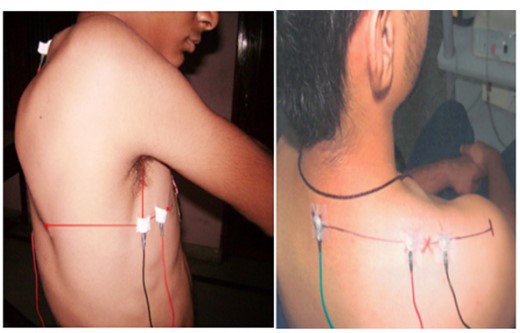
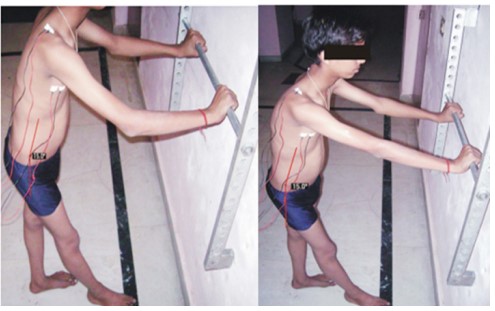
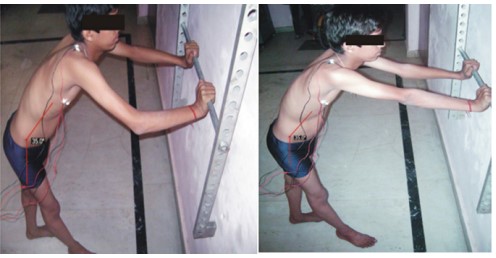
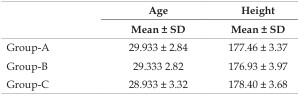
The convenience sample of forty-five male subjects including only adult were recruited in the study. All subjects were right side dominant. For group-A, the mean age was (29.933 ± 2.84) years and mean height was (177.46 ± 3.37) cm. For group-B, the mean age and height was (29.333 ± 2.82) years and (176.93 ± 3.97) cm respectively. For group-C, mean age was (28.933 ± 3.32) years and mean height was (178.40 ± 3.68) cm. All the subjects were taken from the population in and around the different hospitals of Dehradun. Each and every subject was informed about the procedure and demonstrated by the experimental therapist prior to the study. The study had received a written informed consent from the subjects with their willingness. From the above study, it was concluded that pushing activity performed, when the trunk is forward bend and elbow is extended, produce increased myoelectrical activity of Serratus anterior.
References
- 1. M.J.M Hoozeman et.al. Low-back and shoulder complaints among workers with pushing and pulling tasks. Scand J Work Environ Health 2002; 28(5):293–30.
- 2. P. Paul F.M.Kuijer et.al. A different approach for the ergonomic evaluation of pushing and pulling in practice, International Journal of Industrial Ergonomics, Vol 37, Issue 11-12, dec 2007, p 855-862.
- 3. Van der Windt et.al. : Occupational risk factors for shoulder pain: a systematic review, Occup Environ Med. 2000 July; 57(7): 433–442.
- 4. M.J.M Hoozemenn et.al. Pushing and pulling in association with low back and shoulder complaints . Occupational and Environmental Medicine 2002;59:696-702.
- 5. Andrew I Todd: Current Trends In Research Focused On Pushing And Pulling. Journal of Ergonomics Society of South Africa, 2005, No 2, p 42-5.
- 6. Biman Das and Y.Wang: Isometric Pull-push Strength in workspace: 2.Analysis of spatial factors. International Journal of Occupational Safety and Ergonomics (JOSE) Volume 10, No.1, p 59-64.
- 7. Hoozemans MJM et. al, Pushing and pulling in relation to musculoskeletal disorders: a review of risk factors. Ergonomics 1998;41:757–81.
- 8. Brian A.Garner and Joe Shim: Isometric Shoulder Girdle Strength Of Healthy Young Adults. Clinical Biomechanics Vol 23, Issue 1, Jan 2008,P 30-37.
- 9. Gray’s Anatomy: The Anatomical basis of medicine and surgery. Late. Peter L. Williams, Churchill Livingstone 38th edition, 1995. 85.
- 10. C.K Huang et.al. Scapular activities during pushing tasks. Journal of biomechanics, 40, 2007, page 396.
- 11. Susan B.O’Sullivan, Physical Rehabilitation: Assessment and Treatment. Jeypee Brothers, 4th Edition, 213-255, 2001.
- 12. B.D.Charasia, Human Anatomy: Regional and Applied, CBS Publishers, 3rd Edition, Vol 1,131-134,2001.
- 13. WilfridT.Dempster, Mechanims of shoulder movement, Archives of Physical Med. and Rehab, Jan, 49-70,1965.
- 14. Richard A. Ekstrom et.al. Comparing the Function of the Upper and Lower Parts of the Serratus Anterior Muscle Using Surface Electromyography. JOSPT.35, (5), May 2004, 235-243.
- 15. ChristopherI.M.Price, Paul Franklin et.al. Active and passive scapulohumeral movement in healthy persons: A comparison, Arch.phys. Med.Rehab., 81,28-31,2000.
- 16. Kevin P. Granata and Bradford C. Bennett: Low-Back Biomechanics and Static Stability During Isometric Pushing. Human Factors. 2005; 47(3): 536–549.
- 17. D.O Odebiyi et.al. Relationship between Spinal Mobility, Physical Performance, Pain Intensity And Functional Disability In Patients With Chronic Low Back Pain. Nigerian Journal of Medical Rehabilitation (NJMR); Vol. 11, No. 2, (Issue No. 20) Dec. 2006 49-54.
- 18. Roger M. Enoka and Jacques Duchateau, Muscle fatigue: what, why and how it influences muscle function. Journal of Physiology.
- 19. D. David Ebaugh et.al,: Effects of shoulder muscle fatigue caused by repetitive overhead activities on scapulothoracic and glenohumeral 86 kinematics. Journal of Electromyography and Kinesiology, 16 (2006) 224–235.
- 20. Richard S.Snell, clinical anatomy for medical students, Lippincott Williams and Wilkins, 6th Edition, 408-410, 2000.
- 21. Michael J. Decker et.al. Serratus Anterior Muscle Activity During Selected rehabilitation Exercises. The American Journal of Sports Medicine, volume 27 No. 6, P 784-91.
- 22. Baril-Gingras and Lortie M. The handling of objects other than boxes: univariate analysis of handling techniques in a large transport company. Ergonomics, 38: 1995,905 – 925.
- 23. Davinder Gaur et.al. Effect of aging on activation of shoulder muscles during dynamic activities: An electromyographic analysis. International journal of shoulder surgery, volume 1, Issue 2 2007, P 51- 57.
- 24. Travell J.Simmons D: Myofacial pain and dysfunction: The trigger point manual. Williams and Wilkins, 2nd Edition, 183-202, 1999.
- 25. R. H. Westgaard: Work-related musculoskeletal complaints: some ergonomics challenges upon the start of a new century. Applied Ergonomics, Volume 31, Issue 6, December 2000, Page 569-580.
- 26. D. David Ebaugh et al, Scapulothoracic and glenohumeral kinematics following an external rotation fatigue protocol, Journal of Electromyography and Kinesiology, 36(8), 557-571.2006.
Data Sharing Statement
There are no additional data available.
Author Contributions
All authors contributed significantly to the work and approve its publication.
Ethics Declaration
This article does not involve any human or animal subjects, and therefore does not require ethics approval
Acknowledgements
Information Not Provided
About this article

Cite this article
Aslam M. To analyze the effect of trunk forward bending with and without elbow flexion on the myoelectrical activity of serratus anterior during pushing. Physio Ther Occup Ther J. 2024;17(2):83-91.
Licence:
Attribution-Non-commercial 4.0 International (CC BY-NC 4.0)This license enables reusers to distribute, remix, adapt, and build upon the material in any medium or format for noncommercial purposes only, and only so long as attribution is given to the creator.
| Received | Accepted | Published |
|---|---|---|
| May 24, 2024 | June 29, 2024 | June 30, 2025 |
DOI: http://dx.doi.org/10.21088/potj.0974.5777.17224.3
Keywords
Pushing activityMyoelectric activitySerratus anteriorSearch for Similar Articles
Similar Articles
- Leadership in Physiotherapy: A Narrative Review
- Effectiveness of Low Level Laser Theapy in the Management of Temporomandibular J...
- The Impact of Air Pollution on Cardiopulmonary Health: Molecular Mechanisms, Pre...
- Efectiveness of Physiotherapy in Postpartum Women with Diastasis Recti: A Review
- Pain Neuroscience Education: Transforming Physiotherapy Practice
Article Level Metrics
Last UpdatedFriday 23 October 2026, 16:22:54 (IST)
4358
Accesses
14
739
00
Citations
NA
NA
NA
Download citation
Article Keywords
Keyword Highlighting
Highlight selected keywords in the article text.
Timeline
| Received | May 24, 2024 |
| Accepted | June 29, 2024 |
| Published | June 30, 2025 |
licence
Attribution-Non-commercial 4.0 International (CC BY-NC 4.0)
This license enables reusers to distribute, remix, adapt, and build upon the material in any medium or format for noncommercial purposes only, and only so long as attribution is given to the creator.