Full Text (PDF)
Physiotherapy and Occupational Therapy Journal 17(2):p 93-101, April – June 2024. | DOI: http://dx.doi.org/10.21088/potj.0974.5777.17224.4
Review Article
Effect of Gaze Direction Recognition Exercise (GDRE) Program in Reducing Pain & Increasing Range of Motion in Chronic Neck Pain
Niraj Kumar, Minal Chaudhary, Sharda Sharma, Parveen Shama, Tabussum null
Author Information
Licence:
Attribution-Non-commercial 4.0 International (CC BY-NC 4.0)This license enables reusers to distribute, remix, adapt, and build upon the material in any medium or format for noncommercial purposes only, and only so long as attribution is given to the creator.
Physiotherapy and Occupational Therapy Journal 17(2):p 93-101, April – June 2024. | DOI: http://dx.doi.org/10.21088/potj.0974.5777.17224.4
How Cite This Article:
Chaudhary M, Sharma S, Kumar N, et al. Effect of gaze direction recognition exercise (GDRE) program in reducing pain & increasing range of motion in chronic neck pain. Physio Ther Occup Ther J. 2024;17(2):93-101.Timeline
Received : July 24, 2024
Accepted : August 29, 2024
Published : June 30, 2024
Abstract
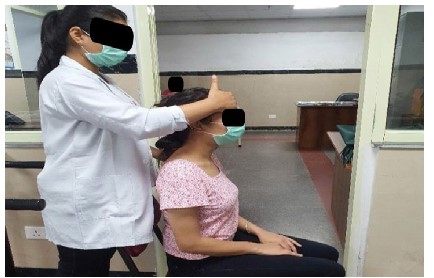
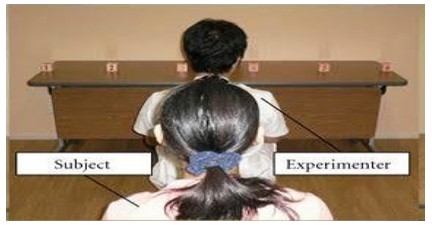
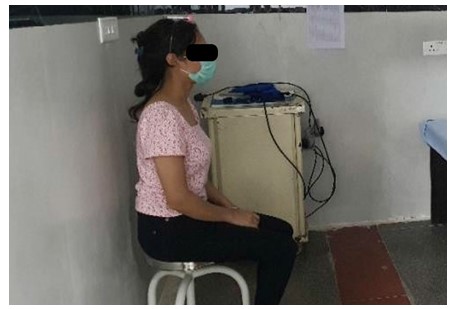
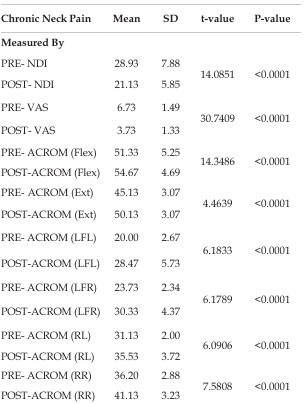
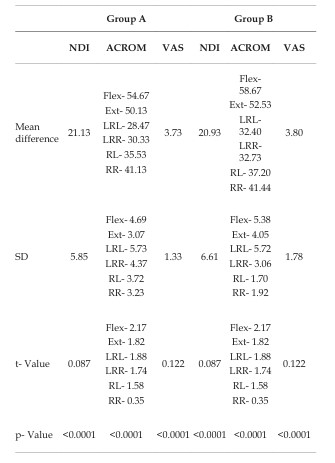
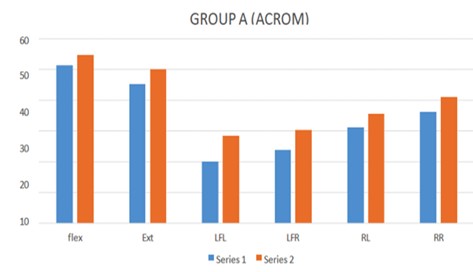
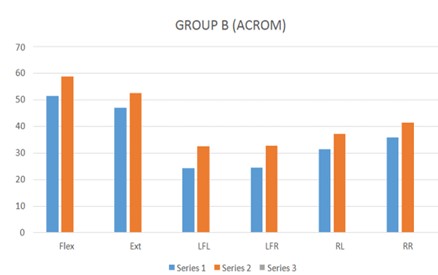
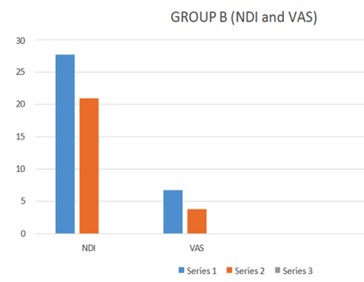
Introduction: Chronic neck is a prevalent musculoskeletal condition affecting individuals worldwide, often leading to decreased range of motion and diminished quality of life. It is characterized by persistent discomfort and functional limitations in the cervical region. The increasing prevalence of chronic neck pain is attributed to various factors, including sedentary lifestyles, poor ergonomics, and psychological stressors. This study presents a comparative investigation into the effects of proprioceptive training vs conventional training on increasing range of motion and reducing pain in patients with chronic neck pain. Objectives of the Study: To improve range of motion and reduce pain in patients with chronic neck pain. To assess the effectiveness of Gaze Direction Recognition Exercise (GDRE) Program. Procedure: All the participants were explained about the purpose of study. The subjects were screened for inclusion and exclusion criteria and then the baseline measurement was taken. An informed consent was taken from patients who were willing to participate in the study. Eligible subjects were randomly allocated into two groups. Group A participants receiving conventional training. Group B participants receiving proprioceptive training. Both groups had received exercises program for chronic neck pain. The study was of 6 weeks, 5 days per week at department of physiotherapy in SMIH. Examination include assessment which was performed on first and the last day of treatment & data was recorded in group A pre scoring was via VAS, NDI, cervical goniometer and after the scoring the patient undergone treatment with proprioceptive training. Conclusion: Gaze Direction Recognition Exercise (GDRE) Program shows more improvement in range of motion and pain in chronic neck pain after 6 weeks of therapy.
References
- 1. Victoria Misailidou PT, MS, Paraskevi Malliou PhD, et.al (2010). Assessment of patients with neck pain: A Review of definitions, selection criteria, and measurement tools. Journal of Chiropractic Medicine (2010) 9, 49- 59.
- 2. Mehmet Duray, Sule Simsek, et.al (2018). Effect of proprioceptive training on balance in patients with chronic neck pain. Department of physical therapy and rehabilitation, Pamukkale University, Denizil, Turkey.
- 3. Neeraj Kumar Shiv Verma (2016), To Compare the Effect of Strenthening Neck Exercise andMckenzie Neck Exercise In Neck Pain Subject. British Journal of Medical and Health Research, Br J Med Health Res. Volume- 3(10).
- 4. Abdullah Raizah, Ravi Shankar Reddy, et.al (2023). A cross sectional study on mediating effect of chronic pain on the relationship between cervical proprioception and functional balance in elderly individuals with chronic neck pain: Mediation Analysis Study. J. Clin. Med. 2023, 12, 3140.
- 5. Rene Fejer, Kristen Ohm Kyvik, et.al (2006). The prevalence of neck pain in the world population: A systematic critical review of literature. Eur Spine J (2006) 15:834- 848.
- 6. Niraj Kumar, Sandeep Kumar, Bharat Puri (2020) Compare the effectiveness of between Isometric Strengthening Exercise and Postural Correction in Patients with Neck Pain, European Journal of Molecular & Clinical Medicine, Volume 07, Issue 11, PP 2515-8260.
- 7. Tasha R. Stanton, Hayley B. Leake, et.al (2015). Evidence of impaired proprioception in chronic, idiopathic neck pain: Systematic review and meta- analysis. Phys Ther. 2016; 96:876- 887.
- 8. Vito Enrico Pettrossi, Marco Schieppati, et.al (2014). Neck proprioception shapes body orientation and perception of motion.
- 9. Baogan Peng, Liang Yang, et.al (2021). Cervical proprioception impairment in neck pain- Pathophysiology, clinical evaluation and management: A Narrative Review. Pain Ther (2021) 10:143- 164.
Data Sharing Statement
There are no additional data available.
Funding
This research received no funding.
Author Contributions
All authors contributed significantly to the work and approve its publication.
Ethics Declaration
This article does not involve any human or animal subjects, and therefore does not require ethics approval
Acknowledgements
Information Not Provided
About this article

Cite this article
Chaudhary M, Sharma S, Kumar N, et al. Effect of gaze direction recognition exercise (GDRE) program in reducing pain & increasing range of motion in chronic neck pain. Physio Ther Occup Ther J. 2024;17(2):93-101.
Licence:
Attribution-Non-commercial 4.0 International (CC BY-NC 4.0)This license enables reusers to distribute, remix, adapt, and build upon the material in any medium or format for noncommercial purposes only, and only so long as attribution is given to the creator.
| Received | Accepted | Published |
|---|---|---|
| July 24, 2024 | August 29, 2024 | June 30, 2024 |
DOI: http://dx.doi.org/10.21088/potj.0974.5777.17224.4
Keywords
NDIVASACROMGaze Direction Recognition Exercise (GDRE) ProgramChronic neck painSearch for Similar Articles
Similar Articles
- Leadership in Physiotherapy: A Narrative Review
- Effectiveness of Low Level Laser Theapy in the Management of Temporomandibular J...
- The Impact of Air Pollution on Cardiopulmonary Health: Molecular Mechanisms, Pre...
- Efectiveness of Physiotherapy in Postpartum Women with Diastasis Recti: A Review
- Pain Neuroscience Education: Transforming Physiotherapy Practice
Article Level Metrics
Last UpdatedFriday 23 October 2026, 16:21:06 (IST)
4358
Accesses
12
739
00
Citations
NA
NA
NA
Download citation
Article Keywords
Keyword Highlighting
Highlight selected keywords in the article text.
Timeline
| Received | July 24, 2024 |
| Accepted | August 29, 2024 |
| Published | June 30, 2024 |
licence
Attribution-Non-commercial 4.0 International (CC BY-NC 4.0)
This license enables reusers to distribute, remix, adapt, and build upon the material in any medium or format for noncommercial purposes only, and only so long as attribution is given to the creator.