Full Text (PDF)
International Journal of Food, Nutrition & Dietetics 10(1):p 17-19, January-April 2022. | DOI: https://doi.org/10.21088/ijfnd.2322.0775.10122.2
Review Article
The Science of Browning: Useful or Dangerous?
Author Information
Licence:
Attribution-Non-commercial 4.0 International (CC BY-NC 4.0)This license enables reusers to distribute, remix, adapt, and build upon the material in any medium or format for noncommercial purposes only, and only so long as attribution is given to the creator.
International Journal of Food, Nutrition & Dietetics 10(1):p 17-19, January-April 2022. | DOI: https://doi.org/10.21088/ijfnd.2322.0775.10122.2
How Cite This Article:
K Silambu Selvi/The Science of Browning: Useful or Dangerous?/Int J Food Nutr Diet. 2022; 10(1):17–19.Timeline
Received : December 18, 2021
Accepted : February 11, 2022
Published : April 30, 2022
Abstract
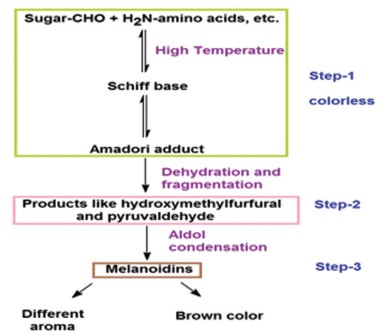
The last few years in India, have witnessed an upsurge in the barbeque culture which draws youngsters towards grilled and browned foods. It is no wonder that teens are attracted to the special charred aroma and flavor along with the appealing golden brown colored layer on the foods. This special attraction could be attributed to various factors such as the preparation and cooking method involved, the chemical components of the food, and the different chemical reactions that occur while cooking. The effect of these foods on health has been a subject of huge debate. On one side, they are promoted to be a healthy cooking method that reduces fat content and on the other hand, the chemical products released from these foods have proven to be carcinogenic. Limiting the frequency of consumption of grilled foods and increasing the usage of other safe methods such as boiling, poaching, or steaming will be more beneficial in improving individual health status.
References
- 1. Oracz, J., Nebesny, E. Effect of roasting parameters on the physicochemical characteristics of high-molecular-weight Maillard reaction products isolated from cocoa beans of different Theobroma cacao L. groups. Eur Food Res Technol 2019:245; 111–128
- 2. Nahid Tamanna, Niaz Mahmood,
- 3. Wang, He-Ya; Qian, H. & Yao, Wei-Rong. (2011). Melanoidins produced by the Maillard reaction: Structure and biological activity. Food Chemistry, Vol.128, No.3, October, pp.573–584.
- 4. ALjahdali N, Carbonero F. Impact of Maillard reaction products on nutrition and health: Current knowledge and need to understand their fate in the human digestive system. Crit Rev Food Sci Nutr. 2019;59(3):474-487.
- 5. Voyer LE, Alvarado C. Reacción de Maillard. Efectos patogénicos [Maillard reaction. Pathogenic effects]. Medicina (B Aires). 2019;79(2):137-143.
- 6. Yamagishi, S., Matsui, T., and Fukami, K. Role of receptor for advanced glycation end products (RAGE) and Its ligands in cancer risk. Rejuvenation Research. 2015;18: 48-56.
- 7. Jiao, L., Stolzenberg-Solomon, R., Zimmerman, T. P., Duan, Z., Chen, L., Kahle, L., Risch, A., Subar, A. F., Cross, A. J., Hollenbeck, A., Vlassara, H., Striker, G., and Sinha, R. Dietary consumption of advanced glycation end products and pancreatic cancer in the prospective NIHAARP Diet and Health Study. Am J Clin Nutr. 2015;101: 126-134.
- 8. Beland, F. A., Mellick, P. W., Olson, G. R., Mendoza, M. C. B., Marques, M. M., and Doerge, D. R. Carcinogenicity of acrylamide in B6C3F (1) mice and F344/N rats from a 2-year drinking water exposure. Food and Chemical Toxicology. 2013; 51: 149-159.
- 9. Lund MN, Ray CA. Control of Maillard Reactions in Foods: Strategies and Chemical Mechanisms. J Agric Food Chem. 2017 Jun 14;65(23):4537-4552.
- 10. Uribarri, J., Woodruff, S., Goodman, S., Cai, W., Chen, X., Pyzik, R., Yong, A., Striker, G. E., & Vlassara, H. (2010). Advanced glycation end products in foods and a practical guide to their reduction in the diet. Journal of the American Dietetic Association, 110(6), 911–16.e12.
Data Sharing Statement
There are no additional data available. All raw data and code are available upon request.
Funding
This research received no funding.
Author Contributions
All authors contributed significantly to the work and approve its publication.
Ethics Declaration
This article does not involve any human or animal subjects, and therefore does not require ethics approval.
Acknowledgements
We would like to express our gratitude to the patients, their families, and all those who have contributed to this study.
Conflicts of Interest
No conflicts of interest in this work.
About this article

Cite this article
K Silambu Selvi/The Science of Browning: Useful or Dangerous?/Int J Food Nutr Diet. 2022; 10(1):17–19.
Licence:
Attribution-Non-commercial 4.0 International (CC BY-NC 4.0)This license enables reusers to distribute, remix, adapt, and build upon the material in any medium or format for noncommercial purposes only, and only so long as attribution is given to the creator.
| Received | Accepted | Published |
|---|---|---|
| December 18, 2021 | February 11, 2022 | April 30, 2022 |
DOI: https://doi.org/10.21088/ijfnd.2322.0775.10122.2
Keywords
Grilled foodsBrowningMaillard reactionCarcinogensHealthSearch for Similar Articles
Similar Articles
- Smart and Sustainable Packaging Approaches for Reducing Heavy Metal Contaminatio...
- Traditional Rhythms for Modern Health: Seed Cycling in the Management of Women’s...
- School-Based Nutrition Education Improves Knowledge and Consumption of Omega-3-R...
- Nutrition as Precision Therapy in Rare Genetic Diseases: Moving beyond Supportiv...
- A Review on Health Risks Associated with the Repetitive use of Cooking Oil and D...
Article Level Metrics
Last UpdatedMonday 07 September 2026, 02:46:59 (IST)
1797
Accesses
7
247
00
Citations
NA
NA
NA
Download citation
Article Keywords
Keyword Highlighting
Highlight selected keywords in the article text.
Timeline
| Received | December 18, 2021 |
| Accepted | February 11, 2022 |
| Published | April 30, 2022 |
licence
Attribution-Non-commercial 4.0 International (CC BY-NC 4.0)
This license enables reusers to distribute, remix, adapt, and build upon the material in any medium or format for noncommercial purposes only, and only so long as attribution is given to the creator.