Full Text (PDF)
International Journal of Food, Nutrition & Dietetics 10(1):p 21-28, January-April 2022. | DOI: https://doi.org/10.21088/ijfnd.2322.0775.10122.3
Review Article
Factors Influencing Consumption Patterns and Choices for Mushrooms in “Mushroom City of India”, Solan (HP)
Nisha Kumari, Bhavya Shrma, Kapil Kathuria
Author Information
Licence:
Attribution-Non-commercial 4.0 International (CC BY-NC 4.0)This license enables reusers to distribute, remix, adapt, and build upon the material in any medium or format for noncommercial purposes only, and only so long as attribution is given to the creator.
International Journal of Food, Nutrition & Dietetics 10(1):p 21-28, January-April 2022. | DOI: https://doi.org/10.21088/ijfnd.2322.0775.10122.3
How Cite This Article:
Nisha Kumari, Bhavya Shrma, Kapil Kathuria/Factors Influencing Consumption Patterns and Choices for Mushrooms in “Mushroom City of India”, Solan (HP)/Int J Food Nutr Diet. 2022; 10(1):21–28.Timeline
Received : November 25, 2021
Accepted : November 30, 2021
Published : April 30, 2022
Abstract
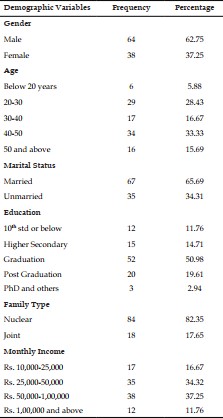
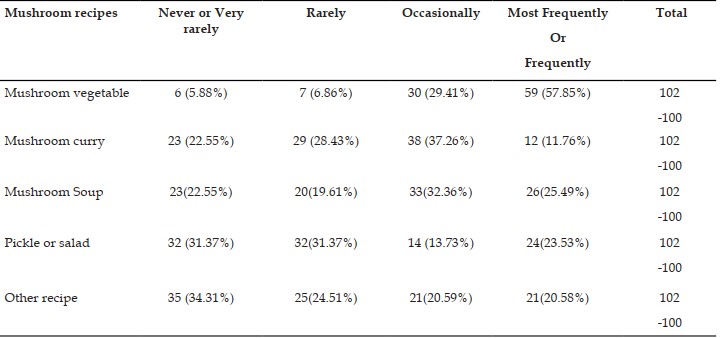
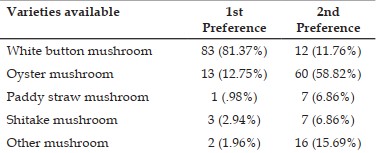
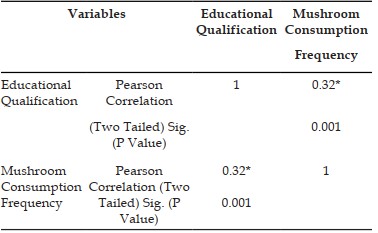
Purpose of the present research work is to study mushroom as a popular food & nutrient option in post COVID-19 era; further the work aim to understand the factors that influence the choices and consumption patterns of mushroom consumers. The responses of a sample of 102 respondents have been recorded using a structured questionnaire. These respondents consisted of the visitors to the points of sales for mushrooms in comprising Municipal Corporation area, Solan, (HP). Percentage, Chi-Square and Pearson correlation method were used to analyse the quantitative data collected. The study clearly indicated that mushroom as vegetable is popular among respondents in the study area. White button mushroom is the first preference followed by oyster and Gucchi for respondents. Shape and size followed by price and color acted as the evaluation criteria for mushroom purchase. Education level had a significant positive Correlation with the mushroom consumption frequency. ‘Good for health’ followed by ‘to add variety to diet’ and ‘medicinal value/prosperities’ are the main reasons for mushroom consumption among respondents. The non availability of fresh mushrooms on regular basis in local market led to mushrooms not being purchased.
References
- 1. Adejo, P. E. & Ademu, H. (2018). Attitude of rural farming households towards the consumption of edible mushrooms in Dekina Local Government Area, Kogi State, Nigeria. Nutri Food Science International Journal, 5(3), 555-661.
- 2. Aniket, K. & Roshan, D. (2021). Mushroom Market by Type (Button, Shiitake, Oyster, and Others), Form (Fresh and Processed), End Use (Residential, Commercial, and Industrial), and Distribution Channel (Hypermarkets & Supermarkets, Convenience Stores, Specialty Stores, and Online Sales Channel): Global Opportunity Analysis and Industry Forecast 2021–2027, Allied Market Research.
- 3. Boulding, K. E. (1945). The consumption concept in economic theory. The American Economic Review, 35(2), 1-14, American Economic Association. http://www.jstor.org/ stable/1818427.
- 4. Bringye, B., Fekete-Farkas, M. & Vinogradov, S. (2021). An analysis of mushroom consumption in Hungary in the International Context. Agriculture, 11, 677. https://doi.org/10.3390/ agriculture11070677.https://www.mdpi. com/2077-0472/11/7/677.
- 5. Business Standard, (2021). Farmers in Himachal Pradesh all set to export mushrooms. E- paper, https://www.business-standard.com/article/ news-ani/farmers-in-himachal-pradesh-allset-to-export-mushrooms-113090600568_1. html.
- 6. Chenarides, L., Grebitus, C., Lusk, J.L. & Printezis, I. (2021). Food consumption behavior during the COVID-19 pandemic. Agribusiness, 37, 44-81. Wiley Open Access Library, https:// onlinelibrary.wiley.com/doi/10.1002/ agr.21679.
- 7. Das, A.K., Nanda, P.K., Dandapat, P., Bandyopadhyay, S., Gullon, P., Sivaraman, G.K., McClements, D.J., Gullon, B. & Lorenzo, J.M. (2021). Edible mushrooms as functional ingredients for development of healthier and more sustainable muscle foods: A flexitarian approach. Molecules, 26, 2463. https://doi. org/10.3390/ molecules26092463.
- 8. Elisa, B. & Joao, N. (2018). Mushroom Consumption Behavior and Influencing Factors in a Sample of the Portuguese Population. Journal of International Food & Agribusiness Marketing, 30(1), 35-48, DOI: 10.1080/08974438.2017.1382420. https://www. tandfonline.com/doi/abs/10.1080/08974438.2 017.1382420?journalCode=wifa20.
- 9. Fortune Business Insight (2021). Mushroom market size, share & industry analysis, by Type (Button Mushroom, Shiitake Mushroom, Oyster Mushroom, and Others), Form (Fresh Mushroom, Frozen Mushroom, Dried Mushroom, and Canned Mushroom), and Regional Forecast 2019 – 2026. https://www. fortunebusinessinsights.com/industryreports/mushroom-market-100197.
- 10. Gurgen, A., Yildiz, S. & Yildiz, U. C. (2018). Determination of mushroom consumption preferences by using fuzzy analytic hierarchy process. Eurasian journal of forest science, 6(3), 25-34.
- 11. FAO, (2012) cited by Suzanna Smith and Kamal Bhattacharyya in, “Case Study: Men’s Perceptions of Their Roles and Involvement in Household Decisions around Food in Rural Bangladesh”, United States Agency for International Development (USAID) and US Government Feed the Future project “Integrating Gender and Nutrition within Extension and Advisory Services” (INGENAES). Leader with Associates Cooperative Agreement No. AIDOAA-LA-14-00008. www.ingenaes.illinois. edu, pp-4.
- 12. Hetland, G., Johnson, E., Bernardshaw, S.V. & Grinde, B. (2020). Can medicinal mushrooms have prophylactic or therapeutic effect against COVID-19 and its pneumonic super infection and complicating inflammation? Scand J Immunol, 93(1) 12937. doi:10.1111/ sji.12937, Cited in can medical mushroom fight against SARS-COV-2/COVID-19? By Abdul K.M. (2021). Journal of Internal Medicine: Science & Art, V2. https://www.researchgate. net/publication/235951796_Mushrooms_ Cultivation_Marketing_and_Consumption.
- 13. HP Govt. 2018, http://himachalpr.gov.in/ OneNews.aspx?Language=1&ID=12475.
- 14. Industry ARC (2021), Mushroom market - global industry analysis, size, share, growth, trends, and forecast 2021 – 2026. “Mushroom Market Forecast (2020-2025)”, Report CodeFBR 0229. https://www.industryarc.com/ Report/16679/mushroom-market.html.
- 15. Jannatul F., Zabid A. R., Mohammad, I. H., Satya R. S. & Mohammad Z.(2019). Mushroom production, status, challenges and opportunities in Bangladesh: A review. Annual Research & Review in Biology, 34(6), 1-13.
- 16. Jayawardena, R., Sooriyaarachchi, P., Chourdakis, M., Jeewandara, C. & Ranasinghe, P.(2020). Enhancing immunity in viral infections, with special emphasis on COVID-19: A review. Diabetes Metab Syndr, 14(4), 367-382. doi:10.1016/j.dsx.2020.04.015.
- 17. Jegadeesh, R., Lee Seul-Ki, Ji-Hoon Im, Oh Min-Ji, Oh Youn-Lee & Jang Kab- Yeul(2018). Current prospects of mushroom production and industrial growth in India. Journal of Mushroom, 16(4), 239-249.
- 18. Kotler, P. (1997). Marketing Management: Analysis, Planning, Implementation and Control (9th ed.) India: Prentice Hall. Cited in, An extended Model of Behavioural process in consumer decision making by Nagasimha B. K. (2016). International Journal of Marketing Studies, 8(4), 87-93. Doi:10.5539/ijms.v8n4p87.
- 19. Kumar, H., Bhardwaj, K., Sharma, R., Nepovimova, E., Cruz-Martins, N., Dhanjal, D.S., Singh, R.,Chopra, C.,Verma, R., AbdElsalam, K.A., Ashwani T., Kamil M., Dinesh K. & Kamil K. (2021). Potential usage of edible mushrooms and their residues to retrieve valuable supplies for industrial applications. Journal of Fungi, 7, 427. https://doi.org/ 10.3390/jof7060427.
- 20. Mayett, Y., Martinez-Carrera, D., Sanchez, M., Macias, A., Mora, S. & Estrada-T., A. (2006). Consumption trends of edible mushrooms in developing countries: The case of Mexico. Journal of International Food & Agribusiness Marketing, 18, 151-176
- 21. Mohana Priya, K. P., Moghana L. S., Hemalatha, S. & Maherandran,K.(2021). Growth trends in mushroom production; an analysis of Indian and global scenario. International Journal of Microbiology Research, 13(1), 1939-1941.
- 22. Murphy, E.J., Masterson,C., Rezoagli, E., O'Toole, D., Major, I., Stack, G.D., Lynch, M., Laffey, J.G.& Rowan, N.J. (2020). β-Glucan extracts from the same edible shiitake mushroom Lentinus edodes produce differential in-vitro immunomodulatory and pulmonary cytoprotective effects - Implications for coronavirus disease (COVID-19) immunotherapies. Sci Total Environ. 732:139330. doi:10.1016/j.scitotenv.2020.139330, Cited in, Can medical mushroom fight against SARSCOV-2/COVID-19? By Abdul K.M. (2021). Journal of Internal Medicine: Science & Art, V2.
- 23. Rahman, M.M., Mosaddik, A. & Alam, A.K. (2021) Traditional foods with their constituent’s antiviral and immune system modulating properties. Heliyon, 7(1):e05957. doi:10.1016/j. heliyon.2021.e05957, Cited in can medical mushroom fight against SARS-COV-2/ COVID-19? By Abdul K.M. (2021). Journal of Internal Medicine: Science & Art, V2.
- 24. Rangsinth, P., Sillapachaiyaporn, C., Nilkhet, S., Tencomnao, T., Ung AT & Chuchawankul, S. (2021). Mushroom-derived bioactive compounds potentially serve as the inhibitors of SARS-CoV-2 main protease: An in silico approach. Journal of Traditional and Complementary Medicine, 11(2), 158-172. doi:10.1016/j.jtcme.2020.12.002. Cited in can medical mushroom fight against SARS-COV-2/ COVID-19? By Abdul K.M. (2021). Journal of Internal Medicine: Science & Art, V2.
- 25. Shahzad, F., Anderson, D. & Najafzadeh, M. (2020). The antiviral, anti-inflammatory effects of natural medicinal herbs and mushrooms and SARS-CoV-2 infection. Nutrients. 12(9), 2573. doi:10.3390/nu12092573. Cited in can medical mushroom fight against SARS-COV-2/ COVID-19? By Abdul K.M. (2021). Journal of Internal Medicine: Science & Art, V2.
- 26. Sharma, V.P., Sudheer, A.K., Yogesh, G., Manjit, S. & Shwet K. (2017).Status of mushroom production in India. Mushroom Research, 26 (2), 111-120.
- 27. Shirur, M., Ahlawat, O.P. & Manikandan K. (2014). Mushroom consumption and purchasing behaviour in India: A study among selected respondents. Mushroom Research, 23 (2), 225-231.
- 28. Thota, S.M., Balan,V. & Sivaramakrishnan,V. (2020). Natural products as home-based prophylactic and symptom management agents in the setting of COVID-19. Phytother Res. 34(12), 3148-3167. doi:10.1002/ptr.6794. Cited in can medical mushroom fight against SARS-COV-2/COVID-19? By Abdul K.M. (2021). Journal of Internal Medicine: Science & Art, V2.
- 29. UN, Agenda (2030). Transforming our world: the 2030 agenda for sustainable development, department of economic and social affairs sustainable development. https://sdgs. un.org/2030agenda.
- 30. Wakchaure, G. C. (2011). Production and Marketing of Mushroom: golobal and national Scenario, (Singh, M., Vijay, B., Kamal, S. & Wakchaure, G. C. (eds.). Mushrooms Cultivation, Marketing and Consumption, Published by Directorate of Mushroom Research (ICAR), Solan (India), M/s Yugantar Prakashan Pvt. Ltd, WH-23, Mayapuri Industrial Area, Phase-I, New Delhi. 15-22.
- 31. Wen, Q., Lu J., Xinlei C., Yang S. & Zhang C. (2016). Research on consumer behaviour of edible mushroom and its influencing factors: Based on spot investigation in Beijing. Advances in Social Sciences, 5(3), 442–451. doi:10.12677/ ASS.2016.53062.
- 32. Yanuck, S.F., Pizzorno, J., Messier, H. & Fitzgerald, K.N. (2020). Evidence supporting a phased immuno-physiological approach to COVID-19 from prevention through recovery. Integr Med (Encinitas). 19(Suppl-1), 8- 35. Cited in can medical mushroom fight against SARSCOV-2/COVID-19? By Abdul K.M. Journal of Internal Medicine: Science & Art, V2.
- 33. Yuan J., Lisa, A. H., Hyeyoung, K. & Susan, S. P. (2017). Zero-inflated ordered probit approach to modeling mushroom consumption in the United States. International Food and Agribusiness Management Review, 20(5), 655- 672, DOI: 10.22434/IFAMR2017.0006
Data Sharing Statement
There are no additional data available. All raw data and code are available upon request.
Funding
This research received no funding.
Author Contributions
All authors contributed significantly to the work and approve its publication.
Ethics Declaration
This article does not involve any human or animal subjects, and therefore does not require ethics approval.
Acknowledgements
We would like to express our gratitude to the patients, their families, and all those who have contributed to this study.
Conflicts of Interest
No conflicts of interest in this work.
About this article

Cite this article
Nisha Kumari, Bhavya Shrma, Kapil Kathuria/Factors Influencing Consumption Patterns and Choices for Mushrooms in “Mushroom City of India”, Solan (HP)/Int J Food Nutr Diet. 2022; 10(1):21–28.
Licence:
Attribution-Non-commercial 4.0 International (CC BY-NC 4.0)This license enables reusers to distribute, remix, adapt, and build upon the material in any medium or format for noncommercial purposes only, and only so long as attribution is given to the creator.
| Received | Accepted | Published |
|---|---|---|
| November 25, 2021 | November 30, 2021 | April 30, 2022 |
DOI: https://doi.org/10.21088/ijfnd.2322.0775.10122.3
Keywords
Consumer behaviorMushroom ConsumptionFood markets in IndiaPurchasing behaviorMushroomMushroom as super foodSearch for Similar Articles
Similar Articles
- Smart and Sustainable Packaging Approaches for Reducing Heavy Metal Contaminatio...
- Traditional Rhythms for Modern Health: Seed Cycling in the Management of Women’s...
- School-Based Nutrition Education Improves Knowledge and Consumption of Omega-3-R...
- Nutrition as Precision Therapy in Rare Genetic Diseases: Moving beyond Supportiv...
- A Review on Health Risks Associated with the Repetitive use of Cooking Oil and D...
Article Level Metrics
Last UpdatedMonday 07 September 2026, 02:48:26 (IST)
1797
Accesses
29
247
00
Citations
NA
NA
NA
Download citation
Article Keywords
Keyword Highlighting
Highlight selected keywords in the article text.
Timeline
| Received | November 25, 2021 |
| Accepted | November 30, 2021 |
| Published | April 30, 2022 |
licence
Attribution-Non-commercial 4.0 International (CC BY-NC 4.0)
This license enables reusers to distribute, remix, adapt, and build upon the material in any medium or format for noncommercial purposes only, and only so long as attribution is given to the creator.