Full Text (PDF)
Indian Journal of Maternal-Fetal & Neonatal Medicine 12(2):p 45-50, July- Dec. 2025. | DOI: https://doi.org/10.21088/ijmfnm.2455.8621.12225.2
Review Article
The Role of Artificial Intellect and Machine Learning in Techniques for Assisted Fertility
Author Information
Licence:
Attribution-Non-commercial 4.0 International (CC BY-NC 4.0)This license enables reusers to distribute, remix, adapt, and build upon the material in any medium or format for noncommercial purposes only, and only so long as attribution is given to the creator.
Indian Journal of Maternal-Fetal & Neonatal Medicine 12(2):p 45-50, July- Dec. 2025. | DOI: https://doi.org/10.21088/ijmfnm.2455.8621.12225.2
How Cite This Article:
Swati Jaiswal. The Role of Artificial Intellect and Machine Learning in Techniques for Assisted Fertility. Indian Journal of Maternal-Fetal & Neonatal Medicine. 2025; 12(2): 45-50.Timeline
Received : June 02, 2025
Accepted : July 21, 2025
Published : December 30, 2025
Abstract
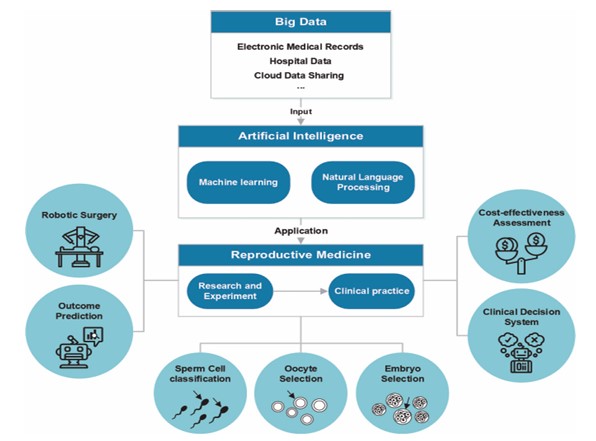
Large data sets and clever algorithms are the strengths of artificial intelligence (AI) and machine learning, the fields most frequently employed in medicine. These systems have the potential to transform treatment delivery, access to healthcare, and outcome improvement, especially in the field of reproductive medicine. More accurate follicular measurement or more reliable oocyte and embryo grading are just two examples of how AI can help doctors and most importantly, patients provide the best, most customised care possible. All of AI’s potential benefits not with standing, algorithms are not impervious to prejudice and are susceptible to the numerous socio-economic and demographic prejudices that plague the healthcare systems of today. Inaccurate diagnoses and the continuation of healthcare discrimination are real potential outcomes if our understanding of AI’s potential and constraints is lacking. Clinicians will be able to develop and apply machine learning-based innovations for the advancement of reproductive medicine and ultimately the creation of healthy families if they are equipped with the necessary knowledge about how AI can function most effectively in the field of medicine, particularly reproductive medicine.
References
- 1. Abdel-Hamid O, Mohamed A-r, Jiang H, Deng L, Penn G, Yu D. 2014. Convolutional neural networks for speech recognition. IEEE/ACM Transactions on Audio, Speech, and Language Processing 1533–1545.
- 2. Advincula AP, Xu X, Goudeau St, Ransom SB. 2007. Robot-assisted laparoscopic myomectomy versus abdominal myomectomy: a comparison of short-term surgical outcomes and immediate costs. Journal of Minimally Invasive Gynecology 698–705.
- 3. Akinsal EC, Haznedar B, Baydilli N, Kalinli A, Ozturk A, Ekmekcioglu O. 2018. Artificial Neural Network for the Prediction of Chromosomal Abnormalities in Azoospermic Males. Urology Journal 122–125. (10.22037/uj.v0i0.4029).
- 4. Andreu-Perez J, Poon CC, Merrifield RD, Wong ST, Yang GZ. 2015. Big data for health. IEEE Journal of Biomedical and Health Informatics 1193–1208.
- 5. Armstrong S, Bhide P, Jordan V, Pacey A, Farquhar C. 2018. Time-lapse systems for embryo incubation and assessment in assisted reproduction. Cochrane Database of Systematic Reviews CD011320 (10.1002/14651858. CD011320.pub3).
- 6. Akinsal EC, Haznedar B, Baydilli N, Kalinli A, Ozturk A, Ekmekcioglu O. 2018. Artificial Neural Network for the Prediction of Chromosomal Abnormalities in Azoospermic
- 7. Andreu-Perez J, Poon CC, Merrifield RD, Wong ST, Yang GZ. 2015. Big data for health. IEEE Journal of Biomedical and Health Informatics 1193–1208.
- 8. Armstrong S, Bhide P, Jordan V, Pacey A, Farquhar C. 2018. Time-lapse systems for embryo incubation and assessment in assisted reproduction. Cochrane Database of Systematic Reviews CD011320. (10.1002/14651858. CD011320.pub3)
Data Sharing Statement
There are no additional data available. All raw data and code are available upon request.
Funding
This research received no funding.
Author Contributions
All authors contributed significantly to the work and approve its publication.
Ethics Declaration
This article does not involve any human or animal subjects, and therefore does not require ethics approval.
Acknowledgements
We would like to express our gratitude to the patients, their families, and all those who have contributed to this study.
Conflicts of Interest
No conflicts of interest in this work.
About this article

Cite this article
Swati Jaiswal. The Role of Artificial Intellect and Machine Learning in Techniques for Assisted Fertility. Indian Journal of Maternal-Fetal & Neonatal Medicine. 2025; 12(2): 45-50.
Licence:
Attribution-Non-commercial 4.0 International (CC BY-NC 4.0)This license enables reusers to distribute, remix, adapt, and build upon the material in any medium or format for noncommercial purposes only, and only so long as attribution is given to the creator.
| Received | Accepted | Published |
|---|---|---|
| June 02, 2025 | July 21, 2025 | December 30, 2025 |
DOI: https://doi.org/10.21088/ijmfnm.2455.8621.12225.2
Keywords
Convolutional neural networks• Artificial intelligenceEthicsIVFMachine learningSupport vector machinesSearch for Similar Articles
Similar Articles
- Maternal Mental-Health During Pregnancy and Postpartum Period: A Review of Recen...
- Prenatal Diagnosis of Costello Syndrome: A Case Report
- Innovations in Obstetric Hemorrhage Management: The Evolution of Transvaginal Ba...
- Maternal Plasma Cytokines and the Subsequent Risk of Uterine Atony and Postpartu...
- Amniotic Band Syndrome
Article Level Metrics
Last UpdatedSaturday 17 October 2026, 14:06:20 (IST)
1730
Accesses
40
189
00
Citations
NA
NA
NA
Download citation
Article Keywords
Keyword Highlighting
Highlight selected keywords in the article text.
Timeline
| Received | June 02, 2025 |
| Accepted | July 21, 2025 |
| Published | December 30, 2025 |
licence
Attribution-Non-commercial 4.0 International (CC BY-NC 4.0)
This license enables reusers to distribute, remix, adapt, and build upon the material in any medium or format for noncommercial purposes only, and only so long as attribution is given to the creator.