Full Text (PDF)
Physiotherapy and Occupational Therapy Journal 15(1):p 17-22, January-March 2022. | DOI: https://doi.org/10.21088/potj.0974.5777.15122.2
Original Article
The Reliability and Validity of Shoulder Strength Measurements Using a Force Gauge and Strain Gauge in Diabetic Frozen Shoulder Patients
Siddhartha Sen, Niraj Kumar, Navneet Badoni, Anirban Patra
Author Information
Licence:
Attribution-Non-commercial 4.0 International (CC BY-NC 4.0)This license enables reusers to distribute, remix, adapt, and build upon the material in any medium or format for noncommercial purposes only, and only so long as attribution is given to the creator.
Physiotherapy and Occupational Therapy Journal 15(1):p 17-22, January-March 2022. | DOI: https://doi.org/10.21088/potj.0974.5777.15122.2
How Cite This Article:
Niraj Kumar, Siddhartha Sen, Navneet Badoni, et. al, The Reliability and Validity of Shoulder Strength Measurements Using a Force Gauge and Strain Gauge in Diabetic Frozen Shoulder Patients, Physiotherapy and Occupational Therapy Journal. 2022;15(1):17-22.Timeline
Received : January 04, 2022
Accepted : February 15, 2022
Published : March 30, 2022
Abstract
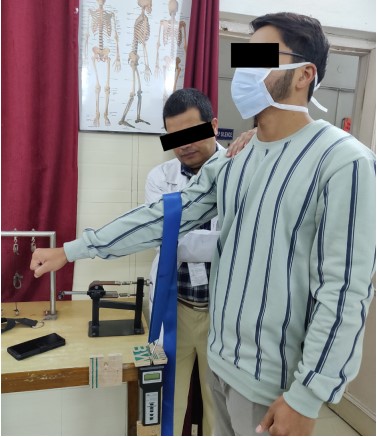
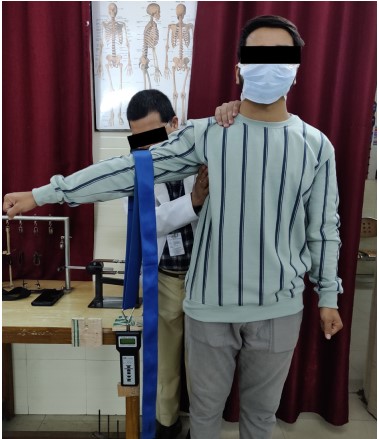
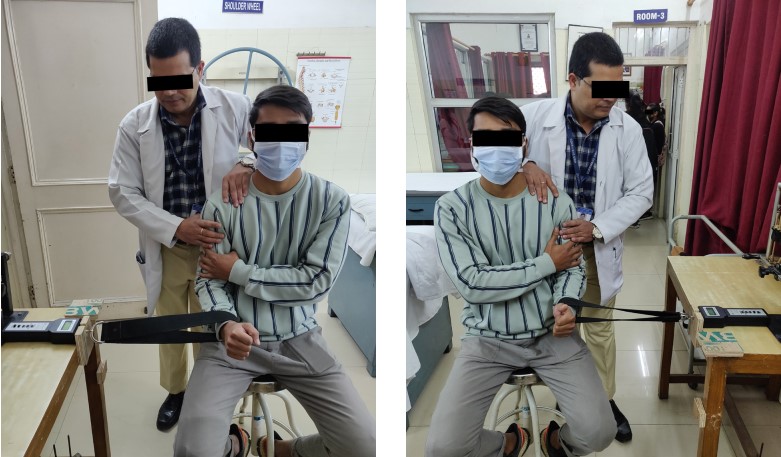
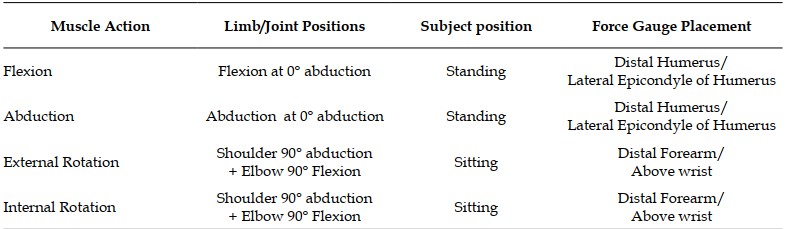
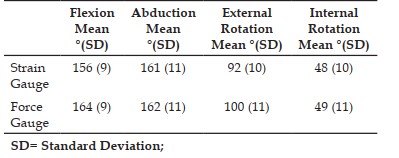
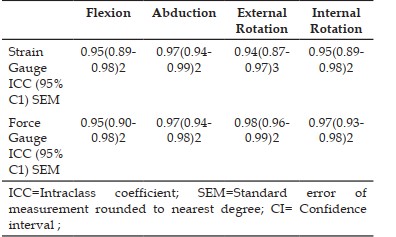
Purpose/Aim: This study investigated the reliability and validity of shoulder strength measurements using a digital force gauge and strain gauge in diabetic frozen shoulder patients. Materials/Methods: Digital force gauge and strain gauge to measure shoulder flexion, abduction, internal and external rotation in diabetic frozen shoulder patients. Results: Excellent intrarater reliability was present with Intraclass Correlation Coefficients (ICC- 3,k) for Force Gauge ≥ 0.95. The concurrent validity Force Gauge was good with ICC (3,k) values of ≥ 0.85. The 95% limits of agreement suggest that the Force Gauge measurement instruments can be expected to strength from 2° to 20°. Digital force gauge flexion, abduction, external rotation and internal rotation measurements had a greater mean and standard deviation than strain gauge flexion, abduction, external rotation and internal rotation measurements. Conclusions: This investigation is the first of its kind to evaluate the reliability and concurrent validity of strain gauge and force gauge measurements of muscles strength of shoulder flexion, abduction, external and internal rotation. When used with the measurement procedures outlined in this investigation, both techniques are reliable, as evidenced by reliability coefficients that exceed 0.90 (the threshold recommended for making clinical decisions). Good concurrent validity statistics were produced; however, one should recognize the potential ranges of disagreement between the two measurement instruments used in this study. When monitoring or comparing static shoulder strength measurements both researchers and clinicians should consider using similar instruments.
References
- 1. Richard Dias, Steven Cutts and Samir Massoud (2005). Frozen shoulder Richard. BMJ Volume- 331 17 bmj.com.PP-1453-1456.
- 2. Emily F. Jenkins, William J.C. Thomas, John P. Corcoran, Ravisankar Kirubanandan Celia R. Beynon, Adrian E. Sayers, David A. Woods, (2012) The outcome of manipulation under general anesthesia for the management of frozen shoulder in patients with diabetes mellitus21, PP1492-1498. Journal of Shoulder and Elbow Surgery Board of Trustees. doi:10.1016/j.jse.2011.11.006.
- 3. Cintia Garcilazo, Javier A. Cavallasca and Jorge L. Musuruana, Shoulder Manifestations of Diabetes Mellitus, Volume 6 , Issue 5 , 2010 Page:- 334 - 340 DOI:10.2174/157339910793360824
- 4. C. Whelton1 C. A. Peac (2017) Review of diabetic frozen shoulder, Eur J OrthopSurgTraumatol DOI 10.1007/s00590-017-2068-8.
- 5. Cedric X. Bryant. A Commonsense Approach to Addressing Shoulder Instability.
- 6. PoojaChughAnand, GulshanLal Khanna, VarshaChorsiya and AnkitRana (2017) Relationship between Shoulder Strength and Bowling Speed in Cricket Bowlers, Journal of Exercise Science & Physiotherapy, Vol. 13, No. 1, PP-81-86.
- 7. P Click Fenter, J W Bellew, T A Pitts, R E Kay (2003) Reliability of stabilised commercial dynamometers for measuring hip abduction strength: a pilot study, Br J Sports Med., Volume-37, PP-331–334.
Data Sharing Statement
There are no additional data available. All raw data and code are available upon request.
Funding
This research received no funding.
Author Contributions
All authors contributed significantly to the work and approve its publication.
Ethics Declaration
This article does not involve any human or animal subjects, and therefore does not require ethics approval.
Acknowledgements
We would like to express our gratitude to the patients, their families, and all those who have contributed to this study.
Conflicts of Interest
No conflicts of interest in this work.
About this article

Cite this article
Niraj Kumar, Siddhartha Sen, Navneet Badoni, et. al, The Reliability and Validity of Shoulder Strength Measurements Using a Force Gauge and Strain Gauge in Diabetic Frozen Shoulder Patients, Physiotherapy and Occupational Therapy Journal. 2022;15(1):17-22.
Licence:
Attribution-Non-commercial 4.0 International (CC BY-NC 4.0)This license enables reusers to distribute, remix, adapt, and build upon the material in any medium or format for noncommercial purposes only, and only so long as attribution is given to the creator.
| Received | Accepted | Published |
|---|---|---|
| January 04, 2022 | February 15, 2022 | March 30, 2022 |
DOI: https://doi.org/10.21088/potj.0974.5777.15122.2
Keywords
Diabetic Frozen Shoulder PatientsLutron Force GaugeReliabilityShoulder ValiditySearch for Similar Articles
Similar Articles
- Leadership in Physiotherapy: A Narrative Review
- Effectiveness of Low Level Laser Theapy in the Management of Temporomandibular J...
- The Impact of Air Pollution on Cardiopulmonary Health: Molecular Mechanisms, Pre...
- Efectiveness of Physiotherapy in Postpartum Women with Diastasis Recti: A Review
- Pain Neuroscience Education: Transforming Physiotherapy Practice
Article Level Metrics
Last UpdatedSaturday 24 October 2026, 19:02:59 (IST)
4392
Accesses
13
739
00
Citations
NA
NA
NA
Download citation
Article Keywords
Keyword Highlighting
Highlight selected keywords in the article text.
Timeline
| Received | January 04, 2022 |
| Accepted | February 15, 2022 |
| Published | March 30, 2022 |
licence
Attribution-Non-commercial 4.0 International (CC BY-NC 4.0)
This license enables reusers to distribute, remix, adapt, and build upon the material in any medium or format for noncommercial purposes only, and only so long as attribution is given to the creator.