Full Text (PDF)
Indian Journal of Genetics and Molecular Research 13(1):p 7-13, January – June 2024. | DOI: https://doi.org/10.21088/ijgmr.2319.4782.13124.1
Review Article
Telomeres and their Clinical Implications in Health and Disease: An Overview
Babu Rao Vundinti, Anjali C Shah C Shah
Author Information
Licence:
Attribution-Non-commercial 4.0 International (CC BY-NC 4.0)This license enables reusers to distribute, remix, adapt, and build upon the material in any medium or format for noncommercial purposes only, and only so long as attribution is given to the creator.
Indian Journal of Genetics and Molecular Research 13(1):p 7-13, January – June 2024. | DOI: https://doi.org/10.21088/ijgmr.2319.4782.13124.1
How Cite This Article:
Shah AC, Vundinti BR. Telomeres and their clinical implications in health and disease: an overview. Ind J Genet Mol Res. 2024;13(1):7-13.Timeline
Received : May 14, 2024
Accepted : June 17, 2024
Published : June 27, 2024
Abstract
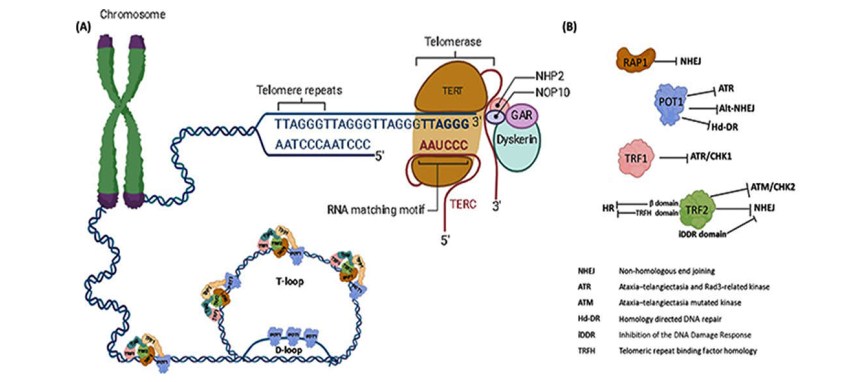
Telomere are the long repetitive stretch of non-coding, G rich DNA sequences, located at the distal end of linear chromosomes. These sequence are non-coding, but functional and also important regulator of the genome, as it is essential for maintenance of genomic integrity, by protecting coding genetic material from the fusion with neighbouring chromosomes. A sheltrin protein complex composed of six subunits and a telomerase enzyme, a ribonucleoprotein complex are important regulator of telomere, which protects the telomere sequences from the DNA damage response machineries and maintains the length of telomere by extension of 3’ G-overhang respectively. Telomerase activity is high in germline and stem cells, which contributes to genome stabilisation, and suppressed in somatic cells; hence with each cell division, telomere undergo age dependent incremental attrition of telomere length. Several factors are reported, which affects telomere length and telomerase activity in healthy individual as well as disease condition. A limited studies from the India have been reported on telomere length attrition and telomere gene mutations in isolated disease conditions. The present review primarily focusing on the telomeres in genetic disease and the cancers, suggesting a need of triad of telomere study including telomere length analysis, telomerase activity along with the genetic mutations using multiple approaches to enhance the clinical implication of telomeres in various diseases.
References
- 1. Shay JW. Telomeres and aging. Current Opinion in Cell Biology. 2018 Jun 1;52:1-7.
- 2. Zvereva MI, Shcherbakova DM, Dontsova OA. Telomerase: structure, functions, and activity regulation. Biochemistry (Moscow). 2010 Dec;75:1563-83.
- 3. Shay JW, Wright WE. Telomeres and telomerase: three decades of progress. Nature Reviews Genetics. 2019 May;20(5):299-309.
- 4. Alter BP, Giri N, Savage SA, Rosenberg PS. Telomere length in inherited bone marrow failure syndromes. Blood. 2014 Dec 6;124(21):1609.
- 5. Adelfalk C, Lorenz M, Serra V, von Zglinicki T, Hirsch-Kauffmann M, Schweiger M. Accelerated telomere shortening in Fanconi anemia fibroblasts–a longitudinal study. FEBS letters. 2001 Sep 28;506(1):22-6.
- 6. Nelson ND, Bertuch AA. Dyskeratosis congenita as a disorder of telomere maintenance. Mutation Research/Fundamental and Molecular Mechanisms of Mutagenesis. 2012 Feb 1;730(1-2):43-51.
- 7. Okuda K, Bardeguez A, Gardner JP, Rodriguez P, Ganesh V, Kimura M, Skurnick J, Awad G, Aviv A. Telomere length in the newborn. Pediatric research. 2002 Sep;52(3):377-81.
- 8. Wysoczanska B, Dratwa M, Gebura K, Mizgala J, Mazur G, Wrobel T, Bogunia-Kubik K. Variability within the human TERT gene, telomere length and predisposition to chronic lymphocytic leukemia. OncoTargets and therapy. 2019 May 31:4309-20.
- 9. Kong CM, Lee XW, Wang X. Telomere shortening in human diseases. The FEBS journal. 2013 Jul;280(14):3180-93.
- 10. Shah A, George M, Dhangar S, Rajendran A, Mohan S, Vundinti BR. Severe telomere shortening in Fanconi anemia complementation group L. Molecular Biology Reports. 2021 Jan;48(1):585-93.
- 11. Yamaguchi H, Baerlocher GM, Lansdorp PM, Chanock SJ, Nunez O, Sloand E, Young NS. Mutations of the human telomerase RNA gene (TERC) in aplastic anemia and myelodysplastic syndrome. Blood. 2003 Aug 1;102(3):916-8.
- 12. De Lange T. Shelterin-Mediated Telomere Protection. Annu Rev Genet. 2018;52:223-247. doi:10.1146/Annurev-Genet-032918-021921
- 13. Jose SS, Tidu F, Burilova P, Kepak T, Bendickova K, Fric J. The telomerase complex directly controls hematopoietic stem cell differentiation and senescence in an induced pluripotent stem cell model of telomeropathy. Frontiers in Genetics. 2018 Aug 29;9:388537.
- 14. Thongon N, Ma F, Santoni A, et al. Hematopoiesis under telomere attrition at the single-cell resolution. Nat Commun. 2021;12(1). doi:10.1038/S41467-021- 27206-7.
- 15. Colla S, Ong DS, Ogoti Y, Marchesini M, Mistry NA, Clise-Dwyer K, Ang SA, Storti P, Viale A, Giuliani N, Ruisaard K. Telomere dysfunction drives aberrant hematopoietic differentiation and myelodysplastic syndrome. Cancer cell. 2015 May 11;27(5):644-57.
- 16. Baird DM. Telomeres and genomic evolution. Philosophical Transactions of the Royal Society B: Biological Sciences. 2018 Mar 5;373(1741):20160437.
- 17. Srinivas N, Rachakonda S, Kumar R. Telomeres and telomere length: a general overview. Cancers. 2020 Feb 28;12(3):558.
- 18. Valdes AM, Andrew T, Gardner JP, Kimura M, Oelsner E, Cherkas LF, Aviv A, Spector TD. Obesity, cigarette smoking, and telomere length in women. The lancet. 2005 Aug 20;366(9486):662-4.
- 19. Ball SE, Gibson FM, Rizzo S, Tooze JA, Marsh JC, Gordon-Smith EC. Progressive telomere shortening in aplastic anemia. Blood, The Journal of the American Society of Hematology. 1998 May 15;91(10):3582-92.
- 20. Martínez P, Blasco MA. Telomere-driven diseases and telomere-targeting therapies. Journal of Cell Biology. 2017 Apr 3;216(4):875-87.
- 21. Fitzpatrick AL, Kronmal RA, Kimura M, Gardner JP, Psaty BM, Jenny NS, Tracy RP, Hardikar S, Aviv A. Leukocyte telomere length and mortality in the Cardiovascular Health Study. Journals of Gerontology Series A: Biomedical Sciences and Medical Sciences. 2011 Apr 1;66(4):421-9.
- 22. Fitzpatrick AL, Kronmal RA, Gardner JP, Psaty BM, Jenny NS, Tracy RP, Walston J, Kimura M, Aviv A. Leukocyte telomere length and cardiovascular disease in the cardiovascular health study. American journal of epidemiology. 2007 Jan 1;165(1):14-21.
- 23. Brouilette SW, Moore JS, McMahon AD, Thompson JR, Ford I, Shepherd J, Packard CJ, Samani NJ. Telomere length, risk of coronary heart disease, and statin treatment in the West of Scotland Primary Prevention Study: a nested case-control study. The Lancet. 2007 Jan 13;369(9556):107-14.
- 24. Zee RY, Michaud SE, Germer S, Ridker PM. Association of shorter mean telomere length with risk of incident myocardial infarction: a prospective, nested case–control approach. Clinica chimica acta. 2009 May 1;403(1-2):139-41.
- 25. Van Der Harst P, van der Steege G, de Boer RA, Voors AA, Hall AS, Mulder MJ, van Gilst WH, van Veldhuisen DJ, Merit-Hf Study Group. Telomere length of circulating leukocytes is decreased in patients with chronic heart failure. Journal of the American College of Cardiology. 2007 Apr 3;49(13):1459-64.
- 26. Sampson MJ, Winterbone MS, Hughes JC, Dozio N, Hughes DA. Monocyte telomere shortening and oxidative DNA damage in type 2 diabetes. Diabetes care. 2006 Feb 1;29(2):283-9.
- 27. Wu X, Amos CI, Zhu Y, Zhao H, Grossman BH, Shay JW, Luo S, Hong WK, Spitz MR. Telomere dysfunction: a potential cancer predisposition factor. Journal of the national cancer institute. 2003 Aug 20;95(16):1211-8.
- 28. McGrath M, Wong JY, Michaud D, Hunter DJ, De Vivo I. Telomere length, cigarette smoking, and bladder cancer risk in men and women. Cancer Epidemiology Biomarkers & Prevention. 2007 Apr 1;16(4):815-9.
- 29. Fernandes SG, Dsouza R, Khattar E. External environmental agents influence telomere length and telomerase activity by modulating internal cellular processes: Implications in human aging. Environmental Toxicology and Pharmacology. 2021 Jul 1;85:103633.
- 30. Arsenis NC, You T, Ogawa EF, Tinsley GM, Zuo L. Physical activity and telomere length: Impact of aging and potential mechanisms of action. Oncotarget. 2017 Jul 7;8(27):45008.
- 31. Young NS. Telomere biology and telomere diseases: implications for practice and research. Hematology 2010, the American Society of Hematology Education Program Book. 2010 Dec 4;2010(1):30-5.
- 32. Mitchell JR, Wood E, Collins K. A telomerase component is defective in the human disease dyskeratosis congenita. 1999;3:551-555.
- 33. Martinez Rodriguez P, Blasco MA. Telomere-driven diseases and telomere-targeting therapies.
- 34. Calado RT, Cooper JN, Padilla-Nash HM, Sloand EM, Wu CO, Scheinberg P, Ried T, Young NS. Short telomeres result in chromosomal instability in hematopoietic cells and precede malignant evolution in human aplastic anemia. Leukemia. 2012 Apr;26(4):700-7.
- 35. Xu L, Li S, Stohr BA. The role of telomere biology in cancer. Annual Review of Pathology: Mechanisms of Disease. 2013 Jan 24;8:49-78.
- 36. Bryan TM, Englezou A, Gupta J, Bacchetti S, Reddel RR. Telomere elongation in immortal human cells without detectable telomerase activity. The EMBO journal. 1995 Sep 1;14(17):4240-8.
- 37. Shammas MA. Telomeres, lifestyle, cancer, and aging. Current Opinion in Clinical Nutrition & Metabolic Care. 2011 Jan 1;14(1):28-34.
- 38. Shammas MA, Reis RJ, Li C, Koley H, Hurley LH, Anderson KC, Munshi NC. Telomerase inhibition and cell growth arrest after telomestatin treatment in multiple myeloma. Clinical Cancer Research. 2004 Jan 15;10(2):770-6.
- 39. Shammas MA, Shmookler RJ, Akiyama M, Koley H, Chauhan D, Hideshima T, Goyal RK, Hurley LH, Anderson KC, Munshi NC. Telomerase inhibition and cell growth arrest following porphyrin treatment of multiple myeloma cells. Mol Cancer Therapeutics. 2003;2:825-33.
- 40. Vulliamy TJ, Dokal I. Dyskeratosis congenita: the diverse clinical presentation of mutations in the telomerase complex. Biochimie. 2008 Jan 1;90(1):122- 30.
- 41. Vulliamy T, Marrone A, Goldman F, Dearlove A, Bessler M, Mason PJ, Dokal I. The RNA component of telomerase is mutated in autosomal dominant dyskeratosis congenita. Nature. 2001 Sep 27;413(6854):432-5.
Data Sharing Statement
There are no additional data available.
Funding
This research received no funding.
Author Contributions
All authors contributed significantly to the work and approve its publication.
Acknowledgements
Information not provided.
Conflicts of Interest
No conflicts of interest in this work.
About this article

Cite this article
Shah AC, Vundinti BR. Telomeres and their clinical implications in health and disease: an overview. Ind J Genet Mol Res. 2024;13(1):7-13.
Licence:
Attribution-Non-commercial 4.0 International (CC BY-NC 4.0)This license enables reusers to distribute, remix, adapt, and build upon the material in any medium or format for noncommercial purposes only, and only so long as attribution is given to the creator.
| Received | Accepted | Published |
|---|---|---|
| May 14, 2024 | June 17, 2024 | June 27, 2024 |
DOI: https://doi.org/10.21088/ijgmr.2319.4782.13124.1
Keywords
TelomereTelomeraseBone marrow failureCancersClinical implicationsSearch for Similar Articles
Similar Articles
- Success After Unexplained Multiple Miscarriages using PGT-A and PGT-M for RELN G...
- A Translational Strategy to Overcome Platinum Resistance in Ovarian Cancer via...
- Bridging Classic Cytogenetics with Modern Chromosomics: A Historical and Scienti...
- Mitochondrial D-Loop and HBB Gene Profiling in Antenatal Hemoglobinopathy Carrie...
- Histopathologic Features of High Grade Serous Ovarian Carcinomas Associated with...
Article Level Metrics
Last UpdatedWednesday 26 August 2026, 08:06:04 (IST)
1461
Accesses
22
316
00
Citations
NA
NA
NA
Download citation
Article Keywords
Keyword Highlighting
Highlight selected keywords in the article text.
Timeline
| Received | May 14, 2024 |
| Accepted | June 17, 2024 |
| Published | June 27, 2024 |
licence
Attribution-Non-commercial 4.0 International (CC BY-NC 4.0)
This license enables reusers to distribute, remix, adapt, and build upon the material in any medium or format for noncommercial purposes only, and only so long as attribution is given to the creator.