Full Text (PDF)
Journal of ENT and Allied Sciences 8(2):p 47-50, July - December 2023. | DOI: n.a
Case Report
Submucosal Globular Tongue Swelling: A Rare Presentation of Adenoid Cystic Carcinoma
Mehneet Sawhney, Prince Handa, Anmol Rattan Kath, Nishtha Batra
Author Information
Licence:
Attribution-Non-commercial 4.0 International (CC BY-NC 4.0)This license enables reusers to distribute, remix, adapt, and build upon the material in any medium or format for noncommercial purposes only, and only so long as attribution is given to the creator
Journal of ENT and Allied Sciences 8(2):p 47-50, July - December 2023. | DOI: n.a
How Cite This Article:
Handa P, Sawhney M, Kath AR, et al. Submucosal globular tongue swelling: a rare presentation of adenoid cystic carcinoma. RFP J ENT Allied Sci. 2023;8(2):47–50.Timeline
Received : August 12, 2023
Accepted : September 11, 2023
Published : December 12, 2023
Abstract
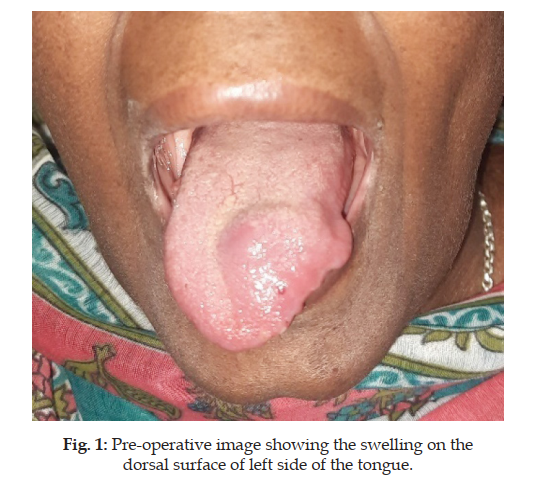
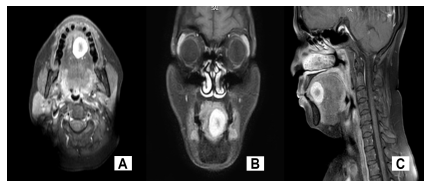
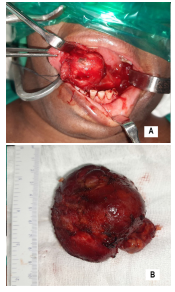
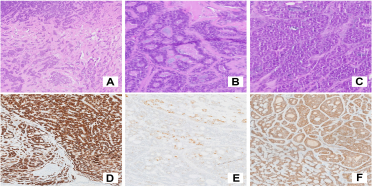
Introduction: Adenoid cystic is an infrequent malignancy of the salivary glands. Some of its unique features include slow growth, the tendency for perineural invasion, local recurrence, and the ability to metastasize. The mobile tongue's adenoid cystic carcinoma (ACC) is a rare reported case in the literature. Report: We report a rare case of adenoid cystic carcinoma, in a 55-year-old female arising in the dorsal and lateral aspect of tongue. Histopathology after complete excision of the mass confirmed the diagnosis of adenoid cystic carcinoma. There has been no evidence of disease following excision with tumour-free margins. Discussion: The pathophysiology of ACC is an understudied area due to the condition's rarity. Chromosomal abnormality and dysregulated MYB oncoprotein have to be thought to play a key role in the pathophysiology and proliferation of ACC. Conclusions: Adenoid cystic carcinoma of the tongueis exceedingly rare but should be considered in the differential diagnosis in patients with tongue swelling. These tumours are malignant and treatment requires surgical excision and neck dissectionfollowed by adjuvant radiotherapy.
References
- 1. Spiro RH, Huvos AG, Strong EW. Adenoid cystic carcinoma of salivary origin. A clinicopathologic study of 242 cases. Am J Surg 1974;128: 512–20.
- 2. Tang X, Zhang C, Chen R, Zhou X, Zhang Y. Treatment of adenoid cystic carcinoma of the mobile tongue with anterolateral thigh flap reconstruction. Medicine 2019;98:e15250. https://doi.org/10.1097/ md.0000000000015250.
- 3. Dillon PM, Chakraborty S, Moskaluk CA, Joshi PJ, Thomas CY. Adenoid cystic carcinoma: A review of recent advances, molecular targets, and clinical trials. Head Neck. 2016 Apr;38(4):620-7.
- 4. Luna-Ortiz K, Carmona-Luna T, Cano-Valdez AM, et al. Adenoid cystic carcinoma of the tongue–clinicopathological study and survival analysis. Head Neck Oncol 2009;1:15.
- 5. Azumi N, Battifora H. The cellular composition of adenoid cystic carcinoma. An immunohistochemical study. Cancer. 1987 Oct 01;60(7):1589-98.
- 6. Carrasco Ortiz D, Aldape Barrios B. Adenoid cystic carcinoma of the dorsum of the tongue: presentation of a case. Med Oral Patol Oral Cir Bucal 2006;11:E417–20.
- 7. Luna-Ortiz, K., Carmona-Luna, T., Cano-Valdez, A.M. et al. Adenoid cystic carcinoma of the tongue – clinicopathological study and survival analysis. Head Neck Oncol 1, 15 (2009). https://doi. org/10.1186/1758-3284-1-15.
- 8. Goldblat LI, Ellis GL: Salivary Gland Tumors of theTongue. Analysis of 55 new cases and review of literature. Cancer. 1987, 60: 74-81. 10.1002/1097-0142(19870701)60:1<74::AID-CNCR28 20600113>3.0.CO;2-B.
- 9. Tang X, Zhang C, Chen R, Zhou X, Zhang Y. Treatment of adenoid cystic carcinoma of the mobile tongue with anterolateral thigh flap reconstruction. Medicine 2019b;98:e15250. https://doi.org/10.1097/ md.0000000000015250.
- 10. Kumar, S., Agarwal, P., & Nimmi, V. (2016). Adenoid cystic carcinoma: A rare late presentation of the mobile tongue. Journal of Oral Biology and Craniofacial Research, 6(2), 164–167. doi:10.1016/j. jobcr.2016.02.001.
Data Sharing Statement
There are no additional data available
Funding
This research received no funding
Author Contributions
All authors contributed significantly to the work and approve its publication
Ethics Declaration
This article does not involve any human or animal subjects, and therefore does not require ethics approval
Acknowledgements
Information Not Provided
Conflicts of Interest
No conflicts of interest in this work.
About this article

Cite this article
Handa P, Sawhney M, Kath AR, et al. Submucosal globular tongue swelling: a rare presentation of adenoid cystic carcinoma. RFP J ENT Allied Sci. 2023;8(2):47–50.
Licence:
Attribution-Non-commercial 4.0 International (CC BY-NC 4.0)This license enables reusers to distribute, remix, adapt, and build upon the material in any medium or format for noncommercial purposes only, and only so long as attribution is given to the creator
| Received | Accepted | Published |
|---|---|---|
| August 12, 2023 | September 11, 2023 | December 12, 2023 |
DOI: n.a
Keywords
Adenoid cystic carcinoma; Carcinoma tongue; Oral cavity; Perineural invasion; Lingual tumours.Search for Similar Articles
Similar Articles
- Concurrent Epidermal Inclusion Cyst and Lipoma of the Cervical Region: A Rare Co...
- Beyond the Lower Lip: Blandin–Nuhn Cyst—Clinicopathological Insights into a Rare...
- Histopathology in Disease Diagnosis: Interpreting Cellular Patterns
- Artificial Intelligence: An Aid in Diagnosis by Otoscopy
- Pseudomonas Aeruginosa in an Immunocompetent Individual with Acute Tonsillitis;...
Article Level Metrics
Last UpdatedSunday 06 September 2026, 20:39:53 (IST)
833
Accesses
3
117
00
Citations
NA
NA
NA
Download citation
Article Keywords
Keyword Highlighting
Highlight selected keywords in the article text.
Timeline
| Received | August 12, 2023 |
| Accepted | September 11, 2023 |
| Published | December 12, 2023 |
licence
Attribution-Non-commercial 4.0 International (CC BY-NC 4.0)
This license enables reusers to distribute, remix, adapt, and build upon the material in any medium or format for noncommercial purposes only, and only so long as attribution is given to the creator