Full Text (PDF)
Indian Journal of Library and Information Sciences 17(1):p 49-61, January-April 2023. | DOI: https://doi.org/10.21088/ijlis.0973.9548.17123.6
Review Article
Study on Knowledge Sharing and Job Satisfaction: A Systematic Review R
Author Information
Licence:
Attribution-Non-commercial 4.0 International (CC BY-NC 4.0)This license enables reusers to distribute, remix, adapt, and build upon the material in any medium or format for noncommercial purposes only, and only so long as attribution is given to the creator.
Indian Journal of Library and Information Sciences 17(1):p 49-61, January-April 2023. | DOI: https://doi.org/10.21088/ijlis.0973.9548.17123.6
How Cite This Article:
Padmavathi, R., & Sethuraj, P. (2023). Study on knowledge sharing and job satisfaction: A systematic review. Indian Journal of Library and Information Science, 17(1), 49–61.Timeline
Received : December 10, 2022
Accepted : December 26, 2022
Published : April 21, 2023
Abstract
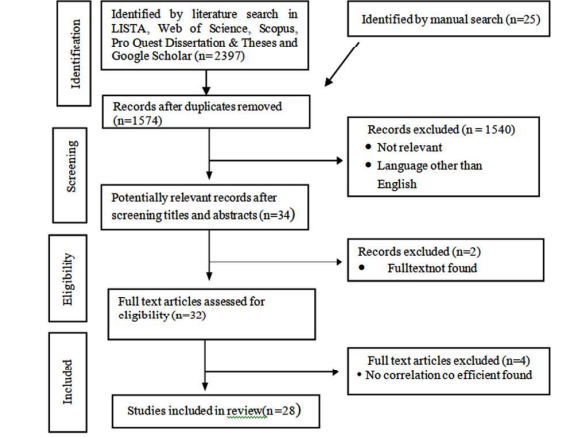
The purpose of this study was to systematically collect and review the english language studies that provided empirical evidence for the existence of relationship between knowledge sharing (KS) and job satisfaction (JS) and their impact on each other.
References
- 1. Al-Hosani, A. A. (2011). Job satisfaction and knowledge sharing in oil and gas industry: The case of ADNOC company, Abu Dhabi [Master’s dissertation, The British University in Dubai].
- 2. Almahamid, S., McAdams, A. C., & Kalaldeh, T. (2010). The relationship among organizational knowledge sharing practices, employees learning commitments, employees adaptability and employees job satisfaction: An empirical investigation of the listed manufacturing companies in Jordan. Interdisciplinary Journal of Information, Knowledge, and Management, 5, 327–355.
- 3. Bakan, I., Ersahan, B., & Buyukbese, T. (2011). A research model on the effects of job satisfaction, extrinsic motivation and knowledge sharing intention on knowledge sharing. China-USA Business Review, 10(10), 1047–1060.
- 4. Bartol, K. M., & Srivastava, A. (2002). Encouraging knowledge sharing: The role of organizational reward systems. Journal of Leadership & Organizational Studies, 9(1), 64–76.
- 5. Becerra-Fernandez, I., & Sabherwal, R. (2014). Knowledge management: Systems and processes. Routledge.
- 6. Bock, G. W., & Kim, Y.-G. (2002). Breaking the myths of rewards. Information Resources Management Journal, 15(2), 14–21.
- 7. Bontis, N., Richards, D., & Serenko, A. (2011). Improving service delivery: Investigating the role of information sharing, job characteristics, and employee satisfaction. The Learning Organization, 18(3), 239–250.
- 8. Boynton, P. M., & Greenhalgh, T. (2004). Selecting, designing, and developing your questionnaire. British Medical Journal, 328(7451), 1312–1315.
- 9. Braun, F., & Avital, M. (2007). Good project management practices drive more than project success: Learning, knowledge sharing and job satisfaction in IT project teams. Proceedings of the Americas Conference on Information Systems (AMCIS). http://aisel.aisnet.org/amcis2007/297/
- 10. Cabrera, A., Collins, W. C., & Salgado, J. F. (2006). Determinants of individual engagement in knowledge sharing. The International Journal of Human Resource Management, 17(2), 245–264.
- 11. Carpenter, S., & Rudge, S. (2003). A self-help approach to knowledge management benchmarking. Journal of Knowledge Management, 7(5), 82–95.
- 12. Cohen, J. (1988). Statistical power analysis for the behavioral sciences. Lawrence Erlbaum Associates.
- 13. Cranny, C. J., Smith, P. C., & Stone, E. F. (1992). Job satisfaction: Advances in research and application. Lexington Books.(Note: Corrected author name from
- 14. Dawley, D. D., & Munyon, T. P. (2012). Enhancing employee outcomes in crime labs: Test of a model. Forensic Science Policy & Management: An International Journal, 3(3), 105–112.
- 15. Dawson, R. (2000). Knowledge capabilities as the focus of organisational development and strategy. Journal of Knowledge Management, 4(4), 320–327.
- 16. de Vries, R. E., Hooff, B. V. D., & de Ridder, J. A. (2006). Explaining knowledge sharing: The role of team communication styles, job satisfaction, and performance beliefs. Communication Research, 33(2), 115–135.
- 17. Filius, R., De Jong, J. A., & Roelofs, E. C. (2000). Knowledge management in the HRD office: A comparison of three cases. Journal of Workplace Learning, 12(7), 286–295.
- 18. Hodson, R. (1991). Workplace behaviors. Work and Occupations, 18(3), 271–290.
- 19. Hoppock, R. (1935). Job satisfaction. Harper and Brothers.
- 20. Hsu, C.-L., & Lin, J. C.-C. (2008). Acceptance of blog usage: The roles of technology acceptance, social influence and knowledge sharing motivation. Information & Management, 45(1), 65–74.
- 21. Hu, B., & Zhao, Y. (2016). Creative self-efficacy mediates the relationship between knowledge sharing and employee innovation. Social Behavior and Personality: An International Journal, 44(5), 815–826.
- 22. Ipe, M. (2003). Knowledge sharing in organizations: A conceptual framework. Human Resource Development Review, 2(4), 337–359.
- 23. Jacobs, E., & Roodt, G. (2007). The development of a knowledge sharing construct to predict turnover intentions. Aslib Proceedings, 59(3), 229–248.
- 24. Jacobs, E., & Roodt, G. (2008). Organisational culture of hospitals to predict turnover intentions of professional nurses. Health SA Gesondheid, 13(1), 63–78.
- 25. Javadpour, A., & Samiei, S. (2017). Motivation and barriers to participation in virtual knowledge sharing communities of practice. Management Science Letters, 7(2), 81–86.
- 26. Jones, S. (2002). Employee rights, employee responsibilities and knowledge sharing in intelligent organization. Employee Responsibilities and Rights Journal, 14(2/3), 69–78.
- 27. Khan, K., Kunz, R., Kleijnen, J., & Antes, G. (2011). Systematic reviews to support evidence-based medicine (2nd ed.). Hodder Arnold.
- 28. Kianto, A., Vanhala, M., & Heilmann, P. (2016). The impact of knowledge management on job satisfaction. Journal of Knowledge Management, 20(4), 621–636.
- 29. Kim, S., & Lee, H. (2006). The impact of organizational context and information technology on employee knowledge–sharing capabilities. Public Administration Review, 66(3), 370–385.
- 30. King, W. R., & Marks, P. V. (2008). Motivating knowledge sharing through a knowledge management system. Omega, 36(1), 131–146.
- 31. Kondakci, Y., Beycioglu, K., Sincar, M., & Ugurlu, C. T. (2017). Readiness of teachers for change in schools. International Journal of Leadership in Education, 20(2), 176–197.
- 32. Kuo, Y.-K., Kuo, T.-H., & Ho, L.-A. (2014). Enabling innovative ability: Knowledge sharing as a mediator. Industrial Management & Data Systems, 114(5), 696–710.
- 33. Leung, K., Lin, X., & Lu, L. (2014). Compensation disparity between locals and expatriates in China: A multilevel analysis of the influence of norms. Management International Review, 54(1), 107–128.
- 34. Lichtenthaler, U., & Ernst, H. (2006). Attitudes to externally organising knowledge management tasks: A review, reconsideration and extension of the NIH syndrome. R & D Management, 36(4), 367–386.
- 35. Lin, H. F. (2007). Knowledge sharing and firm innovation capability: An empirical study. International Journal of Manpower, 28(3/4), 315–332.
- 36. Lin, X. (2015). How does procedural justice climate influence individual outcomes? An affective perspective. Asia Pacific Journal of Management, 32(3), 771–800.
- 37. Locke, E. A. (1976). The nature and causes of job satisfaction. In M. D. Dunnette (Ed.), Handbook of industrial and organizational psychology (pp. 1297–1349). Rand McNally.
- 38. Master, D. (2013). Knowledge sharing, job satisfaction, and self-efficacy among trainers from one California training and development organization: A case study [Doctoral dissertation, Capella University].
- 39. McKibbon, A. (2006). Systematic reviews and librarians. Library Trends, 55(1), 202–215.
- 40. Michailova, S., & Minbaeva, D. B. (2012). Organizational values and knowledge sharing in multinational corporations: The Danisco case. International Business Review, 21(1), 59–70.
- 41. Misuraca, P. M. (2013). An examination of the relationship between job satisfaction and tacit knowledge sharing among knowledge workers: A quantitative study [Doctoral dissertation, Capella University].
- 42. Mogotsi, I. C. (2009). An empirical investigation into the relationships among knowledge sharing behaviour, organizational citizenship behaviour, job satisfaction and organizational commitment [Doctoral dissertation, University of Pretoria].
- 43. Mogotsi, I. C., Boon, J., & Fletcher, L. (2011). Modelling the relationships between knowledge sharing, organisational citizenship, job satisfaction and organisational commitment among school teachers in Botswana. African Journal of Library, Archives and Information Science, 21(1), 41–58.
- 44. Moher, D., Liberati, A., Tetzlaff, J., Altman, D. G., & The PRISMA Group. (2009). Preferred reporting items for systematic reviews and meta-analyses: The PRISMA statement. PLoS Medicine, 6(7), 1–6.
- 45. Moher, D., Shamseer, L., Clarke, M., Ghersi, D., Liberati, A., Petticrew, M., Shekelle, P., & Stewart, L. A. (2015). Preferred reporting items for systematic review and meta-analysis protocols (PRISMA-P) 2015 statement. Systematic Reviews, 4(1), 1–6.
- 46. Mowday, R., Porter, L., & Steers, R. (1982). The commitment and job tenure of new employees: Some evidence of post-decisional justification. Administrative Science Quarterly, 26(4), 597–616.
- 48. Oldenkamp, J. H. (2001). Succesvol overdragen van kennis [Successful knowledge transfer]. Lemma BV.
- 49. Petticrew, M., & Roberts, H. (2008). Systematic reviews in the social sciences: A practical guide. John Wiley & Sons.
- 50. Rutherford, B., Boles, J., Hamwi, G. A., Madupalli, R., & Rutherford, L. (2009). The role of the seven dimensions of job satisfaction in salesperson’s attitudes and behaviors. Journal of Business Research, 62(11), 1146–1151.
- 51. Saeed, M. S. (2016). The impact of job satisfaction and knowledge sharing on employee performance. Journal of Resources Development and Management, 21, 16–23.
- 52. Sarker, S. J., Crossman, A., & Chinmeteepituck, P. (2003). The relationships of age and length of service with job satisfaction: An examination of hotel employees in Thailand. Journal of Managerial Psychology, 18(7), 745–758.
- 53. Schiuma, G., Andreeva, T., & Kianto, A. (2012). Does knowledge management really matter? Linking knowledge management practices, competitiveness and economic performance. Journal of Knowledge Management, 16(4), 617–636.
- 54. Spector, P. E. (1997). Job satisfaction: Application, assessment, causes, and consequences. Sage.
- 55. Ståhle, P., & Grönroos, M. (2000). Dynamic intellectual capital: Knowledge management in theory and practice. WSOY.
- 56. Suliman, A., & Al-Hosani, A. A. (2014). Job satisfaction and knowledge sharing: The case of the UAE. Business Management and Economics, 2(2), 24–33.
- 57. Sveiby, K.-E. (2001). A knowledge-based theory of the firm to guide in strategy formulation. Journal of Intellectual Capital, 2(4), 344–358.
- 58. Tarigh, M. P., & Nezhad, F. R. (2016). The impact of job satisfaction and work environment friendly on services innovation with mediator role of knowledge sharing in companies under supervision of Pars Tousheh in Gilan province. Bulletin de la Société Royale des Sciences de Liège, 85, 1017–1025.
- 59. Teh, P. L., & Sun, H. (2012). Knowledge sharing, job attitudes and organisational citizenship behaviour. Industrial Management & Data Systems, 112(1), 64–82.
- 60. Temitope, O. E. (2013). Work motivation, job satisfaction, knowledge sharing and team-oriented commitment of library personnel in some academic and research libraries in South West, Nigeria. Cochin Journal of Library and Information Science, 6(1/2), 135–148.(Note: Corrected journal name from
- 61. Thiptanamanee, P., & Ussahawanitchakit, P. (2016). Learning orientation, emotional intelligence and job success: An empirical research of automobile industry in Thailand. The Business & Management Review, 7(5), 212–219.
- 62. Trivellas, P., Akrivouli, Z., Tsifora, E., & Tsoutsa, P. (2015). The impact of knowledge sharing culture on job satisfaction in accounting firms: The mediating effect of general competencies. Procedia Economics and Finance, 19, 238–247.
- 63. Varshney, D., & Damanhouri, H. M. S. (2013). Does perception of knowledge sharing, transfer and recognition have an impact on job satisfaction? An empirical study in Saudi Arabia. International Journal of Advanced Research in Management and Social Sciences, 2(9), 64–81.
- 64. Walder, W. T. I. (2012). The impact of knowledge sharing on the relationship between organizational culture and job satisfaction: The perception of information communication and technology (ICT) practitioners in Hong Kong [Doctoral dissertation, The University of Newcastle].
- 65. Wang, S., & Noe, R. A. (2010). Knowledge sharing: A review and directions for future research. Human Resource Management Review, 20(2), 115–131.
- 66. Weggeman, M. (2000). Kennismanagement: de praktijk [Knowledge management: Practice]. Scriptum Management.
- 67. Wu, C.-C., Liu, Y.-C., Lin, Y.-T., & Chou, C.-H. (2013). The empirical study of job satisfaction and knowledge sharing-based on two-factor motivation theory. Business and Information, 368–382.
- 68. Yunus, N. A. M., Yunus, N. A. M., Rahman, R. A., Aziz, R. A., Noranee, S., & Razak, N. A. (2014, August 12–15). Knowledge sharing on job satisfaction and organizational commitment among customer service representatives [Paper presentation]. Knowledge Management International Conference (KMICe), Malaysia.
- 69. Zack, M., McKeen, J., & Singh, S. (2009). Knowledge management and organizational performance: An exploratory analysis. Journal of Knowledge Management, 13(6), 392–409.
- 70. Zhang, Z. X., Luk, W., Arthur, D., & Wong, T. (2001). Nursing competencies: Personal characteristics contributing to effective nursing performance. Journal of Advanced Nursing, 33(4), 467–474.
Data Sharing Statement
There are no additional data available. All raw data and code are available upon request.
Funding
This research received no funding.
Author Contributions
All authors contributed significantly to the work and approve its publication.
Ethics Declaration
This article does not involve any human or animal subjects, and therefore does not require ethics approval.
Acknowledgements
We would like to express our gratitude to the patients, their families, and all those who have contributed to this study.
Conflicts of Interest
No conflicts of interest in this work.
About this article

Cite this article
Padmavathi, R., & Sethuraj, P. (2023). Study on knowledge sharing and job satisfaction: A systematic review. Indian Journal of Library and Information Science, 17(1), 49–61.
Licence:
Attribution-Non-commercial 4.0 International (CC BY-NC 4.0)This license enables reusers to distribute, remix, adapt, and build upon the material in any medium or format for noncommercial purposes only, and only so long as attribution is given to the creator.
| Received | Accepted | Published |
|---|---|---|
| December 10, 2022 | December 26, 2022 | April 21, 2023 |
DOI: https://doi.org/10.21088/ijlis.0973.9548.17123.6
Keywords
RelationshipKnowledge SharingLiterature reviewJob SatisfactionSystematic reviewKnowledge transferSearch for Similar Articles
Similar Articles
- Scientometric Portrait of Dr. Anil Kumar Dhiman, an Information Scientist-Part I...
- A Study on Humanities Students’ Literacy Skills at Alagappa University in Using...
- Awareness and Utilization of Artificial Intelligence Tools (ChatGPT) among Stude...
- Global Trends on Artificial Intelligence in Science Research: A Scientometric Ob...
- Information Needs of Persons with Visual Impairments: A Socioeconomic Analysis
Article Level Metrics
Last UpdatedFriday 11 September 2026, 03:54:49 (IST)
3949
Accesses
19
741
00
Citations
NA
NA
NA
Download citation
Article Keywords
Keyword Highlighting
Highlight selected keywords in the article text.
Timeline
| Received | December 10, 2022 |
| Accepted | December 26, 2022 |
| Published | April 21, 2023 |
licence
Attribution-Non-commercial 4.0 International (CC BY-NC 4.0)
This license enables reusers to distribute, remix, adapt, and build upon the material in any medium or format for noncommercial purposes only, and only so long as attribution is given to the creator.