Full Text (PDF)
Indian Journal of Obstetrics and Gynecology 10(2):p 105-107, April – June 2022. | DOI: https://doi.org/10.21088/ijog.2321.1636.10222.12
Original Article
Study of Women Presenting with Leiomyoma in Terms of Symptoms, Age of Presentation and Location
Gitanjali Kumari, Rupali Bharambe, Aniket Kakade
Author Information
Licence:
Attribution-Non-commercial 4.0 International (CC BY-NC 4.0)This license
enables reusers to distribute, remix, adapt, and build upon the material in any
medium or format for noncommercial purposes only, and only so long as
attribution is given to the creator.
Indian Journal of Obstetrics and Gynecology 10(2):p 105-107, April – June 2022. | DOI: https://doi.org/10.21088/ijog.2321.1636.10222.12
How Cite This Article:
Rupali Bharambe, Gitanjali Kumari, Aniket Kakade/Study of Women Presenting with Leiomyoma in Terms of Symptoms, Age of Presentation and Location/Indian J Obstet Gynecol. 2022;10(2):105–107.Timeline
Received : December 04, 2022
Accepted : March 05, 2022
Published : June 30, 2022
Abstract
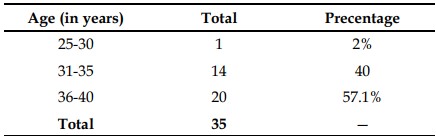
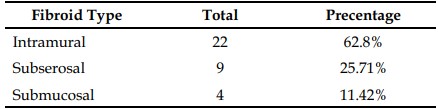
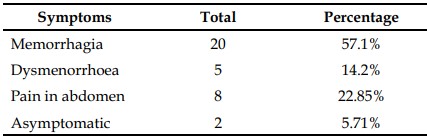
Aim and objective: To Categories women presenting with leiomyoma with respect to: • Age • Most common symptom • Location of leiomyoma. Settings and Design: This was an observational study carried out in a tertiary health center for a period of 1 year from September 2019 to September 2020. Materials and Methods: A retrospective observational study was conducted in 35 women having pain in abdomen, abnormal uterine bleeding, who were presented to the department of obstetric and gynecology, Bharati Vidyapeeth deemed university, Pune between sept 2019 and sept 2020. All the patient presented with above mentioned symptoms were studied after obtaining consent from participant. Ultrasound was done and location of leiomyoma was studied. Fibroid were studied in terms of its, location and most common presenting symptoms and age of occurrence of symptoms. Results: In our study, themost common age group of presentation was 36-40 years (reproductive age group.) Most common type of fibroid was intramural (62.8 %) Most common symptoms was menorrhagia (57.1%). Most commonly associated with nulligravida (49.5%).
References
- 1. Islam MS, Ciavattini A, Petraglia F, Castellucci M, Ciarmela P. Extracellular matrix in uterine leiomyoma pathogenesis: a potential target for future therapeutics. Human reproduction update. 2018 Jan 1;24(1):59-85.
- 2. Baird DD, Dunson DB, Hill MC, Cousins D, Schectman JM. High cumulative incidence of uterine leiomyoma in black and white women: ultrasound evidence. American journal of obstetrics and gynecology. 2003 Jan 1;188(1):100-7.
- 3. Wallach EE, Vlahos NF. Uterine myomas: an overview of development, clinical features, and management. Obstet Gynecol. 2004;104(2):393–406.
- 4. Bukulmez O, Doody KJ. Clinical features of myomas. ObstetGynecol Clin North Am. 2006;33(1):69–84.
- 5. Laughlin Tommaso SK, Hesley GK, Hopkins MR, Brandt KR, Zhu Y, Stewart EA. Clinical limitations of the International Federation of Gynecology and Obstetrics (FIGO) classification of uterine fibroids. International Journal of Gynecology& Obstetrics. 2017 Nov;139(2):143-8.
- 6. Pavone D, Clemenza S, Sorbi F, Fambrini M, Petraglia F. Epidemiology and risk factors of uterine fibroids. Best Practice & Research Clinical Obstetrics & Gynaecology. 2018 Jan 1;46:3-11.
- 7. Evans P, Brunsell S. Uterine fibroid tumors: diagnosis and treatment. American family physician. 2007 May 15;75(10):1503-8.
- 8. Vilos GA, Allaire C, Laberge PY, et al. The management of uterine leiomyomas. J ObstetGynaecol Can. 2015;37(2):157–181.
- 9. Carranza-Mamane B, Havelock J, Hemmings R, et al. The management of uterine fibroids in women with otherwise unexplained infertility. J ObstetGynaecol Can. 2015;37(3):277–288.
- 10. Aarts JW, Nieboer TE, Johnson N, et al. Surgical approach to hysterectomy for benign gynaecological disease. Cochrane Database Syst Rev. 2015;(8):CD003677.
Data Sharing Statement
There are no additional data available. All raw data and code are available upon request.
Funding
This research received no funding.
Author Contributions
All authors contributed significantly to the work and approve its publication.
Ethics Declaration
This article does not involve any human or animal subjects, and therefore does not require ethics approval.
Acknowledgements
We would like to express our gratitude to the patients, their families, and all those who have contributed to this study.
Conflicts of Interest
No conflicts of interest in this work.
About this article

Cite this article
Rupali Bharambe, Gitanjali Kumari, Aniket Kakade/Study of Women Presenting with Leiomyoma in Terms of Symptoms, Age of Presentation and Location/Indian J Obstet Gynecol. 2022;10(2):105–107.
Licence:
Attribution-Non-commercial 4.0 International (CC BY-NC 4.0)This license
enables reusers to distribute, remix, adapt, and build upon the material in any
medium or format for noncommercial purposes only, and only so long as
attribution is given to the creator.
| Received | Accepted | Published |
|---|---|---|
| December 04, 2022 | March 05, 2022 | June 30, 2022 |
DOI: https://doi.org/10.21088/ijog.2321.1636.10222.12
Keywords
UltrasoundClinical symptomsAbnormal uterine bleedingSearch for Similar Articles
Similar Articles
- Fibromyoma: A Clinical Dilemma
- Optimizing Obstetric Care: A Review of Indications and Outcomes for First-Time C...
- A Rare Case of Geriatric Endometrial Adenocarcinoma Presenting with Nonpuerperal...
- Relationship between Hypothyroidism and Gestational Diabetes Mellitus: A Prospec...
- Influence of Maternal Anthropometry and Hemoglobin on Neonatal Anthropometry
Article Level Metrics
Last UpdatedTuesday 08 September 2026, 16:16:48 (IST)
3505
Accesses
10
580
00
Citations
NA
NA
NA
Download citation
Article Keywords
Keyword Highlighting
Highlight selected keywords in the article text.
Timeline
| Received | December 04, 2022 |
| Accepted | March 05, 2022 |
| Published | June 30, 2022 |
licence
Attribution-Non-commercial 4.0 International (CC BY-NC 4.0)
This license
enables reusers to distribute, remix, adapt, and build upon the material in any
medium or format for noncommercial purposes only, and only so long as
attribution is given to the creator.