Full Text (PDF)
Journal of Plastic Surgery and Transplantation 4(2):p 59-61, July-December 2024. | DOI: NA
Review Article
Role of Low Level Laser Therapy on Full Thickness Skin Graft
Bharath Prakash Reddy, Ravi Kumar Chittoria, Barath Kumar Singh P
Author Information
Licence:
Attribution-Non-commercial 4.0 International (CC BY-NC 4.0)This license enables reusers to distribute, remix, adapt, and build upon the material in any medium or format for noncommercial purposes only, and only so long as attribution is given to the creator.
Journal of Plastic Surgery and Transplantation 4(2):p 59-61, July-December 2024. | DOI: NA
How Cite This Article:
Reddy BP, Chittoria RK, Singh PK. Role of Low level Laser Therapy on Full Thickness Skin Graft. J Plast Surg Transplant. 2024;4(2):59-61.Timeline
Received : September 03, 2024
Accepted : October 12, 2024
Published : December 20, 2024
Abstract
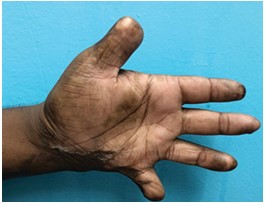
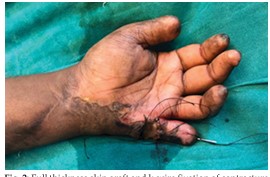
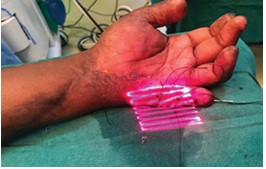
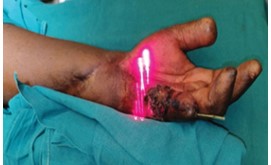
Low level laser therapy (LLLT) has been used in different fields, including healing of chronic ulcers like diabetic and pressure ulcers. Here we are using this method to look for role in FTSG donor site. Full-thickness skin grafts include full thickness of the epidermis and dermis where as split-thickness skin grafts (STSG) include the entire epidermis and only partial dermis. LLLT improves tissue perfusion and fibroblast proliferation, with increases in collagen synthesis accelerating wound healing. In this case report we highlight the role of Low level Laser therapy (LLLT) as a adjuvant agent for accelerating healing of full thickness skin graft recipient site.
References
- 1. Goel, Arun, and Prabhat Shrivastava. “Post-burn scars and scar contractures.” Indian journal of plastic surgery: official publication of the Association of Plastic Surgeons of India vol. 43, Suppl (2010): S63-71.
- 2. Karo TI. Low-power laser therapy. In: Vo-Dinh T, editor. Biomedical photonics handbook, vol. 48. London: CRC Press, 2003. p. 7–20.
- 3. Baxter CD. Therapeutic lasers. Theory and practice. Churchill, Living stone, 1994.
- 4. Andrade FSSD, Clark RMO, Ferreira ML. Effects of Low level laser therapy on wound healing. Rev Colégio Brasileiro Cirurgiões. 2014;41(2):129–33.
- 5. Lichtenstein, D., Morag, B. Low level laser therapy in ambulatory patients with venous stasis ulcers. Laser Therapy 1998; 11: 71-78.
- 6. Karo, T. Molecular mechanism of therapeutic effect of low intensity laser irradiation Do kl Akad Nauk SSSR 1986; 291:1245-1249.
- 7. Saperia, D., Glassberg, E., Lyons, R.F. et al. Demonstration of elevated type I and type III procollagen mRNA levels in cutaneous wounds treated with helium-neon laser. Proposed mechanism for enhanced wound healing. Biochem Biophys Res Commun 1986; 138:1123-1128.
- 8. Schendel, A., Schendel, M., Schendel, L. et al. Increased dermal angiogenesis after low-intensity laser therapy for a chronic radiation ulcer determined by a video measuring system. JAm Acad Dermatol 1999;40: 481-484.
Data Sharing Statement
There are no additional data available.
Funding
This research received no funding.
Author Contributions
All authors contributed significantly to the work and approve its publication.
Ethics Declaration
None
Acknowledgements
No Information Provided
Conflicts of Interest
No conflicts of interest in this work.
About this article

Cite this article
Reddy BP, Chittoria RK, Singh PK. Role of Low level Laser Therapy on Full Thickness Skin Graft. J Plast Surg Transplant. 2024;4(2):59-61.
Licence:
Attribution-Non-commercial 4.0 International (CC BY-NC 4.0)This license enables reusers to distribute, remix, adapt, and build upon the material in any medium or format for noncommercial purposes only, and only so long as attribution is given to the creator.
| Received | Accepted | Published |
|---|---|---|
| September 03, 2024 | October 12, 2024 | December 20, 2024 |
DOI: NA
Keywords
Low level Laser TherapyFull Thickness Skin Graft; Post Burn ContractureSearch for Similar Articles
Similar Articles
- Application of Amnion Allograft in Treatment of Thermal Burns
- Bio-cellulose Dressing in the Management of Deep Second-Degree Burns: Our Experi...
- Autologous Whole Blood Clot Matrix in the Management of SecondDegree Burns
- CT Image Reconstruction & 3D Reconstruction CT in Plastic Surgery: A Review
- Out of Love and Affection: A Medicolegal Paradox for Denying Gains Vs Pleading C...
Article Level Metrics
Last UpdatedSaturday 24 October 2026, 22:37:23 (IST)
1122
Accesses
8
539
00
Citations
NA
NA
NA
Download citation
Article Keywords
Keyword Highlighting
Highlight selected keywords in the article text.
Timeline
| Received | September 03, 2024 |
| Accepted | October 12, 2024 |
| Published | December 20, 2024 |
licence
Attribution-Non-commercial 4.0 International (CC BY-NC 4.0)
This license enables reusers to distribute, remix, adapt, and build upon the material in any medium or format for noncommercial purposes only, and only so long as attribution is given to the creator.