Full Text (PDF)
Journal of Plastic Surgery and Transplantation 2(2):p 55-60, July- December 2022. | DOI: NA
Original Article
Role of Alternative Therapy in Management of Partial Thickness Burnexperience with Use of Collagen Dressing Compared with Paraffin Gauze and Silver Sulfadiazine
Ankur Bhatnagar, Anupama Singh
Author Information
Licence:
Attribution-Non-commercial 4.0 International (CC BY-NC 4.0)This license enables reusers to distribute, remix, adapt, and build upon the material in any medium or format for noncommercial purposes only, and only so long as attribution is given to the creator.
Journal of Plastic Surgery and Transplantation 2(2):p 55-60, July- December 2022. | DOI: NA
How Cite This Article:
Singh A, Bhatnagar A. Role of Alternative Therapy in Management of Partial Thickness Burn–experience with Use of Collagen Dressing Compared with Paraffin Gauze and Silver Sulfadiazine. J Plast Surg Transplant. 2022;2(2):55–60.Timeline
Received : July 21, 2022
Accepted : August 22, 2022
Published : December 12, 2022
Abstract
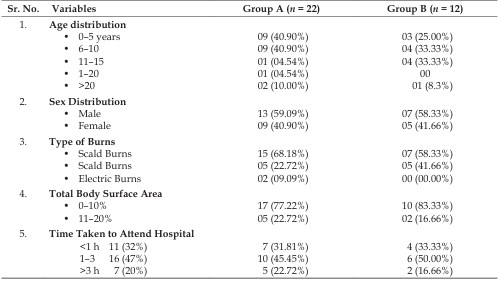
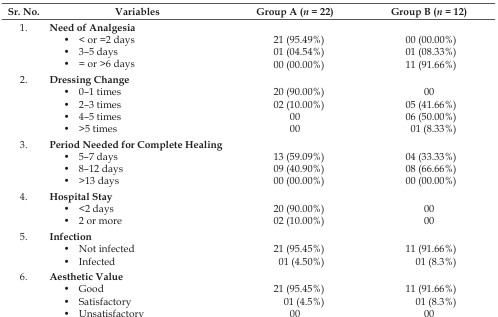
Introduction: Burn injury is a global problem that equally concerns under-developed, developing and developed countries. Goal in the management of burn wounds is to obtain physiological closure in the shortest period of time. An ideal dressing material has to maintain a moist environment, act as a bacterial barrier, and as a medium for free exchange of gases, while providing a barrier against toxic contaminants. Treatment of partial thickness burn wounds is directed towards promoting healing and a wide variety of dressings are currently available there effects on healing, but ease of application and removal, dressing change requirements, cost and patient comfort should also be considered. Materials and Methods: 34 Patients with partial thickness burns ≤ 20% BSA were randomly assigned to Collagen dressing (Group A ) and to conventional dressing Paraffin gauge (P.G) plus silver sulphadizine (SSD) (Group B) from April 2017 to 2018 were analyzed. 22 patient received Collagen dressing and 12 patients received to conventional dressing Paraffin gauge (P.G) plus silver sulphadizine (SSD). Patients were followed up for clinical outcome on alternate day until burns wound healed. Result: A total 34 Patients with partial thickness burns ≤ 20% BSA were analyzed. Patient were divided in to two group, Group A in which Collagen dressings were used (64.70% cases) and Group B in which Paraffin gauge (P.G) plus silver sulphadizine (SSD) dressing were used (35.29% cases). In our study of 34 patient, 20 (58.8%) patients were male and 14 (41.7%)Were female. We have included ≤ 20% partial thickness burns of which 22 (64.70%) cases were of scald burns, 10 (29.41%) cases of thermal burn, 2 (5.88%) cases of electric flash burn. 100% healing in 5-7days of 13 cases (59%) in Group A, in 8–12 days of 8 cases (66.66%) in Group B. 21 cases (95.5%) of Group A required analgesia only for ≤ 2 days, 11 cases (90.90%) of group required analgesia for ≥ 6 days. Hospital stay in 20 cases (90.90%) of Group A were ≤ 2 days, in Group B no patient required hospitalisation. In Group A 20 cases (90.90%) Nil or only one single dressing change were done, in only 2 cases (9.09%) two or more dressing change needed. In Group B 6 cases (50.00%) 4–5 times dressing done, 5 cases (41.66%) 2–3 times change of dressing done, in 1 case (8.33%) > 6 times dressing change done. Conclusion: Collagen dressing has proven to be highly advantageous for burn patients especially for small areas of partial thickness of burns (<20% BSA), and in paediatric age group of patient. It confer better pain relief, less analgesia is required, most of time no dressing change needed, rate of wound healing is better. However conventional dressings tend to adhere to the wound surface and their need for frequent changes traumatises newly epithelialised surfaces and delays healing.
References
- 1. Wasiak J, Cleland H, Campbell F, et al. Dressings for superficial and partial thickness burns. Cochrane Database Syst Rev, 2013;3:CD002106.
- 2. Rowan MP, Cancio LC, Elster EA, et al. Burn wound healing and treatment: review and advancements. Crit Care. 2015;19:243.
- 3. Norman AT, Judkins KC. Pain in the patient with burns. Contin Educ Anaesth Crit Care Pain. 2004;4:57–61.
- 4. White RJ. An historical view of the use of silver in wound management. Brit J Nurs. 2001;10:3–8.
- 5. Polk Jr. HC. Treatment of severe burns with aqueous silver nitrate (0.5 percent). Ann Surg. 1966;164:753–70
- 6. Murphy PS, Evans GR. Advances in wound healing: a review of current wound healing products. Plast Surg Int. 2012;2012:190436.
- 7. Gillett AP. Antibiotic prophylaxis and therapy in burns. J Hosp Infect. 1985;6 (Suppl. B):59–66.
- 8. Bose B: Burn wound dressing with human amniotic membrane. Ann R Coll Surg. 1979;61:444–7.
- 9. Purna Sai K, Babu M: Collagen based dressings: A review. Burns. 2000;26;54–62.
- 10. Balasubramani M, Kumar TR, Babu, M: Skin substitutes: A review. Burns. 2001;27:534–44.
- 11. Singh O, Gupta SS, Soni M, et al. Collagen dressing versus conventional dressings in burn and chronic wounds: A retrospective study. J Cutan Aesthet Surg. 2011;4:12–16.
- 12. Lazovic G, Colic M, Grubor M, et al. The wounds and ulcers: A multicenter pilot study. Ann Plast Surg. 2002;48:226–7.
- 13. Atiyeh BS, Dham R, Kadry M, et al. Benefit–cost analysis of moist exposed burn ointment. Burns. 2002;28:659–63.
- 14. Ang E, Lee ST, Gan CS, et al. Pain control in a randomized, controlled, clinical trial comparing moist exposed burn ointment and conventional methods in Patients with partial-thickness burns. J Burn Care Rehabil 2003 Application oXu RX. A great historical turn in the burn medical science. Chinese J Burns Wounds Surf Ulcers. 1989;1:62.
- 15. Xu RX. Moist exposed burn therapy (MEBT). Textbook for technological training. Beijing Guangming Chinese Medicine Institute for Burns. Beijing: Wounds and Ulcers. 1989a. p. 160–8.
- 16. Ang ES, Lee ST, Gan CS, et al. The role of alternative therapy in the management of partial thickness burns of the face-experience with the use of moist exposed burn ointment (MEBO) compared with silver sulphadiazine. Ann Acad Med Singapore. 2000;29:7–10.
- 17. Iovanovich J, Tsati E, Tsoutsos D, et al. Moist exposed burn therapy: Evaluation of the epithelial repair process (an experimental model). Ann Burns Fire Disast. 2000;13:3–9.
- 18. Ali Al-Numairy. Clinical use of MEBO in wounds management in U.A.E. Int J Cosm Surg Aesthet Dermatol. 2000;2:27–33.
- 19. Ang ES, Lee ST, Gan CS, et al. Evaluating the role of alternative therapy in burn wound management: Randomized trial comparing moist exposed burn ointment with conventional methods in the management of patients with second-degree burns. MedGenMed. 2001;3:3.
- 20. Atiyeh BS, Ioannovich J, Magliacani G, et al. Efficacy of moist exposed burn ointment in the management of cutaneous. 24:289–96
- 21. Nadworny PL, Burrell RE. A review of assessment techniques for silver technology in wound care. J Wound Technol. 2008;2:6–22.
- 22. Ramakrishnan KM, Jayaraman V: Management of partial-thickness burn wounds by amniotic membrane: A cost effective treatment in developing countries. Burns. 1997;23:33–6.
- 23. Hadjiiski 0, Anatassov N: Amniotic membranes for temporary burn coverage. Ann Burns Fire Disasters. 1996;9:88–92.
- 24. Gruss JS, Jirsch DW: Human amniotic membrane: A versatile wound dressing. Can Med Assoc J. 1978;118:1237–46.
- 25. Mathangi Ramakrishnan K, Babu M, Mathivanan, et al. Advantages of collagen based biological dressings In the management of superficial and superficial partial thickness burns in children; Annals of Burns and Fire Disasters. 2013 June;26(2):98-104.
Data Sharing Statement
There are no additional data available.
Funding
This research received no funding.
Author Contributions
Al authors contributed significantly to the work and approve its publication.
Ethics Declaration
This article does not involve any human or animal subjects, and therefore does not require ethics approval.
Acknowledgements
No Information Provided
Conflicts of Interest
No conflicts of interest in this work.
About this article

Cite this article
Singh A, Bhatnagar A. Role of Alternative Therapy in Management of Partial Thickness Burn–experience with Use of Collagen Dressing Compared with Paraffin Gauze and Silver Sulfadiazine. J Plast Surg Transplant. 2022;2(2):55–60.
Licence:
Attribution-Non-commercial 4.0 International (CC BY-NC 4.0)This license enables reusers to distribute, remix, adapt, and build upon the material in any medium or format for noncommercial purposes only, and only so long as attribution is given to the creator.
| Received | Accepted | Published |
|---|---|---|
| July 21, 2022 | August 22, 2022 | December 12, 2022 |
DOI: NA
Keywords
.Search for Similar Articles
Similar Articles
- Application of Amnion Allograft in Treatment of Thermal Burns
- Bio-cellulose Dressing in the Management of Deep Second-Degree Burns: Our Experi...
- Autologous Whole Blood Clot Matrix in the Management of SecondDegree Burns
- CT Image Reconstruction & 3D Reconstruction CT in Plastic Surgery: A Review
- Out of Love and Affection: A Medicolegal Paradox for Denying Gains Vs Pleading C...
Article Level Metrics
Last UpdatedMonday 26 October 2026, 02:12:43 (IST)
1127
Accesses
24
539
00
Citations
NA
NA
NA
Download citation
Article Keywords
Keyword Highlighting
Highlight selected keywords in the article text.
Timeline
| Received | July 21, 2022 |
| Accepted | August 22, 2022 |
| Published | December 12, 2022 |
licence
Attribution-Non-commercial 4.0 International (CC BY-NC 4.0)
This license enables reusers to distribute, remix, adapt, and build upon the material in any medium or format for noncommercial purposes only, and only so long as attribution is given to the creator.