Full Text (PDF)
Pediatric Education and Research 11(1):p 13-18, January – April 2023. | DOI: https://doi.org/10.21088/per.2321.1644.11123.2
Original Article
Respiratory Distress in Neonates in A Tertiary Care Medical College Hospital: A Cross-Sectional Study
Sakshi Satish Rane, Abhijeet Shinde, Sunil Natha Mhaske
Author Information
Licence:
Attribution-Non-commercial 4.0 International (CC BY-NC 4.0)This license enables reusers to distribute, remix, adapt, and build upon the material in any medium or format for noncommercial purposes only, and only so long as attribution is given to the creator.
Pediatric Education and Research 11(1):p 13-18, January – April 2023. | DOI: https://doi.org/10.21088/per.2321.1644.11123.2
How Cite This Article:
Sakshi Satish Rane, Abhijeet Shinde, Sunil Natha Mhaske/Respiratory Distress in Neonates in A Tertiary Care Medical College Hospital: A Cross-Sectional Study/Pediatr Edu Res. 2023;11(1): 13.18.Timeline
Received : January 01, 2023
Accepted : January 31, 2023
Published : April 25, 2023
Abstract
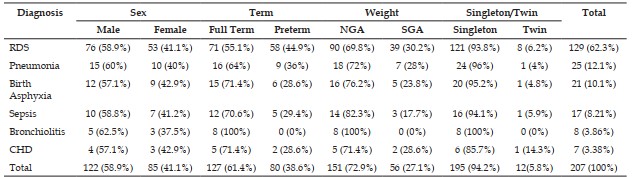
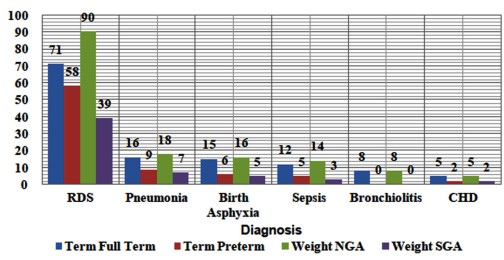
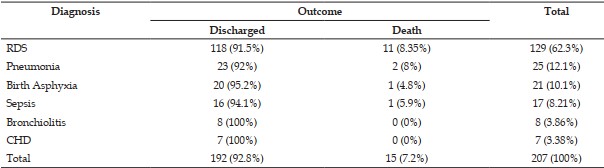
Introduction: Neonatal Respiratory Distress (NRD) is the most frequent reason for admissions to NICUs. Studies on this topic are limited in our setup and mostly focused on finding the incidence of NRD. The aim of this study was to find the incidence and the most common causes of neonatal respiratory distress in our setting to better prepare treatment protocols and improve overall outcomes. Methodology: A cross-sectional study was conducted in a tertiary care medical college hospital from February 2022 to October 2022. Data of all neonates admitted with respiratory distress during this term was collected and analyzed. Results: A total of 550 neonates were admitted to the NICU out of which 207(37.6%) developed respiratory distress. The most common cause of NRD was Respiratory Distress Syndrome 129 cases (62.3%) followed by Pneumonia 25 cases (12.1%), Birth Asphyxia 21 cases (10.1%) and Sepsis 17 cases (8.21%). The highest mortality was observed in cases with RDS (8.35%). Conclusion: The study highlights the importance of NRD which has a high incidence rate in NICUs and a mortality rate of 7.2%. The most common causes are also preventable and treatable, and suggestions have been made to help reduce incidence and mortality and improve outcomes.
References
- 1. Edwards MO, Kotecha SJ, Kotecha S. Respiratory distress of the term newborn infant. Paediatric respiratory reviews. 2013 Mar 1;14(1):29-37.
- 2. Kumar A, Vishnu Bhat B. Epidemiology of respiratory distress of newborns. The Indian Journal of Pediatrics. 1996 Jan;63(1):93-8.
- 3. Reuter S, Moser C, Baack M. Respiratory distress in the newborn. Pediatrics in review. 2014 Oct;35(10):417.
- 4. Hermansen CL, Lorah KN. Respiratory distress in the newborn. American family physician. 2007 Oct 1;76(7):987-94.
- 5. Shah GS, Yadav S, Thapa A, Shah L. Clinical Profile and Outcome of Neonates Admitted to Neonatal Intensive Care Unit (NICU) at a Tertiary Care Centre in Eastern Nepal. Journal of Nepal Paediatric Society. 2013 Sep 1;33(3).
- 6. Piper JM, Xenakis EM, Langer O. Delayed appearance of pulmonary maturation markers is associated with poor glucose control in diabetic pregnancies. The Journal of MaternalFetal Medicine. 1998 May;7(3):148-53.
- 7. Bak SY, Shin YH, Jeon JH, Park KH, Kang JH, Cha DH, Han MY, Jo HS, Lee KH, Lee CA. Prognostic factors for treatment outcomes in transient tachypnea of the newborn. Pediatrics international. 2012 Dec;54(6):875-80.
- 8. Kamath BD, MacGuire ER, McClure EM, Goldenberg RL, Jobe AH. Neonatal mortality from respiratory distress syndrome: lessons for low-resource countries. Pediatrics. 2011 Jun;127(6):1139-46.
- 9. Haque A, Baki M, Begum T, Akhter S, Begum S, Nahar N. Etiology of respiratory distress in newborn experience in BIRDEM. BIRDEM Medical Journal. 2013 Nov 24;3(1):19-22.
- 10. Saboute M, Kashaki M, Bordbar A, Khalessi N, Farahani Z. The incidence of respiratory distress syndrome among preterm infants admitted to neonatal intensive care unit: a retrospective study. Open Journal of Pediatrics. 2015;5(04):285.
- 11. Rijal P, Shrestha M. Scenario of neonatal respiratory distress in tertiary hospital. Birth. 2018;14(10):6.
- 12. Bajad M, Goyal S, Jain B. Clinical profile of neonates with respiratory distress. Int J Contemp Pediatr. 2016 Jul;3(3):1009-13.
- 13. Shrestha SP, Shah AK, Prajapati R, Sharma YR. Profile of neonatal admission at Chitwan Medical College. Journal of Chitwan Medical College. 2013;3(4):13-6.
- 14. Santosh S, Kumar K, Adarsha E. A clinical study of respiratory distress in newborn and its outcome. Indian J Neonatal Med Res. 2013;1(1):2-4.
- 15. B.P. H, Kumar T.S. A, Kumar G, Khan I. An etiological study of respiratory distress in neonates in a tertiary care medical college hospital. Pediatric Rev: int j pediatrics res [Internet]. 2020Feb.7 [cited 2022Dec.9];7(1):22- 6. Available from: https://pediatrics. medresearch.in/index.php/ijpr/article/ view/566
- 16. Farrell PM, Avery ME. Hyaline membrane disease. American Review of Respiratory Disease. 1975 May;111(5):657-88.
- 17. Fedrick J, Butler NR. Hyaline-membrane disease. The Lancet. 1972 Oct 7;300(7780):768-9.
- 18. Sardesai S, Biniwale M, Wertheimer F, Garingo A, Ramanathan R. Evolution of surfactant therapy for respiratory distress syndrome: past, present, and future. Pediatric Research. 2017 Jan;81(1):240-8.
- 19. Dutta A, Sinhamahapatra TK, Gayen S, Basu M, Dutta M, Das GC. Spectrum of respiratory distress in newborn: A study from a tertiary care hospital in Kolkata. The Child and newborn. 2011;20:45.
- 20. Mathur NB, Garg K, Kumar S. Respiratory distress in neonates with special reference to pneumonia. Indian pediatrics. 2002 Jun 27;39(6):529-38.
- 21. Parkash A, Haider N, Khoso ZA, Shaikh AS. Frequency, causes and outcome of neonates with respiratory distress admitted to Neonatal Intensive Care Unit, National Institute of Child Health, Karachi. J Pak Med Assoc. 2015 Jul 1;65(7):771-5.
- 22. Adebami OJ, Joel-Medewase VI, Agelebe E, Ayeni TO, Kayode OV, Odeyemi OA, Oyedeji GA. Determinants of outcome in newborns with respiratory distress in Osogbo, Nigeria. Int J Res Med Sci. 2017 Apr;5(4):1487-93.
- 23. Miller HC. Respiratory Distress Syndrome of Newborn Infants: III. Statistical Evaluation of Factors Possibly Affecting Survival of Premature Infants. Pediatrics. 1963 Apr;31(4):573-9.
- 24. Stutchfield P, Whitaker R, Russell I. Antenatal betamethasone and incidence of neonatal respiratory distress after elective caesarean section: pragmatic randomised trial. Bmj. 2005 Sep 22;331(7518):662.
- 25. Roth-Kleiner M, Wagner BP, Bachmann D, Pfenninger J. Respiratory distress syndrome in near-term babies after caesarean section. Swiss medical weekly. 2003 May 17;133(19-20):283-8.
Data Sharing Statement
There are no additional data available. All raw data and code are available upon request.
Funding
This research received no funding.
Author Contributions
All authors contributed significantly to the work and approve its publication.
Ethics Declaration
This article does not involve any human or animal subjects, and therefore does not require ethics approval.
Acknowledgements
We would like to express our gratitude to the patients, their families, and all those who have contributed to this study.
Conflicts of Interest
No conflicts of interest in this work.
About this article

Cite this article
Sakshi Satish Rane, Abhijeet Shinde, Sunil Natha Mhaske/Respiratory Distress in Neonates in A Tertiary Care Medical College Hospital: A Cross-Sectional Study/Pediatr Edu Res. 2023;11(1): 13.18.
Licence:
Attribution-Non-commercial 4.0 International (CC BY-NC 4.0)This license enables reusers to distribute, remix, adapt, and build upon the material in any medium or format for noncommercial purposes only, and only so long as attribution is given to the creator.
| Received | Accepted | Published |
|---|---|---|
| January 01, 2023 | January 31, 2023 | April 25, 2023 |
DOI: https://doi.org/10.21088/per.2321.1644.11123.2
Keywords
Common CausesNeonatesRespiratory DistressSearch for Similar Articles
Similar Articles
Article Level Metrics
Last UpdatedMonday 07 September 2026, 18:04:31 (IST)
1926
Accesses
3
232
00
Citations
NA
NA
NA
Download citation
Article Keywords
Keyword Highlighting
Highlight selected keywords in the article text.
Timeline
| Received | January 01, 2023 |
| Accepted | January 31, 2023 |
| Published | April 25, 2023 |
licence
Attribution-Non-commercial 4.0 International (CC BY-NC 4.0)
This license enables reusers to distribute, remix, adapt, and build upon the material in any medium or format for noncommercial purposes only, and only so long as attribution is given to the creator.