Full Text (PDF)
Pediatric Education and Research 12(2):p 43-45, July - Dec 2024. | DOI: https://doi.org/10.21088/per.2321.1644.12224.1
Case Report
Mass Abdomen in an Infant: A Pandora Box
Author Information
Licence:
Attribution-Non-commercial 4.0 International (CC BY-NC 4.0)This license enables reusers to distribute, remix, adapt, and build upon the material in any medium or format for noncommercial purposes only, and only so long as attribution is given to the creator.
Pediatric Education and Research 12(2):p 43-45, July - Dec 2024. | DOI: https://doi.org/10.21088/per.2321.1644.12224.1
How Cite This Article:
Kiran B., Geetha M., Mass Abdomen in an Infant: A Pandora Box. Pediatr. Edu. Res. 2024;12(2): 43-45.Timeline
Received : September 06, 2024
Accepted : November 12, 2024
Published : December 25, 2024
Abstract
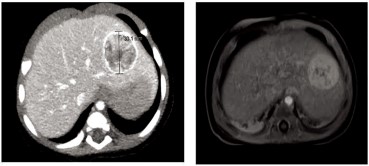
Background: Infantile hepatic hemangioendothelioma/hemangioma (IHH) is the most common type of benign tumor of Liver, contributing to 12% of all childhood liver tumors. (1) It is a neonate’s common hepatic mesenchymal tumor, 90% being less than six months old. (1) The tumor is slightly more predominant in females. It may be asymptomatic or can cause serious complications like cardiac failure or coagulopathy. There is no treatment protocol established yet and increasing number of cases have been reported. There is a varied treatment options like pharmacological or interventional on the basis of the presentation. IHH is classified as a benign vascular tumor with spontaneous regression in some patients. Case presentation: Here is a 6 month old infant presented with Infantile colic and incidentally diagnosed to have IHH. Imaging like Ultrasonography and MRI confirmed the diagnosis. The child had an asymptomatic presentation and regressed with follow up. Conclusion: Increasing awareness about the condition needed for proper follow up. Early identification and prompt treatment is necessary to avoid fatal complications.
References
- 1. Dasgupta M.K., Das S., Patra C., Sarkar S. Symptomatic infantile hepatic haemangioendothelioma successfully treated with steroid. J. Clin Neonatal. 2013 Oct; 2(4):187-9. Doi: 10.4103/2249-4847.123099. PMID: 24404532; PMCID: PMC3883215.
- 2. Zenge J.P., Fenton L., Lovell M.A., Grover T.R. Case report: infantile haemangioendothelioma. Curr Opin Pediatr. 2002 Feb; 14(1):99-102. doi: 10.1097/00008480-200202000-00018. PMID: 11880743.
- 3. Mortele K.J., Vanzieleghem B, Mortele B, Benoit Y., Ros P.R. (2002) Solitary hepatic infantile haemangioendothelioma: dynamic gadoliniumenhanced MR imaging findings. Eur Radiol. 2002; 12:862–865.
- 4. Kunstadter R.H. (1933) Hemangioendothelioma of the liver in infancy. Am J Dis Child, 1933, 46:803-10.
- 5. Fok T.F., Chan M.S., Metreweli C, Ng P.C., Yeung C.K., Li A.K. Hepatic haemangioendothelioma presenting with early heart failure in a newborn: Treatment with hepatic artery embolization and interferon. Acta Paediatr. 1996; 85:1373–5
- 6. Mueller B.U., Lopez- Terrade D., Finegold MJ: Tumors of the liver. Principles and practices of Pediatric oncology. Pizzo P.A., Poplack DG(ed): Lippincott Williams and Wilkins, Philadelphia PA; 2006. 887-904
- 7. Buonomo C., Taylor G.A., Share J.C., Kirks D.R. Abnormalities of the hepatobiliary system. In: Kirks D.R., Griscom N.T., editors. Practical Pediatric Imaging: Diagnostic Radiology of Infants and Children. 3rd ed. Philadelphia: Lippincott-Raven; 1998. pp. 954–79. [Google Scholar]
- 8. Zhang Z., Chen H.J., Yang W.J., Bu H., Wei B., Long X.Y., Fu J., Zhang R, Ni Y.B., Zhang H.Y. (2010) Infantile hepatic haemangioendothelioma: a clinicopathologic study in a Chinese population. World J. Gastroenterol . 2010, 16:4549–4557
- 9. Kim T.J., Lee Y.S., Song Y.S., Park C.K., Shim S.I., Kang C.S., Lee K.Y. Infantile haemangioendothelioma with elevated serum alpha fetoprotein: report of 2 cases with immunohistochemical analysis. Hum Pathol. 2010 May; 41(5):763-7. Doi: 10.1016/j. humpath.2009.05.019. Epub 2010 Feb 12. PMID: 20153513.
Data Sharing Statement
There are no additional data available. All raw data and code are available upon request.
Funding
This research received no funding.
Author Contributions
All authors contributed significantly to the work and approve its publication.
Ethics Declaration
This article does not involve any human or animal subjects, and therefore does not require ethics approval.
Acknowledgements
We would like to express our gratitude to the patients, their families, and all those who have contributed to this study.
Conflicts of Interest
No conflicts of interest in this work.
About this article

Cite this article
Kiran B., Geetha M., Mass Abdomen in an Infant: A Pandora Box. Pediatr. Edu. Res. 2024;12(2): 43-45.
Licence:
Attribution-Non-commercial 4.0 International (CC BY-NC 4.0)This license enables reusers to distribute, remix, adapt, and build upon the material in any medium or format for noncommercial purposes only, and only so long as attribution is given to the creator.
| Received | Accepted | Published |
|---|---|---|
| September 06, 2024 | November 12, 2024 | December 25, 2024 |
DOI: https://doi.org/10.21088/per.2321.1644.12224.1
Keywords
Mass abdomenInfancyVascularLiverSearch for Similar Articles
Similar Articles
- Colonic Atresia with Rectal Atresia: The Management of a Rare Presentation: A Ca...
- Hyper Eosinophilia with Hereditary Angioedema (HAE): Case Report
- Apert’s Syndrome: A Rare Case Report
- Diagnostic Dilemma in Diagnosis of Annular Pancreas: A Case Report
- Penetrating Injury Over the Back Due to Wooden Stick – Don’t Leave the Fragments...
Article Level Metrics
Last UpdatedSaturday 17 October 2026, 09:43:36 (IST)
2855
Accesses
9
240
00
Citations
NA
NA
NA
Download citation
Article Keywords
Keyword Highlighting
Highlight selected keywords in the article text.
Timeline
| Received | September 06, 2024 |
| Accepted | November 12, 2024 |
| Published | December 25, 2024 |
licence
Attribution-Non-commercial 4.0 International (CC BY-NC 4.0)
This license enables reusers to distribute, remix, adapt, and build upon the material in any medium or format for noncommercial purposes only, and only so long as attribution is given to the creator.