Full Text (PDF)
Pediatric Education and Research 12(2):p 51-53, July - Dec 2024. | DOI: https://doi.org/10.21088/per.2321.1644.12224.3
Case Report
Apert’s Syndrome: A Rare Case Report
Rajeev Kumar Thapar, Sumanth Baditela, Meenakshi Bothra
Author Information
Licence:
Attribution-Non-commercial 4.0 International (CC BY-NC 4.0)This license enables reusers to distribute, remix, adapt, and build upon the material in any medium or format for noncommercial purposes only, and only so long as attribution is given to the creator.
Pediatric Education and Research 12(2):p 51-53, July - Dec 2024. | DOI: https://doi.org/10.21088/per.2321.1644.12224.3
How Cite This Article:
Sumanth Baditela, Rajeev Kumar Thapar, Meenakshi Bothra, Apert’s Syndrome: A Rare Case Report. Pediatr. Edu. Res. 2024;12(2): 51-53.Timeline
Received : October 23, 2024
Accepted : November 15, 2024
Published : December 25, 2024
Abstract
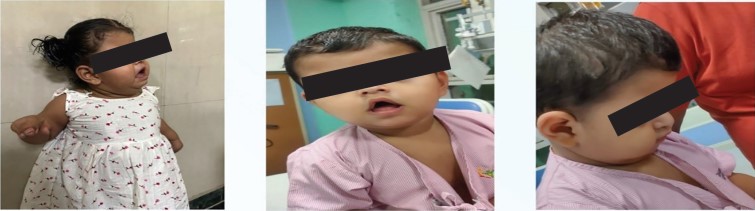
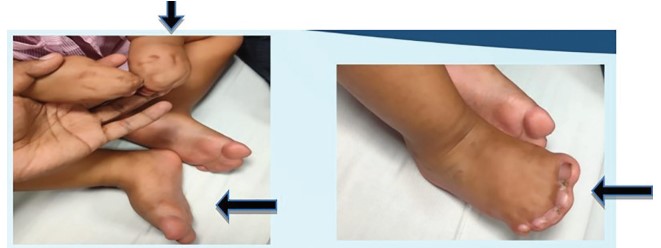
Background: Apert syndrome is a genetic disorder inherited in an autosomal dominant manner, with an occurrence rate of about 15 cases per 100,000 live births. It is caused by a mutation in the fibroblast growth factor receptor-2 (FGFR-2) gene located on chromosome 10q26. The condition mainly impacts the first and second branchial arches, leading to the early closure of cranial sutures (craniosynostosis) with fusion of fingers and toes of the hands and feet. Apert syndrome is rare in India, and a case report is presented. Clinical Description: 21 months female toddler presented with global developmental delay along with distinctive craniofacial features. Clinically toddler exhibited an abnormal head shape and contour, characterized by turribrachycephaly, a depressed nasal bridge, frontal bossing, midface hypoplasia, and a characteristic “crossbow” appearance of the upper lip. Limb examination revealed symmetrical soft tissue syndactyly affecting all digits. Management & Outcome: This case is notable for its rarity and the similarity of its features to other craniosynostosis syndromes, such as Crouzon and Pfeiffer syndromes, posing a diagnostic challenge. Therefore, genetic counselling for the family was recommended, along with early intervention for the child, including plastic surgery for the affected limbs. Conclusion: Acrocephalosyndactyly is an autosomal dominant condition seen rarely, marked by craniosynostosis, craniofacial deformities, and pronounced symmetrical clubbing of fingers and toes of the hands and feet. In the majority of Apert syndrome cases, the condition occurs sporadically, often due to new mutations in the relevant gene.
References
- 1. Koca T.T. Apert syndrome: a case report and review of the literature. Northern clinics of Istanbul. 2016; 3(2):135.
- 2. Kumar G., Garg A., Vignesh R., Dhillon J.K., Faraz F. Apert syndrome: A case report. Journal of South Asian Association of Pediatric Dentistry. 2019; 2(1):32-4.
- 3. Dixit S., Singh A., Mamatha G.S., Desai R.S., Jaju P. Apert’s syndrome: report of a new case and its management. International Journal of Clinical Pediatric Dentistry. 2008 Sep; 1(1):48.
- 4. Pius S., Ibrahim H.A., Bello M., Mbaya K., Ambe JP. Apert syndrome: A case report and review of literature. Open Journal of Pediatrics. 2016 May 20; 6(2):175-84.
- 5. Bhatia P.V., Patel P.S., Jani Y.V., Soni N.C. Apert’s syndrome: Report of a rare case. Journal of Oral and Maxillofacial Pathology. 2013 May 1; 17(2):294-7.
Data Sharing Statement
There are no additional data available. All raw data and code are available upon request.
Funding
This research received no funding.
Author Contributions
All authors contributed significantly to the work and approve its publication.
Ethics Declaration
This article does not involve any human or animal subjects, and therefore does not require ethics approval.
Acknowledgements
We would like to express our gratitude to the patients, their families, and all those who have contributed to this study.
Conflicts of Interest
No conflicts of interest in this work.
About this article

Cite this article
Sumanth Baditela, Rajeev Kumar Thapar, Meenakshi Bothra, Apert’s Syndrome: A Rare Case Report. Pediatr. Edu. Res. 2024;12(2): 51-53.
Licence:
Attribution-Non-commercial 4.0 International (CC BY-NC 4.0)This license enables reusers to distribute, remix, adapt, and build upon the material in any medium or format for noncommercial purposes only, and only so long as attribution is given to the creator.
| Received | Accepted | Published |
|---|---|---|
| October 23, 2024 | November 15, 2024 | December 25, 2024 |
DOI: https://doi.org/10.21088/per.2321.1644.12224.3
Keywords
AcrocephalosyndactylyCraniosynostosisMidface hypoplasiaSearch for Similar Articles
Similar Articles
- Colonic Atresia with Rectal Atresia: The Management of a Rare Presentation: A Ca...
- Hyper Eosinophilia with Hereditary Angioedema (HAE): Case Report
- Diagnostic Dilemma in Diagnosis of Annular Pancreas: A Case Report
- Mass Abdomen in an Infant: A Pandora Box
- Penetrating Injury Over the Back Due to Wooden Stick – Don’t Leave the Fragments...
Article Level Metrics
Last UpdatedSaturday 17 October 2026, 09:43:22 (IST)
2855
Accesses
10
240
00
Citations
NA
NA
NA
Download citation
Article Keywords
Keyword Highlighting
Highlight selected keywords in the article text.
Timeline
| Received | October 23, 2024 |
| Accepted | November 15, 2024 |
| Published | December 25, 2024 |
licence
Attribution-Non-commercial 4.0 International (CC BY-NC 4.0)
This license enables reusers to distribute, remix, adapt, and build upon the material in any medium or format for noncommercial purposes only, and only so long as attribution is given to the creator.