Full Text (PDF)
Pediatric Education and Research 11(1):p 21-24, January – April 2023. | DOI: https://doi.org/10.21088/per.2321.1644.11123.3
Case Report
Osteogenesis Imperfecta: A Rare Case Report
Hamza Moatasim Solkar, Abhijit Shinde, Sunil Natha Mhaske, Suresh Waydande
Author Information
Licence:
Attribution-Non-commercial 4.0 International (CC BY-NC 4.0)This license enables reusers to distribute, remix, adapt, and build upon the material in any medium or format for noncommercial purposes only, and only so long as attribution is given to the creator.
Pediatric Education and Research 11(1):p 21-24, January – April 2023. | DOI: https://doi.org/10.21088/per.2321.1644.11123.3
How Cite This Article:
Hamza Solkar, Abhijit Shinde, Sunil Natha Mhaske, et al./Osteogenesis Imperfecta: A Rare Case Report/Pediatr Edu Res. 2023;11(1): 21-24.Timeline
Received : October 10, 2022
Accepted : November 15, 2022
Published : April 25, 2023
Abstract
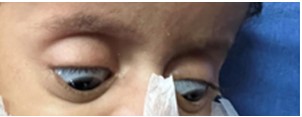
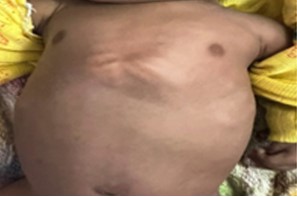
Introduction: Osteogenesis Imperfecta also known as brittle bone disease is a heterogeneous disorder which is rare and characterized by bone fragility, multiple fracture, bone deformity and short stature.1 It has varying degree of classification based on varying degree of fragility and various clinical presentations.2 Osteogenesis imperfecta (OI) is a rare skeletal dysplasia, with an incidence of 1/15,000–20,000.3 Case report: A 7-month-old male child visited our hospital for fever cough, cold & breathlessness. Ultrasonography at 8th month revealed mild polyhydramnios with Fetal growth retardation and shortening of fetal long bones of upper and lower limb & 9th month Ultrasonography revealed moderated Polyhydramnios with short limb Dwarfism. On head to toe examination, patient had triangular shaped face with broad forehead, blue sclera, short neck short statured limbs with cylindrical like appearance that is circumferential fat pads, both the hips and knees were flexed and rotated inwards. Barrel shaped rib cage was present. Discussion: OI, commonly known as brittle bone disease, is a hereditary ailment that includes a diverse range of illnesses. It is characterised by a propensity for bone fractures, which can range in severity from a minor break to a prenatal fracture. Blue sclera, DI, hyperlaxity of ligaments and skin, hearing impairment, small height, and bone abnormalities are further characteristic clinical symptoms.11 Sillence et al categorised OI into four kinds based on their clinical severity and genetic characteristics because OI is a diverse disease with different clinical presentations.12 Conclusion: In conclusion, experimental treatments including gene based therapy and bone marrow and stem cell transplantation offer prospective treatments for OI. But these methods are not yet prepared for clinical testing.15 There should be availability of these approaches in each tertiary care center for better diagnosis & treatment of osteogenesis imperfecta.
References
- 1. Deguchi M, Tsuji S, Katsura D, Kasahara K, Kimura F, Murakami T. Current overview of osteogenesis imperfecta. Medicina. 2021 May 10;57(5):464.
- 2. Hines-Dowell S, Lee S, Baskin S, Janecek A, Rhodes L, Gresham F. Osteogenesis imperfecta type VIII: A case report. Journal of Neonatal Nursing. 2012 Dec 1;18(6):217-220.
- 3. Bregou Bourgeois A, Aubry-Rozier B, Bonafé L, Laurent-Applegate LA, Pioletti D, Zambelli PY. Osteogenesis imperfecta: from diagnosis and multidisciplinary treatment to future perspectives. Swiss medical weekly. 2016;146(ARTICLE):w14322.
- 4. Forlino A, Marini JC. Osteogenesis imperfecta. The Lancet. 2016 Apr 16;387(10028):1657-1671.
- 5. Zhang X, Hirschfeld M, Beck J, Kupke A, Köhler K, Schütz E, Brenig B. Osteogenesis imperfecta in a male holstein calf associated with a possible oligogenic origin. Veterinary Quarterly. 2020 Jan 1;40(1):58-67.
- 6. Marini JC, Forlino A, Bachinger HP, Bishop NJ, Byers PH, Paepe A, Fassier F, Fratzl-Zelman N, Kozloff KM, Krakow D et al. Osteogenesis imperfecta. Nat Rev Dis Primers. 2017 Aug 18;3:17052. [PubMed: 28820180]
- 7. Lindert U, Cabral WA, Ausavarat S, Tongkobpetch S, Ludin K, Barnes AM, Yeetong P, Weis M, Krabichler B, Srichomthong C et al. MBTPS2 mutations cause defective regulated intramembrane proteolysis in X-linked osteogenesis imperfecta. Nat Commun. 2016 Jul 06;7:11920. [PubMed: 27380894]
- 8. Lindert U, Cabral WA, Ausavarat S, Tongkobpetch S, Ludin K, Barnes AM, Yeetong P, Weis M, Krabichler B, Srichomthong C et al. MBTPS2 mutations cause defective regulated intramembrane proteolysis in X-linked osteogenesis imperfecta. Nat Commun. 2016 Jul 06;7:11920. [PubMed: 27380894].
- 9. Semler O, Garbes L, Keupp K, Swan D, Zimmermann K, Becker J, Iden S, Wirth B, Eysel P, Koerber F et al. A mutation in the 5’- UTR of IFITM5 creates an in-frame start codon and causes autosomal-dominant osteogenesis imperfecta type V with hyperplastic callus. Am J Hum Genet. 2012 8 10;91(2):349–357. [PubMed: 22863195].
- 10. Constantino CS, Krzak JJ, Fial AV, Kruger KM, Rammer JR, Radmanovic K, et al. Effect of bisphosphonates on function and mobility among children with osteogenesis imperfecta: a systematic review. JBMR Plus. 2019;3(10):e10216. https://doi.org/10.1002/ jbm4.10216.
- 11. Raunch F and Glorieux FH: Osteogenesis imperfecta. Lancet 363: 1377-1385, 2004.
- 12. Sillence DO, Senn A and Danks DM: Genetic heterogeneity in osteogenesis imperfecta. J Med Genet 16: 101-116, 1979.
- 13. Glourieux FH: Osteogenesis imperfecta. Best Pract Res Clin Rheumatol 22: 85-100, 2008.
- 14. Starr SR, Roberts TT and Fischer PR: Osteogenesis imperfecta: primary care. Pediatr Rev 31: e54-e64, 2010.
- 15. Monti E, Mottes M, Fraschini P, et al: Current and emerging treatments for the management of osteogenesis imperfecta. Ther Clin Risk Manag 6: 367-381, 2010.
- 16. Engelbert RH, Pruijs HE, Beemer FA and Helders PJ: Osteogenesis imperfecta in childhood: treatment strategies. Arch Phys Med Rehabil 79: 1590-1594, 1998.
- 17. Zeitlin L, Fassier F and Glorieux FH: Modern approach to children with osteogenesis imperfecta. J PediatrOrthop B 12: 77-87, 2003.
Data Sharing Statement
There are no additional data available. All raw data and code are available upon request.
Funding
This research received no funding.
Author Contributions
All authors contributed significantly to the work and approve its publication.
Ethics Declaration
This article does not involve any human or animal subjects, and therefore does not require ethics approval.
Acknowledgements
We would like to express our gratitude to the patients, their families, and all those who have contributed to this study.
Conflicts of Interest
No conflicts of interest in this work.
About this article

Cite this article
Hamza Solkar, Abhijit Shinde, Sunil Natha Mhaske, et al./Osteogenesis Imperfecta: A Rare Case Report/Pediatr Edu Res. 2023;11(1): 21-24.
Licence:
Attribution-Non-commercial 4.0 International (CC BY-NC 4.0)This license enables reusers to distribute, remix, adapt, and build upon the material in any medium or format for noncommercial purposes only, and only so long as attribution is given to the creator.
| Received | Accepted | Published |
|---|---|---|
| October 10, 2022 | November 15, 2022 | April 25, 2023 |
DOI: https://doi.org/10.21088/per.2321.1644.11123.3
Keywords
OsteogenesisBrittle boneMultiple fractureShort statureBlue scleraSearch for Similar Articles
Similar Articles
- Mass Abdomen in an Infant: A Pandora Box
- Penetrating Injury Over the Back Due to Wooden Stick – Don’t Leave the Fragments...
- Role of Autologous Platelet Rich Plasma in Management of Pediatric Postburn Web...
- To Study Profile of Hemoglobin and Red Blood Cell Indices during First Week of L...
- Impact of Educational Intervention on Knowledge Regarding Household Waste Manage...
Article Level Metrics
Last UpdatedMonday 07 September 2026, 17:21:06 (IST)
1921
Accesses
3
229
00
Citations
NA
NA
NA
Download citation
Article Keywords
Keyword Highlighting
Highlight selected keywords in the article text.
Timeline
| Received | October 10, 2022 |
| Accepted | November 15, 2022 |
| Published | April 25, 2023 |
licence
Attribution-Non-commercial 4.0 International (CC BY-NC 4.0)
This license enables reusers to distribute, remix, adapt, and build upon the material in any medium or format for noncommercial purposes only, and only so long as attribution is given to the creator.